
What Is the Strategy-Execution Gap?
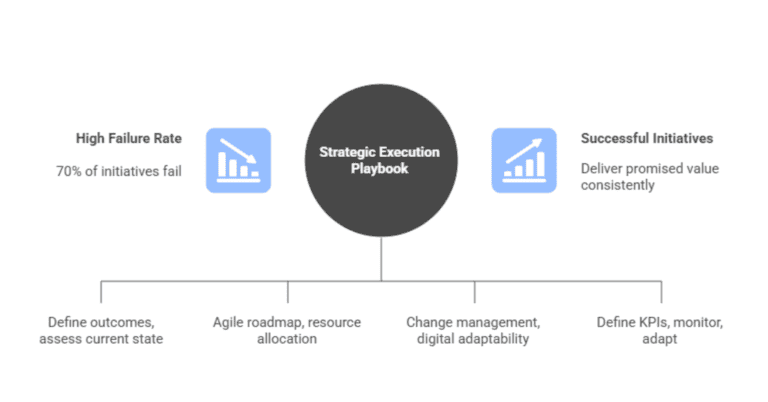
The strategy-execution gap is the critical disconnect between an organization’s high-level strategic planning and its daily operational reality. Studies show that up to 90% of enterprises fail to execute their strategies successfully due to misaligned goals, poor communication, and a lack of clear accountability.
To bridge this gap, organizations must implement structured execution frameworks like the GOST model (Goals, Objectives, Strategies, Tactics), establish definitive leading and lagging performance metrics, and foster absolute clarity across every level of the workforce.
Key Takeaways
- The Strategy Execution Gap Definition: The strategy execution gap is the critical disconnect between leadership’s high-level strategic planning and the frontline team’s daily operational reality
- The Core Cause: Most strategies fail because they are built as a “Frankenstein Strategy”—a fragmented collection of isolated ideas created in a vacuum, lacking clear operational alignment or baseline reality checks
- The Solution (Sequential Strategic Integration): To successfully execute a plan, organizations must follow a strict three-phase integration loop:
- Phase 1 (Discovery): Grounding the strategy in current operational realities rather than executive assumptions
- Phase 2 (Analysis to Action): Turning high-level data insights into specific, actionable everyday tactics
- Phase 3 (Improvement): Establishing continuous real-time tracking loops to adapt the strategy dynamically
- The Ultimate Goal: Closing the execution gap requires moving away from static, annual planning cycles and adopting an integrated ecosystem where tools, teams, and data talk to each other continuously
Why Do Up to 90% of Corporate Strategies Fail in Execution?
It is a frustrating scenario in leadership.
Your team spends weeks off-site analyzing the market. The vision is clear, the data is compelling, and the board enthusiastically signs off. Yet six months later, nothing has changed. Sales teams are chasing the wrong leads, product development is stalled, and the company is in constant motion with no real progress.
You do not have a vision problem. You have an execution gap.
Research consistently shows that up to 90% of strategic initiatives fail. They don’t fail because the ideas were bad; they fail because the execution was invisible. High-level objectives were never translated into frontline operational activities.
What is a Frankenstein Strategy and How Does It Cause Execution Gaps?
Most organizations suffer from framework fragmentation. One quarter, leadership is obsessed with finding a Blue Ocean Strategy. Next, they are running a Value Chain Analysis to cut costs.
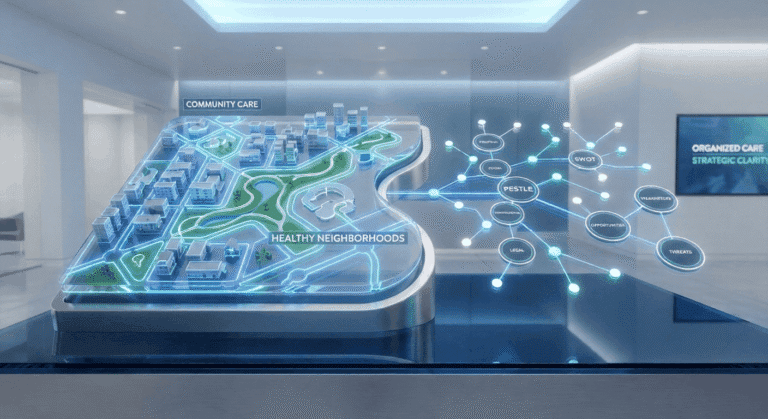
While these tools are individually brilliant, businesses use them in a fragmented, Frankenstein-like fashion. They bolt together different methodologies without a central nervous system to connect them. Your PESTLE Analysis lives in a static PDF, your SWOT Analysis is a photo of a whiteboard on someone’s phone, and your budget is in a disconnected spreadsheet.
When your data doesn’t interact, your strategy is dead on arrival.
Identifying that you have a Strong Brand (Strength) and that there is Rising Market Demand (Opportunity) is just an observation.
Strategy only begins when you ask: Exactly how will we deploy our brand equity to capture that specific market share?
How Does Sequential Strategic Integration Connect Planning to Execution?
To survive in a volatile market, you must stop treating strategy as a creative writing project and start treating it as a dynamic, interconnected engine. This requires a sequential workflow where the output of one framework becomes the fuel for the next.
Here is how world-class strategists bridge the execution gap using an integrated chain of proven frameworks.
Phase 1: How Do You Assess Ground Reality During Strategic Discovery?
Before you decide where you are going, you must relentlessly assess where you are.
- PESTLE Analysis: This is your early-warning system. By scanning Political, Economic, Social, Technological, Legal, and Environmental factors, you map the macro-forces at play. You aren’t just reacting to inflation; you are planning for it
- Porter’s Five Forces: Zoom in on your industry. Who holds the power? If supplier power is rising, your strategy must pivot immediately to secure alternative supply chains before margins shrink
Phase 2: How Do You Turn Strategic Analysis Into Actionable Steps?
This is where most companies fail. They build a SWOT and stop. You must force your data to interact.
- The TOWS Matrix: While SWOT summarizes your current state, TOWS outlines your future maneuvers. It forces you to cross-reference your internal strengths with external opportunities (S-O Strategies) to generate offensive moves and your internal weaknesses with external threats (W-T Strategies) to build defensive moats
- The GOST Framework (Goals, Objectives, Strategies, Tactics): Once your maneuvers are set, GOST cascades them down. It ensures that the high-level Goal set in the boardroom directly dictates the daily Tactics executed by your frontline employees
Phase 3: How Do You Track Progress and Adapt Strategies in Real Time?
A strategy is a hypothesis. You must track its validity in real time.
- The Balanced Scorecard: If you look only at your P&L, you are driving while looking in the rearview mirror. The Balanced Scorecard helps you track forward-looking lead metrics across four perspectives: Financial, Customer, Internal Processes, and Learning & Growth.
- The PDCA Cycle (Plan-Do-Check-Act): In a fast-moving market, the Set and Forget strategy is a death sentence. The PDCA cycle is the scientific method applied to your business, ensuring that every failure is a data point and every success is standardized.
Frequently Asked Questions
What is the main cause of the strategy execution gap?
The main cause of the strategy execution gap is the creation of a “Frankenstein Strategy”—where high-level plans are built by executives in an operational vacuum. When strategic planning lacks input from frontline ground realities, it results in fragmented goals, poor cross-departmental communication, and a total lack of daily team accountability.
What is Sequential Strategic Integration?
Sequential Strategic Integration is a structured three-phase framework designed to connect high-level planning with daily execution. It works by systematically grounding strategy in operational discovery (Phase 1), translating data insights into frontline action steps (Phase 2), and establishing continuous tracking loops to adapt the strategy in real time (Phase 3).
How do you turn high-level strategic analysis into actionable steps?
To turn strategic analysis into action, organizations must explicitly map broad strategies to tactical, assignable work items. This requires breaking down abstract corporate goals into quantifiable, short-term objectives, and assigning clear operational ownership to specific business units and teams.
How often should an enterprise review its strategy execution plan?
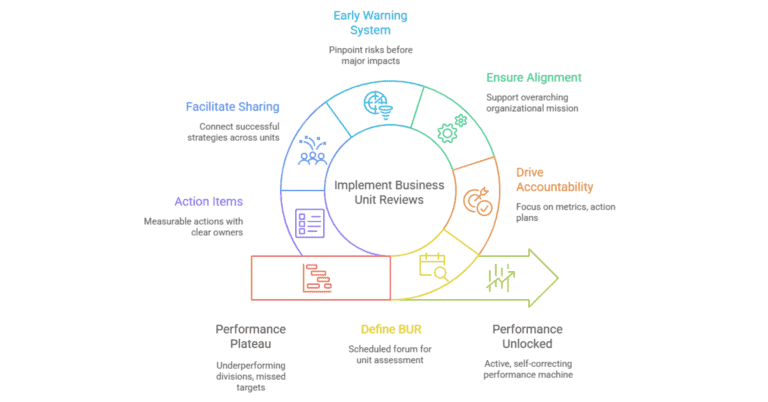
An enterprise should move away from rigid annual planning and adopt a continuous review cycle. Strategy execution is best managed via structured monthly business unit reviews alongside a dynamic quarterly strategic reset, allowing the organization to adapt to market changes in real time.
Why do traditional strategic planning methods fail?
Traditional methods fail because they rely on static, top-down planning assumptions that ignore operational realities. Without an integrated toolkit to connect continuous data intelligence with frontline execution, plans quickly become obsolete as market and internal conditions shift.
Why Use the Strategic Analysis Toolkit to Close Your Execution Gap?
Bridging the execution gap requires more than good intentions; it requires the right infrastructure. You cannot run a sequential, dynamic strategy across scattered spreadsheets and messy slide decks.
This is why top-tier consultants and executives use the Strategic Analysis Toolkit.
The Strategic Analysis Toolkit is not just a digital repository of templates; it is an integrated strategic operating system. It allows you to move seamlessly from a PESTLE Analysis to a TOWS Matrix, ensuring your logic flows perfectly from discovery to implementation without losing a single data point.
Stop competing in the dark. Stop letting brilliant plans gather dust. Elevate your strategy from static plans to continuous intelligence.