What is the Blue Ocean Strategy?
Blue Ocean Strategy is a business framework focused on creating uncontested market space and rendering the competition irrelevant. It does so by pursuing both high differentiation and low cost, thereby breaking the traditional value-cost trade-off.
Is your business fighting over a shrinking pool of customers? It might be time to stop competing and start creating.
In most mature industries, the strategic playbook is painfully predictable. You fight tooth and nail for market share, you cut prices to undercut rivals, and you scramble to add “value-add” features that often do nothing but increase your overhead. You watch your profit margins shrink as you battle for dominance.
In this guide, we’ll move beyond the buzzwords and break down exactly how to find uncontested market space, reconstruct market boundaries, and drive innovation that renders your competitors obsolete.
The result? You are swimming in a “Red Ocean”; a market saturation where the water is bloody from sharks fighting over the same scraps. In a Red Ocean, industry boundaries are defined and accepted, and the competitive rules of the game are known. Companies try to outperform their rivals to grab a greater share of existing demand. As the market becomes crowded, prospects for profits and growth decline. Products become commodities, and cutthroat competition turns the red ocean bloody.
But what if you could make the competition irrelevant? What if, instead of fighting for a sliver of a shrinking pie, you created a whole new pie? This is the essence of Blue Ocean Strategy.
Key Takeaways
- Red Oceans vs. Blue Oceans: Stop fighting for razor-thin market share in bloody, saturated industries (Red Oceans). Instead, reconstruct market boundaries to unlock entirely new, uncontested demand where competition is irrelevant (Blue Oceans)
- The Value Innovation Principle: Reject the myth that higher value always requires higher costs. True growth occurs when you break the value-cost trade-off by lowering operational costs while raising buyer value
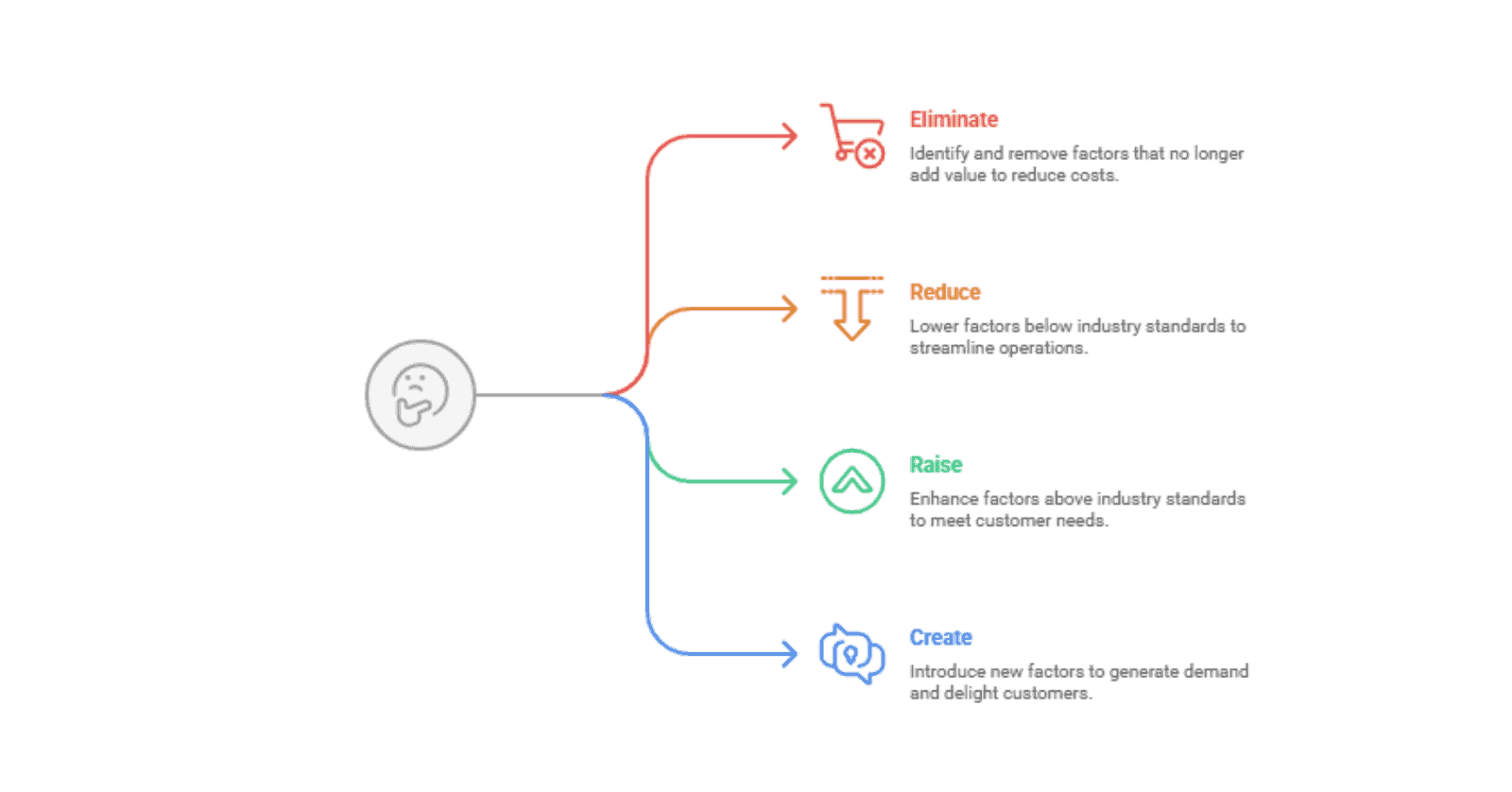
- The ERRC Grid Strategy: Re-engineer your business model by asking four ruthless questions: What can your business Eliminate, Reduce, Raise, and Create? Remember: If you aren’t actively cutting out standard industry expenses, you are just adding cost, not innovating
- Target Non-Customers: Do not obsess over your current client base. The most significant growth opportunities lie with “non-customers,” those who use your industry out of necessity, those who actively refuse it, or those who have never even considered it
- Redefine the Game: Market boundaries are not fixed. Iconic brands such as Cirque du Soleil and Yellow Tail Wine won not by being “better” versions of their competitors, but by rendering traditional industry metrics obsolete
Traditional Business Strategy vs. Blue Ocean Strategy
To understand why Blue Ocean Strategy is so revolutionary, we first have to look at how most businesses plan for growth. Traditionally, business schools and strategists rely on tools like the Ansoff Matrix to map out their future.
The Ansoff Matrix is useful for categorization, but it often traps leaders in a binary, limiting choice:
- The “Safe” Route (Market Penetration): You try to sell more of your existing product to your existing market. This is the definition of a Red Ocean. Growth is slow, and usually achieved only by stealing customers from competitors via price wars or aggressive marketing.
- The “Risky” Route (Diversification): You try to sell completely new products to entirely new markets. While this offers growth, it has a notoriously high failure rate because you are entering unknown territory with no experience.
The Blue Ocean Perspective: Blue Ocean Strategy rejects this strict perspective. It argues that you don’t need to choose between “safe and stagnant” or “risky and unknown.”
Instead of accepting industry boundaries as fixed, Blue Ocean Strategy suggests you can reconstruct them. You don’t enter a pre-existing market where the rules are set (Ansoff’s diversification); you create a market where there are no rules yet. By focusing on value innovation, you can achieve high growth through diversification with manageable risk.
What is Value Innovation in Blue Ocean Strategy?
Most companies make a fatal strategic mistake: they believe in the “Value-Cost Trade-off.” They assume that:
- To offer more value, they must charge more (Differentiation)
- To charge less, they must offer less value (Cost Leadership)
Blue Ocean Strategy breaks this trade-off. It pursues Value Innovation. This means pursuing differentiation and low cost simultaneously.
It sounds impossible, but it is achieved through a specific mechanism:
- Cost Savings are made by eliminating and reducing factors that the industry competes on but customers don’t value
- Buyer Value is lifted by raising and creating elements that the industry has never offered, but customers desperately want
Expert Insight: Many businesses fail here because they think “Blue Ocean” means “Niche.” It does not. It means mass appeal at a distinct, often lower, price point because you have stripped away the expensive things customers don’t actually care about.
How to Use the ERRC (Four Actions) Framework
How do you actually achieve Value Innovation? You cannot just “brainstorm” it. You need a structured tool. This is the ERRC (Eliminate, Reduce, Raise, Create). This tool forces you to reconstruct your business model by asking four specific, challenging questions:
| ERRC Action | Focus Type | Goal | Strategic Objective |
| Eliminate | Cost Side | Remove factors that the industry takes for granted but add no genuine value. | Drastically lower overhead and structural costs. |
| Reduce | Cost Side | Drop operational factors well below standard industry benchmarks. | Prevent over-engineering and streamline execution. |
| Raise | Value Side | Push core factors well above industry standard expectations. | Eliminate forced consumer compromises and lift buyer utility. |
| Create | Value Side | Introduce entirely new elements that the industry has never offered before. | Unlock brand new demand and capture untapped non-customers. |
Blue Oceans in Action: Shifting from Commodities to Cultural Icons
Beyond the Big Top: How Cirque du Soleil Deleted the Competition
The most famous example of Blue Ocean Strategy is Cirque du Soleil. When they entered the scene in the 1980s, the circus industry was dying. Animal rights activists were attacking the use of animals, “star” performers were demanding huge salaries, and children (the primary audience) were turning to video games.
Instead of trying to be a “better” circus with more famous clowns or more exotic tigers (the Red Ocean approach), Cirque du Soleil used the ERRC framework to reinvent the industry:
- ELIMINATE: They completely removed star performers and animal shows. These were the two most expensive elements of a traditional circus, yet they were also the source of most operational headaches and public controversy. They also cut aisle concession sales, which disrupted the viewing experience
- REDUCE: They reduced the “slapstick” humor and the element of raw danger/thrill, which were staples of the Ringling Bros. era but less appealing to modern audiences
- RAISE: They raised the production value by investing in a unique venue (the distinctive tent) and significantly raised the price point, positioning themselves closer to Broadway theater than a traveling carnival
- CREATE: They created a new genre that combined the circus with theater. They introduced artistic music and dance, intellectual themes, and a sophisticated environment
The Result: They didn’t compete with Ringling Bros. for kids. They created a new market for adults and corporate clients willing to pay ticket prices 4x higher than those for a standard circus.
Shaking Up the Wine Snobs: The Yellow Tail Product Pivot
While Cirque du Soleil is a service example, Yellow Tail (Casella Wines) shows how this applies to physical products.
The US wine market was incredibly competitive. Brands competed on prestige, soil quality, aging process, and complex terminology. It wasn’t very comforting for the average person who just wanted a drink.
Yellow Tail used the ERRC to disrupt the market:
- ELIMINATE: They eliminated enological terminology and the focus on aging quality. They stopped trying to sell “prestige.”
- REDUCE: They reduced the range of wines. Most wineries offered dozens of varieties; Yellow Tail offered just two: one Red (Shiraz) and one White (Chardonnay). This streamlined their inventory and logistics.
- RAISE: They raised retail store visibility by using friendly, colorful packaging that looked good on a shelf, rather than the traditional beige/white labels of competitors.
- CREATE: They created a flavor profile that was “easy to drink” (sweeter, fruitier), effectively bridging the gap between wine and beer/cocktails. They made a sense of fun and adventure rather than elitism.
The Result: Yellow Tail became the #1 imported wine in the US, not by stealing wine snobs from competitors, but by bringing beer and cocktail drinkers into the wine market.
From Theory to Horizon: Building Your 3-Step Strategy Roadmap
You don’t need to be a billion-dollar entertainment company to use this. Here is how to start finding your Blue Ocean.
Step 1: Stop Looking at Your Customer
This is counterintuitive. Most businesses obsess over their existing customers. But your Blue Ocean lies with Non-Customers. Blue Ocean theory identifies three tiers of non-customers you should analyze:
- Tier 1: “Soon-to-be” Non-Customers: These people use you out of necessity but are mentally ready to jump ship as soon as a better alternative appears. Why are they unhappy?
- Tier 2: “Refusing” Non-Customers: These people have considered your industry’s offering and consciously rejected it (e.g., people who refuse to join a gym because it’s intimidating). What is the barrier?
- Tier 3: “Unexplored” Non-Customers: These people have never even considered your industry as an option. What assumption are we making that ignores them?
Step 2: List Industry Assumptions
Write down everything your industry believes is “mandatory.”
- Real Estate Agents: “We must work on commission.”
- Software: “We must sell annual contracts.”
- Banks: “We must have physical branches.”
Now, challenge them. What if you didn’t do that? What if you did the opposite?
Step 3: Draft Your ERRC
Get your team in a room and fill out the ERRC.
Warning: If you aren’t eliminating anything, you aren’t doing Blue Ocean Strategy; you are just adding cost. You must be ruthless in cutting the “industry standards” that don’t add value to your specific customer.
Frequently Asked Questions
What are the four actions in the ERRC framework?
The ERRC framework stands for Eliminate, Reduce, Raise, and Create. It requires a business to Eliminate obsolete industry standards, Reduce over-designed features well below industry benchmarks, Raise critical factors far above standard compromises, and Create entirely new elements the industry has never offered.
Who Are the “Non-Customers” in Blue Ocean Strategy?
Blue Ocean Strategy looks at three tiers of non-customers to unlock new demand:
– Tier 1 (“Soon-to-be”): Customers who use the industry minimally out of necessity but are ready to leave.
– Tier 2 (“Refusing”): People who have actively evaluated the industry’s offerings and consciously chosen not to use them.
– Tier 3 (“Unexplored”): Individuals who have never been targeted or considered as potential customers by any player in the market.
Does a Blue Ocean Strategy Mean Targeting a Niche Market?
No. While many businesses mistake a Blue Ocean for a hyper-focused niche market, it is actually designed for mass appeal. The goal is to capture a broad cross-section of the market by stripping away costly, unnecessary complexities that average buyers do not value, enabling a highly attractive, accessible price point.
How Does Blue Ocean Strategy Differ From Traditional Frameworks Like the Ansoff Matrix?
Traditional frameworks like the Ansoff Matrix treat industry boundaries as fixed, forcing companies into binary choices between “safe but crowded” market penetration and “highly risky” diversification. Blue Ocean Strategy rejects fixed boundaries, showing that businesses can reconstruct market lines to find high-growth, low-risk opportunities through Value Innovation.
Conclusion
Competition is a choice. If you find yourself in a price war or struggling to differentiate your product in a crowded market, stop digging. Look up and look out, and ask yourself: What can I eliminate to make room for something entirely new?
The goal isn’t to beat the competition. It’s to make them irrelevant.