
Why Do Most Businesses Fail to Anticipate Market Disruption?
Disruption is often framed as a sudden, cataclysmic event, the Uber moment that wipes out an industry. But if you look closer, the signs were always there. Blockbuster didn’t die overnight; it failed to recognize a shift in consumer behavior and technology that was visible years in advance.
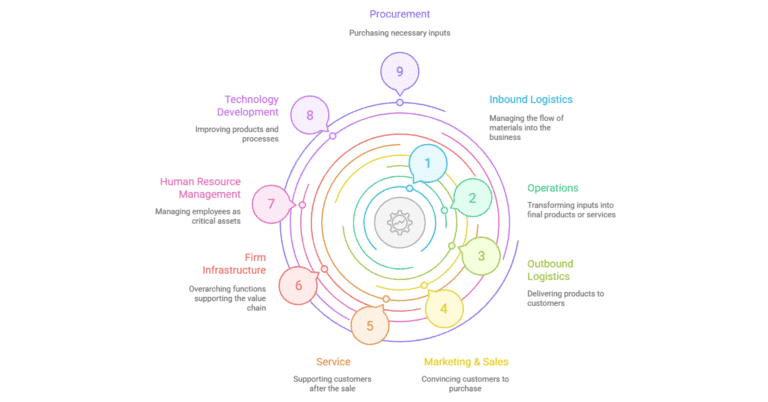
The problem isn’t a lack of data; it’s a lack of a structured lens. Most organizations are so focused on their internal Value Chain, squeezing efficiency from existing processes, that they overlook the macro-environment. To survive a market shift, you don’t need a crystal ball; you need a toolkit.
| Framework | Role in Market Disruption Strategy | Key Metric / Focus |
| PESTLE Analysis | Macro-environment early warning system | Tech, Legal, and Regulatory shifts |
| Porter’s Five Forces | Micro-environment boundary assessment | Threats of AI-driven substitutes & new entrants |
| TOWS Matrix | Translating internal capabilities to action | Matching Strengths against external Threats |
| Blue Ocean Strategy | Market creation and value innovation | Eliminating and creating new market space |
| Kotter’s 8-Step / PDCA | Agile strategy execution and tracking | Managing human transitions and loop feedback |
How Do You Identify Disruption Signals Using PESTLE and Porter’s Five Forces?
Before you can react, you must first detect. Market disruption rarely begins in your direct line of sight. It starts on the periphery.
- The PESTLE Analysis: This is your early-warning system. Are technological breakthroughs making your hardware obsolete? Are Legal or Environmental regulations about to tax your primary revenue stream? By scanning these six pillars, you turn unpredictable change into a manageable roadmap
- Porter’s Five Forces: Disruption often arrives as the Threat of Substitutes. If a startup can solve your customer’s problem for 10% of the cost using AI, your competitive advantage vanishes. Analyzing the bargaining power of buyers and the threat of new entrants reveals where the traditional boundaries of your industry are crumbling
How Do You Translate a Traditional SWOT Analysis Into an Actionable TOWS Matrix?
Knowing a storm is coming is useless if you don’t know whether your ship is watertight. This is where SWOT becomes the missing link. A standard SWOT analysis tells you who you are; a TOWS Matrix tells you what to do.
The Strategic Analysis Toolkit automates this transition. Instead of listing Threats, the toolkit helps you map them against your Strengths to develop a Maxi-Maxi strategy. If a competitor is disrupting your market with a new platform, how can you leverage your existing brand authority (Strength) to launch a competing service (Opportunity) before they gain a foothold?
How Can Businesses Use Blue Ocean Strategy to Escape Crowded Markets?
When your industry becomes a Red Ocean, crowded, price-sensitive, and shrinking, the best strategy isn’t to fight harder; it’s to leave.
Blue Ocean Strategy is about Value Innovation. It challenges you to ask: What can we eliminate, reduce, raise, and create to make the competition irrelevant? This isn’t just thinking outside the box; it’s a structured methodology for redefining the market on your terms.
What Are the Best Frameworks for Implementing a Market Disruption Strategy?
A strategy without execution is just a hallucination. To navigate a complete industry shift, you must manage the human element.
- Kotter’s 8-Step Plan: Disruption demands radical change. Create a sense of urgency and build a guiding coalition
- The PDCA Cycle: The market won’t stop moving just because you have a new plan. Use the Plan-Do-Check-Act cycle to refine your strategy in real time
- What-If Scenarios: Before committing millions to a pivot, use the Strategic Analysis Toolkit to model scenarios. What happens if the disruption accelerates? What if it plateaus?
Frequently Asked Questions
Why do most businesses fail to anticipate market disruption?
Most businesses fail to see market disruption coming because they focus too heavily on their internal value chain and efficiency, rather than scanning the broader macro-environment. Disruption rarely happens overnight; instead, companies overlook the early warning signs because they lack a structured strategic lens to interpret incoming market data.
How do you translate a traditional SWOT analysis into an actionable TOWS matrix?
While a standard SWOT analysis identifies who a business currently is by listing internal strengths and weaknesses alongside external opportunities and threats, it does not outline next steps. A TOWS matrix translates these points into direct actions by mapping your internal strengths directly against external threats, allowing you to develop proactive, defensive, or aggressive strategies.
How can businesses use Blue Ocean Strategy to escape crowded markets?
When an industry becomes a crowded, price-sensitive “Red Ocean,” Blue Ocean Strategy focuses on value innovation. This structured framework challenges an organization to determine what features can be eliminated, reduced, raised, or created to redefine the market entirely and render existing competition irrelevant.
What are the best frameworks for implementing a market disruption strategy?
Successful execution during an industry shift requires managing human change alongside operational strategy. This is achieved by combining Kotter’s 8-Step Plan to establish urgency and a guiding coalition, the Plan-Do-Check-Act (PDCA) cycle to iterate plans in real time, and scenario planning to model different “what-if” disruption trajectories before deploying capital.
Stop Guessing. Start Strategizing.
Strategic frameworks are what separate a Disruptee from a Disruptor. However, manually building these matrices in spreadsheets is slow and error-prone.
The Strategic Analysis Toolkit automates the heavy lifting. From generating comprehensive PESTLE reports to prioritizing your TOWS initiatives and defining your GOST (Goals, Objectives, Strategies, Tactics), the toolkit gives you the speed of a startup with the rigor of a global consultancy.
Explore the Strategic Analysis Toolkit Today. Turn market disruption into your unfair advantage.