
What Are Business Lifecycle Strategic Tools
Business lifecycle strategic tools are structured management tools used by organizations to align their operational strategies, decision-making, and resource allocation with their specific stage of corporate maturity.
The Strategic Compass: Mastering Every Stage of the Business Lifecycle
| Lifecycle Stage | Recommended Frameworks | Core Strategic Goal |
| Idea Phase | PESTLE Analysis, SWOT Analysis, GOST Analysis, Ansoff Matrix | The Idea phase is the pre-commercial, conceptual stage of a venture where a business concept is formulated but not yet executed. Strategic frameworks in this phase are used to map macro-environmental forces, clarify value propositions, and map the theoretical viability of a business model before any capital is deployed. |
| Startup Phase | PESTLE Analysis, Porter’s 5 Forces, SWOT Analysis, GOST Analysis, Ansoff Matrix, Blue Ocean Strategy, TOWS Matrix, Balanced Scorecard | The Startup phase is the initial operational stage of the business lifecycle focused on minimum viable product (MVP) development and early market entry. Strategic frameworks within this phase are designed to analyze immediate competitive forces, validate core market assumptions with real user data, and mitigate foundational launch risks. |
| Growth Phase | PESTLE Analysis, Porter’s 5 Forces, Value Chain Analysis, VRIO Analysis, SWOT Analysis, GOST Analysis, Ansoff Matrix, Blue Ocean Strategy, TOWS Matrix, TOWS Prioritization, Balanced Scorecard, Kotter’s 8-Step Change Plan | The Growth phase is the expansion stage of the business lifecycle characterized by rapidly accelerating customer acquisition, scaling infrastructure, and rising market demand. Strategic frameworks in this phase are utilized to optimize internal value chains, identify new market penetration paths, and effectively manage expanding product portfolios. |
| Mature Phase | PESTLE Analysis, Porter’s 5 Forces, Value Chain Analysis, VRIO Analysis, SWOT Analysis, GOST Analysis, Ansoff Matrix, Blue Ocean Strategy, TOWS Matrix, TOWS Prioritization, Balanced Scorecard, Kotter’s 8-Step Change Plan, PDCA Cycle | The Mature phase is the stabilization stage of the business lifecycle where market share peaks, organizational structures formalize, and organic growth begins to slow. Strategic frameworks at this level are deployed to evaluate internal capabilities for sustained competitive advantage, protect core revenue streams from new entrants, and uncover uncontested market spaces. |
| Stagnating Phase | PESTLE Analysis, Porter’s 5 Forces, Value Chain Analysis, VRIO Analysis, SWOT Analysis, GOST Analysis, Blue Ocean Strategy, TOWS Matrix, TOWS Prioritization, Balanced Scorecard, Kotter’s 8-Step Change Plan, PDCA Cycle | The Stagnating phase is the static or plateau stage of the business lifecycle marked by flatlining revenues, rigid corporate bureaucracies, and a loss of market momentum. Strategic frameworks in this phase are used to diagnose internal organizational misalignments, audit operational efficiencies, and identify the root causes of complacency before structural decline sets in. |
| Declining Phase | PESTLE Analysis, Porter’s 5 Forces, Value Chain Analysis, SWOT Analysis, GOST Analysis, Blue Ocean Strategy, TOWS Matrix, TOWS Prioritization, Kotter’s 8-Step Change Plan, PDCA Cycle | The Declining phase is the critical contraction stage of the business lifecycle characterized by eroding market relevance, falling sales, and outdated business models. Strategic frameworks in this final phase serve as urgent blueprints for transformation, enabling leadership to manage rapid organizational change, divest underperforming assets, and execute structural corporate pivots. |
In business, there is no end state. There is only the lifecycle.
Whether you are sketching a concept on a napkin or managing a multinational in decline, the fundamental challenge is the same: Strategic Alignment.
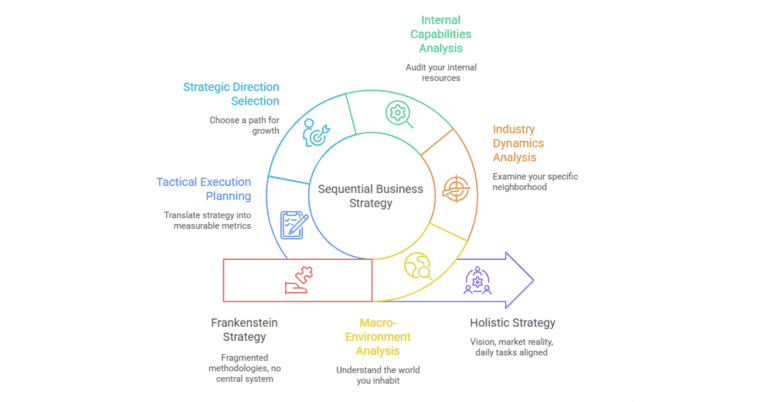
Most leaders fail not because they lack ambition but because they suffer from Strategic Mismatch. They apply the rigid KPIs of a mature company to a startup, or they try to pivot a massive enterprise using the unstructured chaos of an idea-stage shop. To win, you must match your methodology to your maturity.
What Strategic Frameworks Are Best for the Idea and Startup Stage?
In the early stages, your goal isn’t execution; it’s validation. You need to know whether the weather is right for your ship.
- The Framework: PESTLE Analysis
- The Insight: Before writing a single line of code or signing a lease, you must map the Political, Economic, Social, Technological, Legal, and Environmental forces
- The Toolkit Edge: The Strategic Analysis Toolkit automates this environmental scan by pulling real-time data, so you aren’t building a business on yesterday’s assumptions
Which Strategic Tools Help a Business Scale During the Growth Phase?
Once you have product-market fit, the problem shifts from Will it work? to How do we scale without breaking?
- The Frameworks: Porter’s Five Forces & Value Chain Analysis
- The Insight: You must identify where your internal value is created and where margin is being eroded. Simultaneously, you must evaluate the bargaining power of your new, larger suppliers and buyers
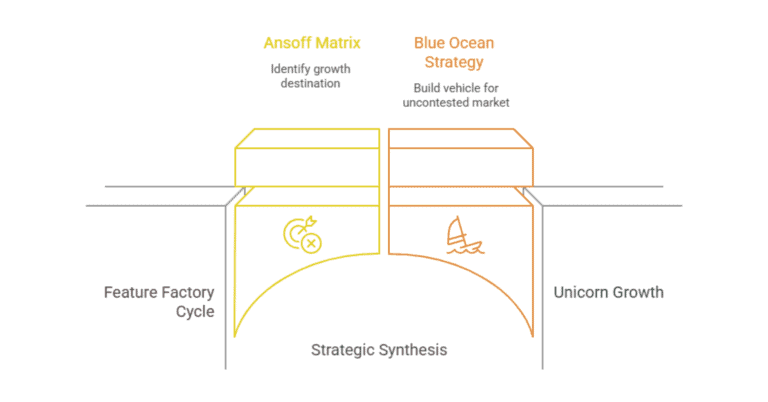
- The Strategy: Use the Ansoff Matrix to decide your next move: Are you deepening your penetration in your current market, or is it time for market development?
How Can a Mature Enterprise Break Out of a Performance Plateau?
Maturity is the most dangerous stage. It feels comfortable, but it’s where the Red Ocean sharks start circling.
- The Framework: Blue Ocean Strategy (ERRC)
- The Insight: To stay relevant, you must stop competing and start creating. Use the ERRC grid to eliminate industry-standard features that no longer add value and to create new value curves that make the competition irrelevant
- The Missing Link: Turn your insights into action with the TOWS Matrix. Don’t just list your strengths; cross-reference them with external opportunities to develop high-impact offensive maneuvers
What is the Best Strategic Blueprint for a Stagnating or Declining Business?
If growth has stalled or revenue is shrinking, incremental change won’t save you. You need a structural reboot.
- The Framework: Kotter’s 8-Step Plan & the PDCA Cycle
- The Insight: Transformation fails 70% of the time because it lacks a human-centric blueprint. Use Kotter’s model to build urgency and a guiding coalition
- The Continuous Loop: Apply the PDCA (Plan-Do-Check-Act) cycle to relentlessly test your new direction, ensuring your pivot is data-driven, not desperate
Frequently Asked Questions
What is the main difference between the Idea phase and the Startup phase?
The Idea phase is a pre-commercial, purely conceptual stage focused on mapping theoretical business model viability and macro-environmental forces. In contrast, the Startup phase is an active operational stage centered on developing a minimum viable product (MVP) and validating market assumptions using real user data.
What strategic framework is best for a company in the Growth phase?
The Ansoff Matrix and Value Chain Analysis are the most effective strategic frameworks for the Growth phase. These tools explicitly help expanding businesses identify new market penetration paths and optimize internal operations to successfully scale alongside rising demand.
How can a Mature phase business avoid entering the Stagnating phase?
A Mature phase business can prevent stagnation by deploying the Blue Ocean Strategy to discover uncontested market spaces and utilizing the VRIO Framework. These models allow stable organizations to continuously audit internal capabilities and unlock new revenue streams before growth flatlines.
What is the operational difference between a Stagnating business and a Declining business?
A Stagnating business is defined by flatlining revenues, rigid internal bureaucracy, and a loss of momentum, though it still maintains market equilibrium. A Declining business represents a more severe contraction phase characterized by actively eroding market relevance, falling sales, and an outdated business model that requires an immediate pivot.
Which change management framework is ideal for the Declining phase?
Kotter’s 8-Step Change Model paired with the PDCA (Plan-Do-Check-Act) Cycle is the ideal supporting framework combination for the Declining phase. Together, they provide a structured, data-driven blueprint for breaking through organizational complacency, managing rapid corporate turnarounds, and executing emergency structural pivots.
Stop Guessing. Start Analyzing.
Strategy shouldn’t be a 50-page PDF gathering digital dust. It should be a living, breathing operating system. The Strategic Analysis Toolkit democratizes professional-grade consulting tools, enabling you to run these complex frameworks in hours rather than weeks.