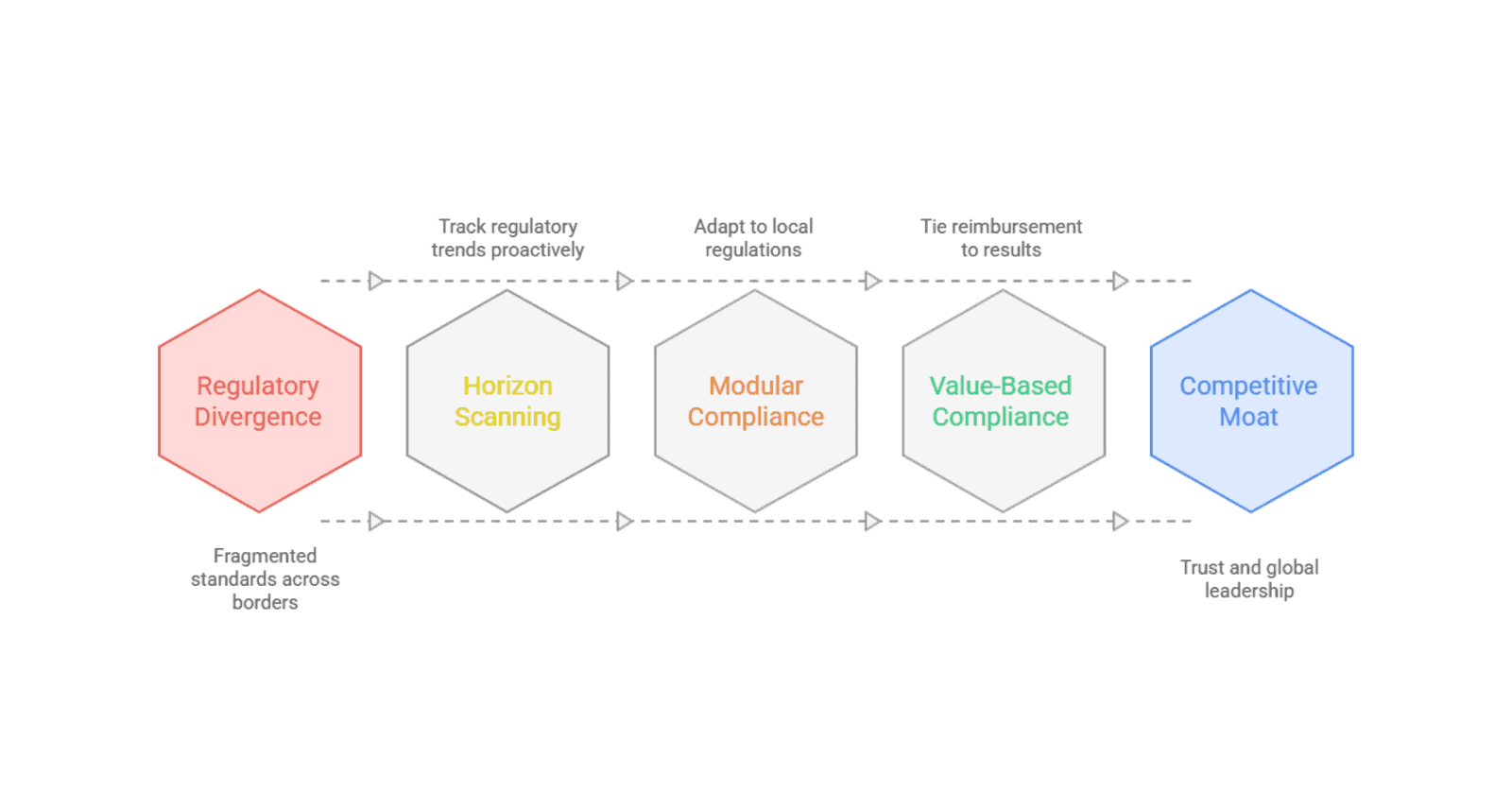
What Is Healthcare Transformation in the Era of Regulatory Divergence?
Healthcare transformation represents a fundamental shift in how the global medical industry operates, driven by the collapse of uniform international standards and the rise of highly localized, fragmented compliance laws. For decades, multinational healthcare, pharmaceutical, and medical technology companies operated under a model of global harmonization, assuming a single product or data strategy could be deployed worldwide. In this new era of regulatory divergence, that approach is obsolete; companies are instead forced to navigate an increasingly localized legal landscape where data sovereignty mandates, strict artificial intelligence ethics frameworks (like the EU AI Act), and rigorous supply-chain transparency laws vary dramatically by region. Survival in this fragmented environment requires organizations to move away from reactive compliance, transforming their technological architectures and operational strategies to turn immense legal complexity into a distinct competitive advantage.
In the boardroom of any global healthcare entity, a new and formidable challenge has taken center stage. It isn’t just the pace of clinical innovation or the rising cost of labor; it is regulatory divergence. For decades, the goal of the global healthcare industry was harmonization, a steady march toward unified standards that would allow a medical device, a pharmaceutical product, or a digital health platform to scale seamlessly across borders. Today, that trend has reversed. We have entered an era of “protectionist compliance,” in which data sovereignty, localized AI ethics, and fragmented supply-chain mandates are the new reality.
In this landscape, compliance can no longer be a reactive check-the-box function buried in the legal department. To survive the next decade, healthcare leaders must transform compliance into a strategic engine of resilience.
Key Takeaways
- The Shift from Global to Local Compliance: Healthcare organizations are facing massive regulatory divergence. Instead of a unified global standard, companies must now navigate localized, protectionist laws regarding data localization, AI ethics, and supply chain transparency
- Overcoming Data Sovereignty Barriers: Traditional centralized data lakes are becoming compliance liabilities. Forward-thinking healthcare firms are adopting federated data architectures and edge computing to query patient insights globally while keeping the raw data strictly within national borders
- Achieving Compliant Healthcare AI: Meeting strict rules like the EU AI Act requires a shift to Explainable AI ($XAI$). Organizations must implement auditable training data loops and strict Human-in-the-Loop ($HITL$) protocols to eliminate clinical bias and validate automated decisions
- Securing the Borderless Supply Chain: Geo-political friction and strict new human rights laws require absolute supply chain visibility. Companies must treat compliance not as a reactive legal hurdle, but as a core operational risk vector that requires real-time mapping from raw materials to final delivery
- Transitioning to Value-Based Compliance: As global healthcare models pivot toward value-based care, regulatory strategy must match. Compliance is shifting from a check-the-box exercises to a mechanism that directly ties reimbursement rates to patient outcomes, safety metrics, and ethical data handling
How Does the Data Sovereignty Trap Impact Global Healthcare Strategy?
The first and perhaps most significant shift in the global regulatory landscape is the transition from Data Privacy to Data Sovereignty. While the world spent the last several years adapting to the General Data Protection Regulation (GDPR) and its many international clones, the goalposts have moved. It is no longer sufficient to protect patient data; regulators are increasingly requiring that health data remain within national borders. From the European Health Data Space (EHDS) to strict localization laws in emerging markets such as India and Indonesia, the borderless cloud is eroding.
What Are the Primary Strategic Risks of Localized Healthcare Privacy Laws?
For global healthcare providers and tech firms, this creates an interoperability trap. If a clinical trial relies on a centralized database in North America but enrolls patients in Southeast Asia or the EU, the organization may face compliance paralysis, unable to move the data needed to improve patient outcomes without violating local laws.
How Do Decentralized Architectures Solve Data Sovereignty Barriers?
The winners in this space are moving away from monolithic, centralized data lakes. Instead, they are investing in federated or edge computing models. These enable localized data storage that complies with sovereignty laws while using global queries to extract insights without moving the underlying sensitive information across a digital border.
How Do Organizations Implement Healthcare Artificial Intelligence Governance?
As Artificial Intelligence (AI) moves from experimental pilot projects to the backbone of clinical decision support and administrative automation, a new regulatory frontier has emerged: Algorithmic Accountability.
We are seeing a global patchwork of AI regulation. The European Union’s AI Act treats healthcare as a high-risk sector, demanding rigorous transparency and human oversight. Simultaneously, other regions are taking a more “innovation-first” approach, creating a minefield for companies trying to deploy a single global AI tool.
What Causes Clinical Bias in Artificial Intelligence, and How Is It Identified?
Regulators are no longer just assessing whether an AI works; they are also evaluating what it was trained on. A diagnostic algorithm trained on a specific demographic in Western Europe may be flagged as non-compliant or even dangerous if deployed in Africa or South America without localized validation.
What Steps Are Required to Build Audit-Ready Healthcare AI Systems?
To navigate this shift, organizations must move toward Explainable AI (XAI). If a regulator asks why a machine recommended a specific treatment path or denied a claim, the black box said so, is no longer a legally defensible answer. Establishing a global AI Ethics Board and implementing Human-in-the-Loop protocols aren’t just a moral choice; they’re a prerequisite for market access.
Why Is Supply-Chain Transparency an Ethical Mandate in Healthcare?
The global pandemic exposed the fragility of healthcare supply chains, but the regulatory response has focused more on ethics than on logistics. New mandates on ESG (Environmental, Social, and Governance) and human rights are forcing healthcare companies to examine their tier-two and tier-three suppliers more closely. Due diligence regulations such as the German Supply Chain Due Diligence Act (LkSG) and the EU’s Corporate Sustainability Due Diligence Directive (CSDDD) hold manufacturers legally responsible for the environmental and labor practices of suppliers of raw materials for their surgical instruments or medication packaging.
How Do Healthcare Supply Chains Shift From Cost Efficiency to Resilience?
The old model of Just-in-Time global shipping is being replaced by Just-in-Case localized manufacturing. Governments are incentivizing (and in some cases, requiring) near-shoring or friend-shoring of essential medical goods. For the worldwide strategist, this means your compliance team must now be as proficient in maritime law and carbon accounting as they are in clinical safety.
How Does Value-Based Healthcare Connect Compliance to Reimbursement?
Perhaps the most profound shift is the global movement from Volume to Value. Whether it is the Value-Based Healthcare (VBHC) initiatives in the Nordics or the outcome-based reimbursement models emerging in the Middle East, regulators are changing the definition of a “successful” healthcare transformation.
What Is the Healthcare Compliance Pivot From Rules-Based to Outcome-Based Care?
In a volume-based world, compliance focuses on preventing upcoding or over-utilization. In a value-based world, the risk shifts toward under-utilization or data manipulation. If your reimbursement is tied to patient recovery rates, the accuracy and integrity of your clinical data become your primary compliance risk.
Regulators are increasingly using sophisticated data analytics to flag anomalies in patient outcome reporting. Transparency is no longer a PR buzzword; it is a financial necessity.
What Is the Three-Step Global Strategy for Healthcare Compliance Resilience?
How does a global healthcare organization stay ahead of a target that is constantly moving? It requires a fundamental restructuring of the compliance function.
How Do Organizations Shift to Proactive Regulatory Horizon Scanning?
Most organizations respond to laws only after they are passed. Strategic leaders invest in Regulatory Intelligence. By tracking white papers from the WHO, draft legislation in the EU, and policy shifts in the G20, you can identify regulatory trends 18 to 24 months before they become enforceable. This lead time is the difference between a smooth transition and a panicked, expensive pivot.
Why Should Global Healthcare Firms Adopt a Modular Compliance Framework?
Stop trying to build a single Global Compliance Manual. Instead, create a Modular Framework. Your Core should consist of universal ethical standards and high-level quality controls. Additionally, you plug in Local Modules for specific regions, a GDPR module for Europe, a HIPAA module for the US, and an NMPA module for China. This allows the organization to remain agile without reinventing the wheel for every new market entry.
How Does Robust Regulatory Compliance Serve as a Corporate Valuation Driver?
In the world of Healthcare M&A, Compliance Due Diligence is now the most scrutinized part of the deal. A company with clean regulatory standing across multiple jurisdictions is worth significantly more than one with high growth but high regulatory risk. Treat your compliance program as an asset that enhances your organization’s enterprise value.
Frequently Asked Questions
How does the data sovereignty trap impact global healthcare strategy?
The data sovereignty trap forces healthcare organizations to abandon centralized data storage models due to strict, localized privacy and data localization laws. To maintain a global strategy without facing severe regulatory penalties, firms must pivot toward decentralized, federated data architectures that allow cross-border analysis without physically moving raw patient data across national borders.
How do organizations implement healthcare artificial intelligence governance?
Implementing robust AI governance requires transitioning away from opaque “black-box” models to Explainable AI ($XAI$). Organizations must establish comprehensive data-lineage tracking to audit training sets for clinical bias, alongside strict Human-in-the-Loop ($HITL$) protocols to ensure clinical professionals validate automated diagnostic and operational decisions.
Why is supply-chain transparency an ethical and regulatory mandate in healthcare?
Geopolitical instability and strict regional laws (like the German Supply Chain Due Diligence Act) have turned supply chain tracking into a legal necessity. Healthcare companies must achieve end-to-end transparency—from raw material sourcing to final delivery—to mitigate compliance risks, ensure ethical sourcing, and shift operations from fragile cost-efficiency to long-term resilience.
How does value-based healthcare connect compliance to financial reimbursement?
Modern regulatory frameworks are increasingly tying financial reimbursement directly to patient outcomes rather than the volume of services provided. This shift means that compliance can no longer be a reactive, check-the-box exercise; instead, it must serve as a core operational driver that directly protects and optimizes healthcare revenue streams.
What is the three-step global strategy for healthcare compliance resilience?
The strategy consists of shifting to proactive horizon scanning to anticipate global regulatory changes before they happen, adopting a modular compliance framework that easily adapts to shifting regional laws, and leveraging strong compliance as a strategic corporate valuation driver to attract investors and gain a competitive edge.
How Can Healthcare Organizations Turn Regulatory Complexity Into a Competitive Moat?
The global healthcare landscape is not going to get simpler. The days of one product, one planet are over. However, this complexity presents a significant opportunity.
Complexity is a barrier to entry. For the organization that masters the art of navigating these shifts, regulatory divergence isn’t a headache; it’s a competitive moat. By staying ahead of data residency laws, leading the way in AI ethics, and embracing transparency, you don’t just remain compliant. You build the trust necessary to lead the next generation of global healthcare.
The cost of transformation is high, but the cost of standing still is the loss of your global footprint. It’s time to stop fearing the shift and start navigating it.