Startup strategy analysis uses structured frameworks like Porter’s Five Forces, PESTLE, and SWOT to validate market assumptions, measure unit economics, and guide data-driven decisions before scaling.
In a startup, a recurring figure is the visionary founder who “just knows” what the market wants. They lead with passion, move at breakneck speed, and treat data as an afterthought to their intuition.
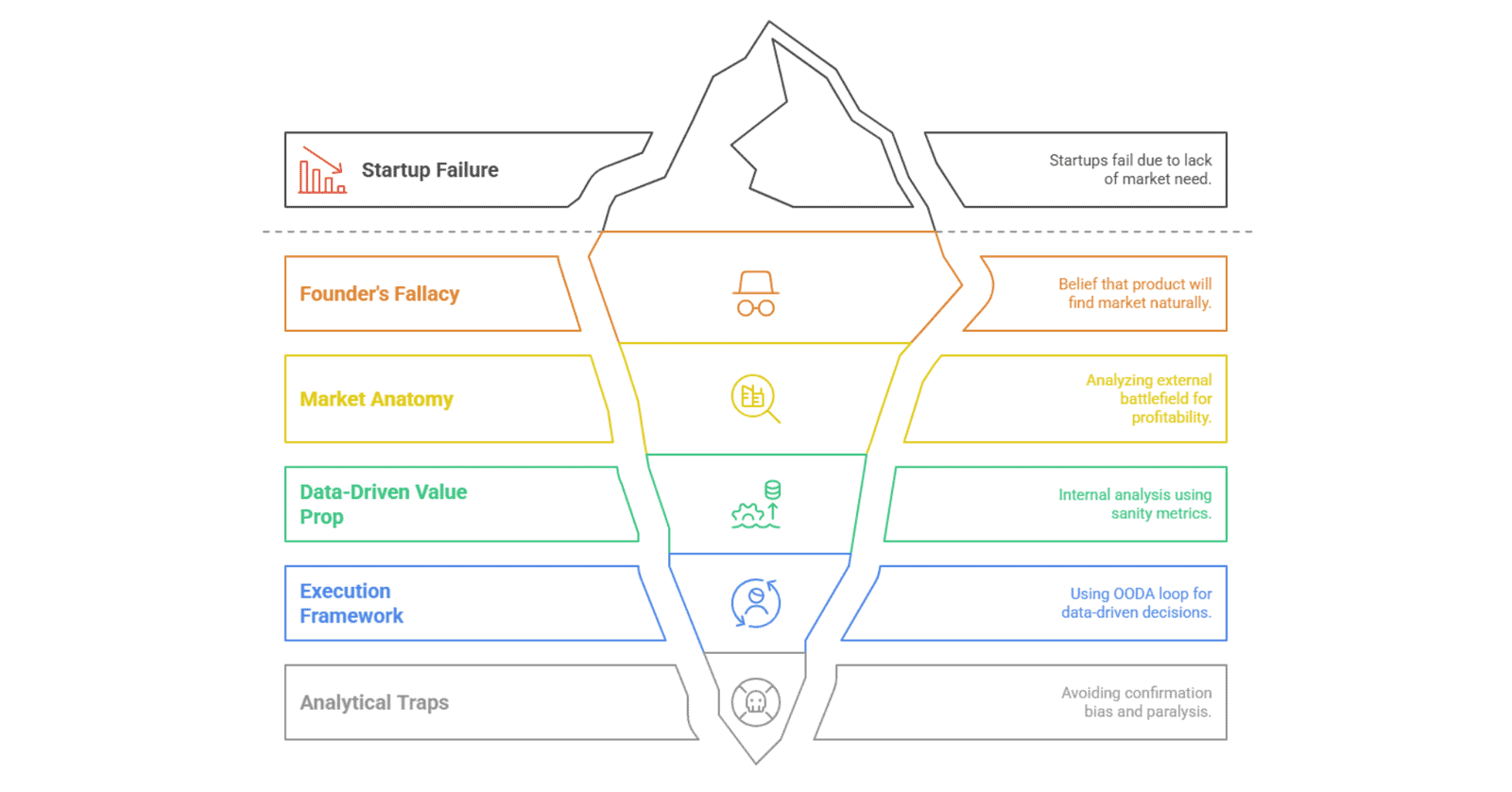
But in the current economic climate, intuition is no longer a reliable compass. According to recent venture data, nearly 42% of startups fail not because of poor coding or bad branding, but because of a “lack of market need.” In other words, they built a solution for a problem that didn’t exist, or at least, wasn’t painful enough for people to pay to solve.
This is the “Founder’s Fallacy”: the belief that a great product will naturally find its market through sheer force of will. To survive today, you must pivot from a culture of guessing to a culture of analysis. Whether you are launching a Business-to-Business (B2B) SaaS platform, a sustainable Consumer Packaged Goods (CPG) brand, or a deep-tech hardware company, the strategic process remains the same.
Strategy is not a static vision statement hanging on a wall; it is a hypothesis validated by rigorous, ongoing analysis.
Market Anatomy: Mapping the External Battlefield
Most pitch decks feature a slide with three concentric circles: Total Addressable Market (TAM), Serviceable Available Market (SAM), and Serviceable Obtainable Market (SOM). While these provide a sense of scale, they are often used as “vanity metrics” for markets. Accurate strategic analysis goes deeper into market anatomy: the fundamental components and structures that define how markets function, from the basic forces of supply and demand to complex market structures and cycles.
What Is a Pocket of Profitability for Startups?
To win, you don’t need a billion-dollar market; you need a Pocket of Profitability. This is a segment where customer pain is high and acquisition cost is low. Analysis begins by identifying where existing solutions are failing.
Porter’s Five Forces in the Age of AI
Michael Porter’s Five Forces framework is more relevant than ever, but the variables have shifted:
- Threat of New Entrants: In 2025, AI has lowered the barrier to entry for software. If your only moat is “we have an app,” you have no moat
- Bargaining Power of Suppliers: For many startups, “suppliers” are now cloud providers and LLM developers. If your margins are tied to API costs you can’t control, your strategy is fragile
- Competitive Rivalry: Don’t just look at who is in the space; look at their velocity. Are they hiring? Is their social sentiment dropping? Use tools like G2 or Trustpilot to find the “feature gaps” your competitors are ignoring
The PESTLE Scan
A strategic leader uses PESTLE to analyze macro shifts (Political, Economic, Social, Technological, Legal, Environmental) to catch tailwinds. For example, a fintech startup that analyzed upcoming “Open Banking” regulations in 2023 was positioned to dominate in 2025, while those who ignored the legal landscape are now scrambling to comply.
The Data-Driven Value Prop: Internal Analysis
Once you understand the battlefield, you must analyze your own arsenal. This is where many startups lose their way by tracking “vanity metrics” (likes, downloads, page views) instead of “sanity metrics.”
Defining Your North Star
Your North Star Metric should be the singular value that represents the core of your business.
- Airbnb doesn’t care about app opens; they care about Nights Booked
- Slack doesn’t care about total users; they care about Messages Sent (a proxy for retention)
If your North Star Metric isn’t growing, your strategy isn’t working, no matter how much VC funding you have in the bank.
What Unit Economics Should a Startup Track?
You cannot “scale your way out” of bad math. Before you pour fuel on the fire, you must analyze two critical ratios:
- LTV (Lifetime Value) > 3x CAC (Customer Acquisition Cost): The Lifetime Value of a customer must be at least three times the Cost to Acquire them. If your CAC is $100 and you only make $150 over the life of that customer, your business is a “walking ghost.”
- Payback Period: How many months does it take to recoup your CAC? In a high-interest-rate environment, a 24-month payback period is a death sentence. Aim for 12 months or less.
Actionable SWOT 2.0
The traditional SWOT (Strengths, Weaknesses, Opportunities, Threats) is often a “fill-in-the-blank” exercise that gets filed away. Instead, use an Actionable TOWS Matrix:
- Strategy S-O: How can we use our Strength to exploit this Opportunity?
- Strategy W-T: How can we shore up this Weakness to survive this Threat?
The Sector-Agnostic Execution Framework
Data analysis is useless if it doesn’t lead to a decision. Successful startups across all sectors utilize an OODA Loop (Observe, Orient, Decide, Act).
- Observe: Collect raw data from the market and your product.
- Orient: Contextualize that data. (e.g., “Our churn is high, but only among users who haven’t completed the onboarding tutorial.”)
- Decide: Formulate a hypothesis. (“If we make the tutorial mandatory, churn will drop by 15%.”)
- Act: Run the experiment.
The Decision Journal
To combat “hindsight bias,” keep a Decision Journal. When you make a strategic pivot, document:
- The decision is being made
- The data points supporting it
- The expected outcome
- The date you will review the results
This prevents the “I knew it all along” syndrome and builds a library of institutional knowledge that is worth more than any proprietary code.
What Analytical Mistakes Do Startups Make? (And How to Avoid Them)
Analysis is a double-edged sword. If handled poorly, it can lead to “Analysis Paralysis” or, worse, “Misleading Confidence.”
Confirmation Bias
This is the silent killer of startups. Founders often seek out data that confirms their existing beliefs while dismissing “outlier” data that suggests they are wrong.
The Fix: Assign a “Devil’s Advocate” in every strategic meeting whose sole job is to argue for the opposite conclusion based on the same data.
Correlation vs. Causation
Just because users who use “Dark Mode” stay longer doesn’t mean “Dark Mode” causes retention. Your most power users might prefer Dark Mode.
The Fix: Run A/B tests to isolate variables before committing significant resources to a change.
The Cost of Waiting
In a startup, speed is a competitive advantage. You will never have 100% of the data.
The Rule: If a decision is reversible, act when you have 60% of the information. If it is irreversible, wait for 80%. Never wait for 100%.
From Analyst to Architect
The transition from a “gut-feeling” founder to a “data-driven” strategist is the hardest leap an entrepreneur can make. It requires humility, the willingness to be proven wrong by a spreadsheet.
However, once you stop guessing and start analyzing, your role changes. You are no longer just a dreamer hoping for the best; you are an architect building a business on a foundation of reality. You will find investors more confident, employees more aligned, and pivots less painful because they are guided by evidence, not ego.
The sectors change, from AI-driven healthcare to brick-and-mortar retail, but the math of success does not.
Don’t guess. Analyze. Win.
Frequently Asked Questions
What Is the Founder’s Fallacy in Startup Strategy?
The Founder’s Fallacy is the belief that a great product will naturally find its market through sheer passion and willpower, without rigorous validation. It leads founders to build solutions to problems that either don’t exist or aren’t painful enough for customers to pay to solve. Research shows that about 42% of startups fail because of a lack of market need, a direct result of this fallacy. The antidote is to replace intuition-led decisions with structured market analysis before committing resources.
What Is a North Star Metric and How Do You Choose One?
A North Star Metric (NSM) is the single number that best represents the core value your product delivers to customers. It should reflect genuine customer engagement, not surface activity. For example, Airbnb tracks Nights Booked rather than app opens, and Slack tracks Messages Sent rather than total registered users. To choose yours, ask: “What is the one action that proves a customer is getting real value?” If your NSM isn’t growing, your strategy isn’t working, regardless of funding or team size.
What Is a Healthy LTV to CAC Ratio for a Startup?
A sustainable startup should aim for a Lifetime Value (LTV) of at least 3× its Customer Acquisition Cost (CAC). If it costs $100 to acquire a customer who generates only $150 in lifetime revenue, the business cannot profitably scale. Alongside the ratio, track your CAC Payback Period, the number of months to recoup acquisition costs. In the current high-interest-rate environment, anything beyond 12 months creates significant financial risk. A 24-month payback period is widely considered unsustainable for early-stage startups.
How Does Porter’s Five Forces Apply to AI-Era Startups?
Porter’s Five Forces remains highly relevant, but three forces have shifted significantly for modern startups. First, the threat of new entrants has increased; AI tools have dramatically lowered the cost of building software, so “we have an app” is no longer a competitive moat. Second, supplier power now often means dependency on cloud providers and LLM APIs, making margins fragile if those costs rise. Third, assessing competitive rivalry now requires tracking competitor hiring velocity, social sentiment trends, and feature gaps using platforms like G2 or Trustpilot, not just market share data.
What Is the OODA Loop and How Do Startups Use It?
The OODA Loop (Observe, Orient, Decide, Act) is a decision-making framework originally developed for military strategy and now widely applied in business. For startups: Observe means collecting raw data from your market and product; Orient means contextualizing that data (e.g., identifying that churn is concentrated among users who skipped onboarding); Decide means forming a testable hypothesis; Act means running the experiment. The loop then repeats. Its power lies in speed; startups that complete OODA cycles faster than competitors build a structural advantage, even with fewer resources.
What Is a PESTLE Analysis and When Should a Startup Use It?
PESTLE stands for Political, Economic, Social, Technological, Legal, and Environmental factors. It is a macro-environmental scan that identifies external forces that could affect your business model, either as risks or tailwinds. Startups should run a PESTLE analysis at founding, before entering a new market, and annually during strategic reviews. A practical example: fintech startups that analyzed upcoming Open Banking regulations in 2023 were positioned to benefit in 2025, while those that ignored the regulatory landscape scrambled to comply after the fact.
How Much Data Do You Need Before Making a Strategic Decision?
Waiting for perfect data is a mistake; it never arrives. A practical rule used by experienced operators: if a decision is reversible, act when you have approximately 60% of the information. If a decision is irreversible (a major pivot, a significant hire, a market exit), wait until you have around 80%. Never wait for 100%. In a startup, the cost of delay often exceeds the cost of being slightly wrong. Speed is itself a competitive advantage, and a disciplined Decision Journal helps you learn from outcomes and improve your information thresholds over time.