What Is the Strategic Analysis Toolkit?
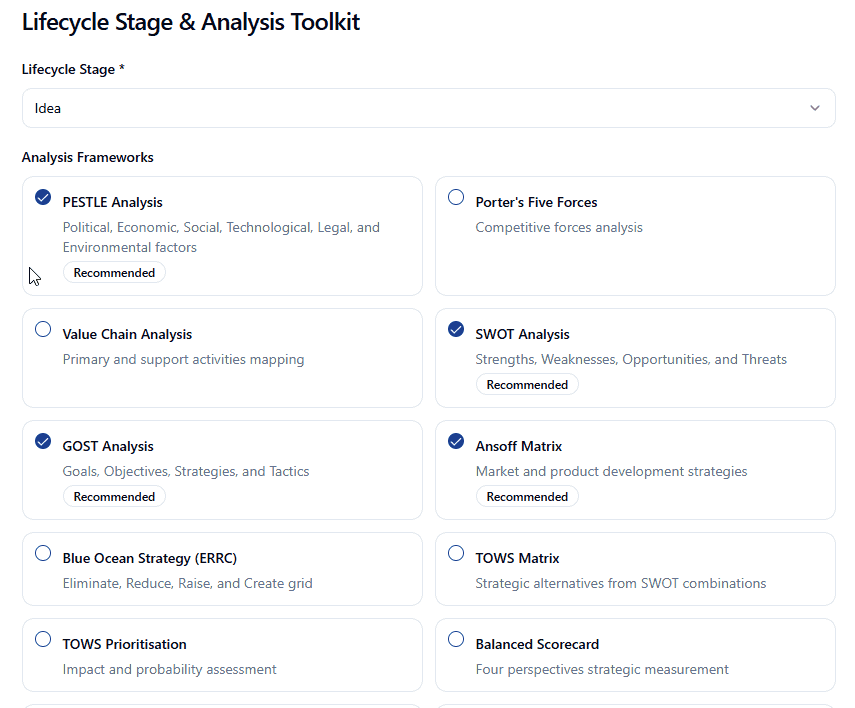
The Strategic Analysis Toolkit is an integrated, end-to-end strategic operating platform designed for business leaders, consultants, and owners. It streamlines strategic planning by organizing industry-standard frameworks (like PESTLE, SWOT, and Porter’s Five Forces) into four actionable, interconnected phases.
What Is the Strategy Maze, and How Does the Strategic Analysis Toolkit Guide You?
The journey of developing and executing a successful business strategy is often compared to navigating a complex maze. Modern market dynamics, characterized by rapid technological change, volatile economic conditions, and evolving customer expectations, make this maze more intricate than ever. For many business leaders, consultants, or even small business owners, starting a significant strategic project brings a unique sense of dread:
- Analysis Paralysis: Where do you begin when dozens of frameworks exist?
- Fragmentation Risk: How do you ensure that the insights from market analysis (external) connect with capability assessment (internal)?
- Execution Gap: How do you translate high-level goals into measurable, tactical steps that your teams can actually implement?
This gap between strategic planning and successful execution is where most organizations falter.
There is a powerful solution that brings clarity, structure, and seamless integration to this challenge: The Strategic Analysis Toolkit.
This platform is not a digital repository of strategic templates; it is an integrated, comprehensive strategic operating system. It has been engineered to guide you through the entire strategic lifecycle, moving you from initial environmental discovery and foundational analysis to measurable implementation and continuous improvement.
This post will dissect the toolkit’s core value proposition, its commitment to structured, comprehensive analysis, and examine the essential features embedded in its four logical phases. By the end, you will understand why this toolkit is becoming an indispensable resource for achieving strategic mastery in any competitive landscape.
| Platform Feature / Lifecycle Phase | Included Frameworks & Capabilities | Practical Business Benefit (The “Why”) |
| Phase 1: Discovery & Foundation | PESTLE, Porter’s Five Forces, Value Chain Analysis | Eliminates blind spots by identifying macro-environmental risks, competitive threats, and internal process bottlenecks before planning begins. |
| Phase 2: Strategic Analysis | SWOT, GOST, Ansoff Matrix, Blue Ocean Strategy | Defines the competitive path by directly converting raw diagnostic data into actionable growth strategies and aligned organizational goals. |
| Phase 3: Implementation Planning | TOWS, Balanced Scorecard | Bridges the execution gap by translating abstract corporate strategy into measurable metrics, clear ownership, and daily team tasks. |
| Phase 4: Change & Improvement | Kotter Model, PDCA Model, What-if Scenario | Sustains long-term momentum by actively managing team adoption, tracking milestones, and adapting the strategy to market shifts. |
What Are the Core Benefits of an End-to-End Strategic Lifecycle?
The single most transformative advantage of the Strategic Analysis Toolkit is its ability to turn the art of complex strategy into a structured, reliable, and repeatable process. It addresses the common pitfall of relying on isolated or disconnected analyses.
How Does Phased Organization Eliminate Guesswork in Business Planning?
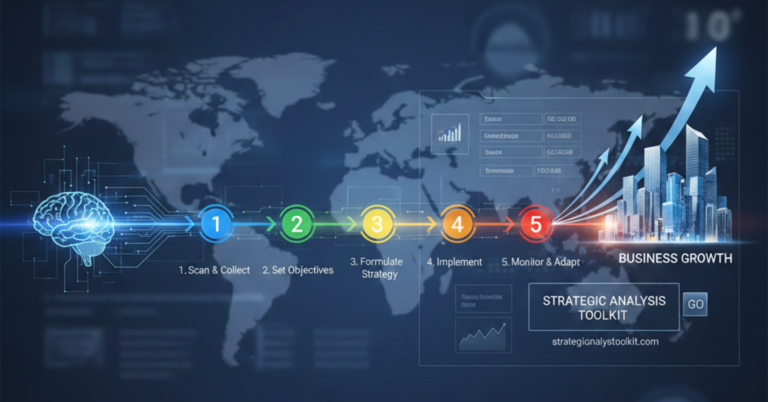
Instead of requiring users to piece together various strategic models, the platform organizes all its tools into four interconnected phases:
- Discovery and Foundation: Understanding the playing field.
- Strategic Analysis: Defining the unique competitive path.
- Implementation Planning: Turning intentions into action.
- Change and Improvement: Ensuring long-term resilience and growth.
This phased architecture eliminates the common problem of analysis paralysis. Users know exactly which tool to engage based on where they are in the strategic journey, ensuring a complete and systematic assessment every time.
How Does the Toolkit Transition Business Strategy From Theory to Action?
The toolkit provides a crucial bridge that is often missing in traditional strategic planning: the flow from diagnostic insights to actionable execution. For example, external threats identified in a PESTLE analysis are fed into the Opportunities and Threats section of the SWOT, which then dictates the defensive strategies generated in the TOWS Matrix, which in turn influences the metrics tracked in the Balanced Scorecard.
This systematic data transfer means that the toolkit is not static; it is dynamic and iterative. It guarantees that the diagnostic insights you gain are not left dormant but are immediately translated into measurable, tactical steps.
Why Should You Use a Curated Collection of Proven Strategic Frameworks?
The toolkit saves countless hours of research and validation by compiling only the most respected, industry-standard strategic models. Users can be confident that their strategy is grounded in battle-tested methodologies compiled in one cohesive, intuitive location. This unified approach provides confidence, reduces the risk of methodological error, and ensures consistency across large teams or organizations.
Phase 1: Discovery and Foundation (Scanning the Environment)
Before a winning strategy can be defined, the operating environment must be understood. This foundational phase helps users lay the groundwork by examining the macro-environmental forces and internal resource allocation impacting the business.
How Does PESTLE Analysis Provide a Wide-Angle Macro Scan?
The PESTLE analysis is the bedrock of external environment scanning. It forces strategists to look beyond immediate competitors and consider broader forces shaping the market and creating long-term risks or opportunities.
- Political stability, tax policy, and regulation
- Economic growth rates, interest rates, and inflation
- Social trends, demographics, and cultural shifts
- Technological advancements, automation, and R&D investment
- Legal frameworks, consumer protection, and labor laws
- Environmental concerns, sustainability, and climate change policy
By identifying these factors, the strategist can predict future market shifts, which is essential for proactive decision-making.
How Do Porter’s Five Forces Deconstruct Industry Competitive Intensity?
Developed by Michael Porter, Porter’s Five Forces moves from the macro-environment to the micro-environment, focusing on industry structure. It helps a firm determine the attractiveness and potential profitability of its industry by analyzing the forces that dictate competitive rivalry:
- The threat of new entrants.
- The bargaining power of suppliers.
- The bargaining power of buyers.
- The threat of substitute products or services.
- Competitive rivalry among existing firms.
A low score across all five areas indicates an attractive industry, e.g., high barriers to entry and low buyer power, allowing the firm to set prices and earn high returns.
How Does Value Chain Analysis Optimize Internal Business Processes?
The Value Chain Analysis focuses on internal activities. It views the business as a series of activities that create value for customers. By mapping these primary activities (like operations, logistics, and marketing) and support activities (like HR and procurement), the firm can:
- Identify where the most customer value is generated
- Pinpoint areas where costs can be reduced without sacrificing quality (efficiency improvement)
- Determine the unique competencies that serve as sources of sustainable competitive advantage
Phase 2: Strategic Analysis (Defining the Competitive Path)
With a rich dataset derived from the foundational phase, the focus shifts to synthesizing this information to define a clear, defensible strategic path.
How Does a SWOT Analysis Pivot Your Strategy From Insights to Actions?
The SWOT framework remains the most crucial synthesis tool. It takes the external factors (from PESTLE and Porter) and classifies them as Opportunities and Threats, while using the internal analysis (Value Chain) to define internal Strengths and Weaknesses.
The power of the SWOT is its ability to distil vast amounts of data into four core areas, serving as the central pivot point for all future decision-making.
How Do You Achieve Organizational Alignment Using the GOST Framework?
The GOST framework ensures that all levels of the organization are pulling in the same direction, a critical step to avoid misaligned resource deployment. It provides a hierarchical alignment:
- Goals: The broad, long-term aspirations, e.g., become the market leader in Europe
- Objectives: Specific, measurable targets that contribute to the Goal, e.g., increase European market share to 20% by Q4 2026
- Strategies: High-level plans for achieving the Objectives, e.g., focus on digital marketing and channel partnerships
- Tactics: Specific, daily actions taken by teams, e.g., launch new affiliate campaign this month
How Do the Ansoff Matrix and Blue Ocean Strategy Drive Market Growth?
Ansoff Matrix and Blue Ocean Strategy are tools for outward-thinking growth.
- Ansoff Matrix: Helps management explore potential growth avenues based on products and markets:
- Market Penetration (Existing Product, Existing Market)
- Product Development (New Product, Existing Market)
- Market Development (Existing Product, New Market)
- Diversification (New Product, New Market – the highest risk)
- Blue Ocean Strategy: Challenges the firm to escape “Red Oceans” (where competition is fierce and profit margins are low) and seek “Blue Oceans”; untapped market space where competition is irrelevant. This often involves lowering costs while increasing the utility for the buyer
Phase 3 and 4: Implementation and Improvement (Driving Results)
Analysis is only half the battle. The final phases ensure that strategic thinking is transformed into measurable, executed action and that the organization maintains a rhythm of continuous performance enhancement.
Which Implementation Planning Tools Bridge the Strategy-to-Execution Gap?
- TOWS Matrix & Prioritisation: This is the execution engine derived from the SWOT. It forces the generation of actionable strategies:
- SO (Strengths/Opportunities): Leverage strengths to capitalize on opportunities (Offensive)
- ST (Strengths/Threats): Use strengths to counter or avoid threats (Defensive)
- WO (Weaknesses/Opportunities): Overcome weaknesses by exploiting opportunities (Adaptive)
- WT (Weaknesses/Threats): Minimize weaknesses and avoid threats (Survival). The toolkit helps prioritize these options based on resource, impact, and timeline
- Balanced Scorecard (BSC): BSC is essential for measuring what matters. It moves beyond financial metrics to ensure a holistic view of performance across four key perspectives:
- Financial: Are we creating shareholder value?
- Customer: How are we meeting customer needs?
- Internal Process: Are we executing our operations effectively?
- Learning & Growth: Are we innovating and improving our talent and technology? The BSC links operational activities to high-level strategy
How Do Change and Improvement Tools Sustain Business Momentum?
- Kotter’s 8 Step Plan for Change: Strategy often requires significant organizational shifts. Kotter’s plan provides a disciplined, human-centric model for managing change, starting with establishing a sense of urgency and culminating in anchoring the new approaches in the corporate culture
- PDCA Cycle (Plan-Do-Check-Act): This is the ultimate tool for continuous improvement. It establishes a necessary feedback loop:
- Plan: Establish objectives and processes necessary to deliver results
- Do: Implement the plan
- Check: Monitor and measure the processes and results against objectives
- Act: Take corrective action to improve processes. This ensures that the strategy is not static but evolves based on real-world performance data
- Executive Summary and What-if Scenarios: The ability to generate a clear, concise Executive Summary allows the strategy to be communicated to leadership and stakeholders. Furthermore, the inclusion of What-if Scenarios is a crucial risk-management feature, allowing strategists to model how key variables (e.g., a 10% recession, a new competitor) would affect the projected outcome and test the plan’s resilience before implementation
Frequently Asked Questions
Is the Strategic Analysis Toolkit Just a Repository of Digital Templates?
No, it is not a static digital repository of strategic templates. The platform functions as an integrated, comprehensive strategic operating system that connects your data seamlessly. Diagnostic insights from environmental scans automatically flow into other frameworks, such as translating threat data into action steps within the TOWS matrix.
Who Is the Strategic Analysis Toolkit Designed For?
The toolkit is engineered specifically for business leaders, consultants, and small business owners who are launching or managing significant strategic projects. It is built to serve anyone looking to move efficiently from initial market discovery to measurable execution and continuous growth.
How Does the Platform Help Eliminate Analysis Paralysis?
The platform eliminates guesswork by organizing all of its industry-standard strategic models into a structured, four-phase architecture: Discovery and Foundation, Strategic Analysis, Implementation Planning, and Change and Improvement. This clear workflow ensures that you always know exactly which tool to engage based on your current stage in the strategic lifecycle.
What Business Frameworks Are Included in the Toolkit?
The platform compiles a curated collection of highly respected, battle-tested strategic models. It includes foundational diagnostic frameworks like PESTLE, Porter’s Five Forces, and Value Chain Analysis, alongside strategic alignment and growth models like SWOT, GOST, the Ansoff Matrix, and Blue Ocean Strategy.
How Does the Toolkit Bridge the Gap Between Strategy and Execution?
Traditional planning often suffers from an execution gap where high-level goals fail to become daily actions. The toolkit solves this by establishing a direct pipeline from core diagnostic insights to implementation planning tools. For example, insights flow continuously into tactical action steps and tracking metrics like the Balanced Scorecard, converting theory into measurable results.
Why Is This Platform the Strategic Operating System Your Business Needs?
The Strategic Analysis Toolkit is more than a software utility; it is the strategic operating system that empowers professionals to navigate the complexities of modern business with unparalleled clarity and confidence. It delivers a structured, end-to-end process that turns intimidating complexity into manageable, sequential tasks.
By integrating proven frameworks and enforcing a logical flow of analysis, the toolkit allows organizations to:
- Save time previously wasted on tool selection and formatting
- Reduce errors from disconnected data and subjective analysis
- Ensure deep alignment across all teams and executive leadership
If your strategy is currently disjointed, stalled, or failing to translate into results, it’s time to upgrade your approach. The Strategic Analysis Toolkit gives you the power to define, execute, and refine your competitive advantage.
Your strategic mastery begins now. Take the next step towards structured success.