
What is Strategic Data Portability?
Strategic data portability refers to the seamless movement of analytical data across strategic business frameworks, e.g., passing PESTLE macro insights into SWOT, TOWS, and Balanced Scorecards, within a unified platform, eliminating manual re-entry and operational silos.
The greatest threat to a successful pivot isn’t a lack of ideas; it’s the friction of moving those ideas from paper to practice. We’ve all seen it: one department performs a brilliant PESTLE analysis, while the marketing team builds a Blue Ocean Strategy in a complete vacuum.
When data is trapped in disconnected spreadsheets or static slide decks, collaboration becomes a buzzword rather than a reality. To win in today’s market, your strategic insights must be portable and flow seamlessly from discovery to implementation. This is exactly why we built the Strategic Analysis Toolkit.
How Does Data Portability Build a Shared Foundation?
Strategic collaboration begins with a shared understanding of the battlefield. By using the toolkit to conduct a PESTLE analysis and Porter’s Five Forces analysis, teams can collectively identify external macro-pressures and industry-specific threats.
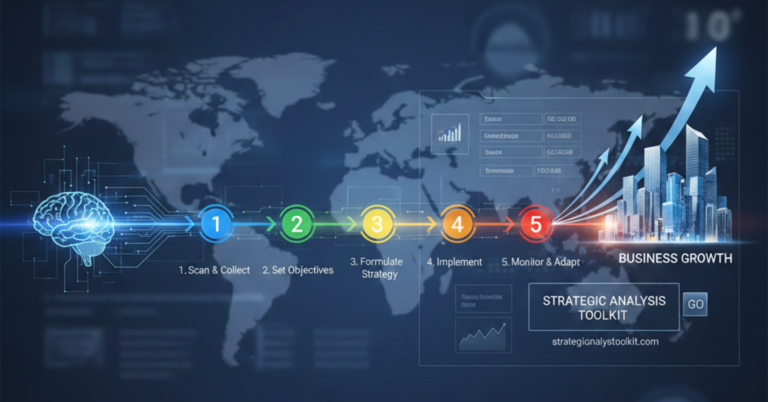
The portability factor is crucial. When your Value Chain Analysis is in the same ecosystem as your external research, you can instantly see where internal operations are vulnerable to external shifts. Instead of re-entering data, the Strategic Analysis Toolkit lets you maintain a continuous thread of logic from the start of your discovery phase.
How Do Teams Move From Strategic Synthesis to Bold Ambitions?
The bridge between where we are and where we want to be is often where strategy goes to die. Most teams struggle to turn a SWOT analysis into a concrete plan. On our platform, your SWOT isn’t just a list; it is the fuel for your GOST (Goals, Objectives, Strategies, Tactics) framework.
When you can directly port the strengths and weaknesses identified in your initial discovery into an Ansoff Matrix or a Blue Ocean Strategy session, you eliminate the strategy gap. You stop guessing and start building on a foundation of verified data. This seamless transition ensures that your pursuit of Blue Oceans is anchored in the reality of your current capabilities.
How Can Strategic Insights Be Turned into Execution?
Execution is the ultimate test of any strategy. Many organizations fail here because they cannot translate high-level theory into day-to-day tasks. This is where the TOWS Matrix and TOWS Prioritization become game-changers.
By porting your SWOT data directly into a TOWS framework within the toolkit, you can immediately identify SO (Strengths-Opportunities) strategies your team can execute. This data then flows into your Balanced Scorecard, ensuring your KPIs are directly aligned with your strategic priorities. This integration ensures that every stakeholder, from the CEO to the project manager, understands exactly how their work contributes to the grand design.
How Do Organizations Manage Change and Continuous Improvement?
Strategy is not a one-and-done event; it is a living cycle. To maintain a competitive edge, you must be able to adapt. The Strategic Analysis Toolkit supports this through the PDCA Cycle (Plan-Do-Check-Act) and Kotter’s 8-Step Plan for leading change.
With seamless data portability, generating an Executive Summary or running What-if Scenarios takes minutes, not days. You can model how a market shift (identified in your PESTLE) might affect your Balanced Scorecard, enabling your team to collaborate on solutions before the crisis even hits.
What Is the Strategic Advantage of Frictionless Collaboration Tools?
The modern consultant or executive doesn’t have time to bridge the gap between disparate tools. You need a single, cohesive environment where data moves as fast as your ideas.
The Strategic Analysis Toolkit was designed to be that environment. By integrating every essential framework, from Porter’s Five Forces to Kotter’s 8 Steps, into a single, portable, collaborative platform, we empower you to spend less time formatting and more time leading.
Are you ready to stop managing files and start leading strategy?
Get Started with the Strategic Analysis Toolkit Today.
Frequently Asked Questions
What Is Strategic Data Portability?
Strategic data portability is the seamless movement of analytical data across interconnected strategic planning frameworks (such as passing PESTLE macro insights into SWOT, TOWS, and Balanced Scorecards) within a single unified platform. It eliminates manual data re-entry, prevents information silos, and keeps operational workflows aligned with overarching strategic goals.
How Do Teams Move From Strategic Synthesis to Bold Ambitions?
Teams bridge the gap between analysis and planning by carrying strengths and weaknesses identified in initial SWOT assessments directly into growth frameworks like the Ansoff Matrix, Blue Ocean Strategy, or GOST (Goals, Objectives, Strategies, Tactics). This automated flow ensures that ambitious expansion targets remain grounded in validated, real-time organizational data.
How Can Strategic Insights Be Turned into Execution?
Strategic insights are converted into action by mapping SWOT findings into TOWS Matrix prioritization models to generate immediate action items (e.g., Strengths-Opportunities strategies). Porting these outputs directly into a Balanced Scorecard ensures operational key performance indicators (KPIs) remain continuously aligned with top-level strategic priorities.
How Do Organizations Manage Change and Continuous Improvement?
Organizations maintain agility by embedding portable data into adaptive cycles like the PDCA (Plan-Do-Check-Act) Cycle and Kotter’s 8-Step Plan. Because analytical data moves dynamically, leaders can run what-if scenarios and generate executive reports in minutes, adjusting strategies proactively before market shifts become critical disruptions.
What Is the Strategic Advantage of Frictionless Collaboration Tools?
Frictionless collaboration platforms give leaders and consultants a centralized environment where strategic insights move as fast as business decisions are made. By unifying disparate management frameworks into a single portable platform, teams spend less time formatting documents and re-keying data, allowing them to focus on aligned execution and strategic leadership.