How Is AI Disrupting the Legacy Business Strategy Consulting Model?
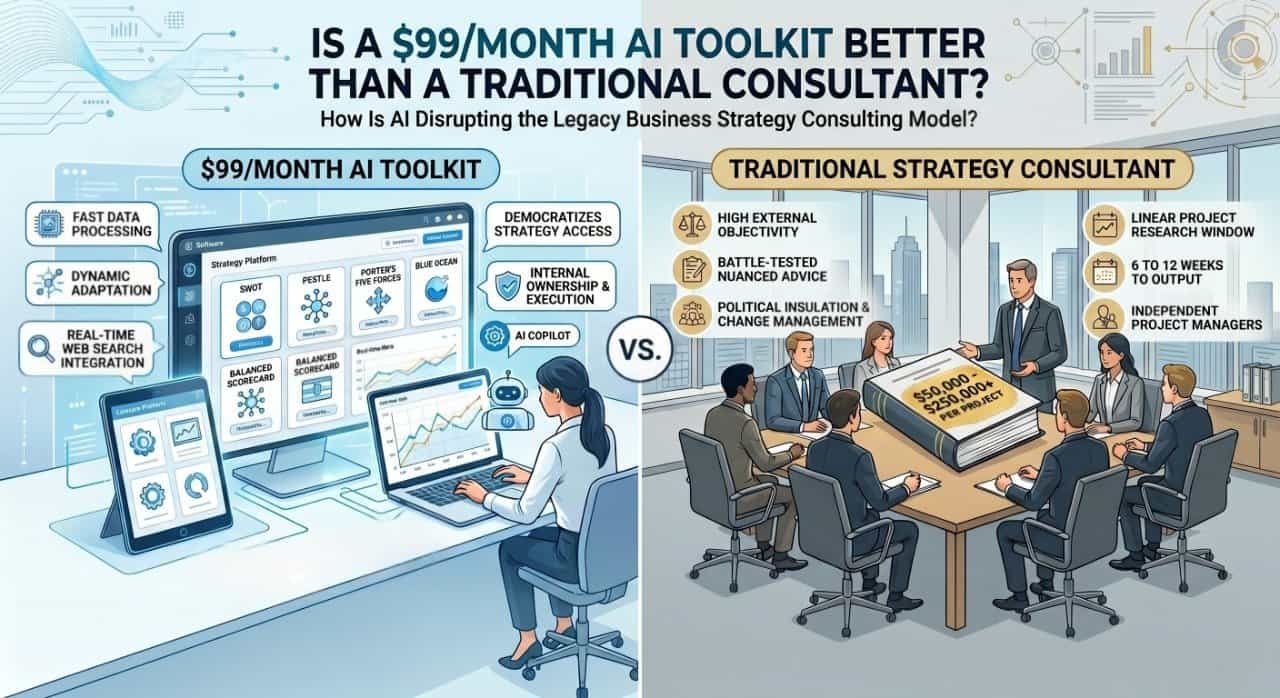
For decades, the playbook for enterprise-grade business strategy was predictable. When growth stalled, a new market beckoned, or competitive pressures mounted, executives did one thing: they hired a business strategy consultancy. A team of junior analysts and a senior partner would arrive, spend six to twelve weeks interviewing your staff, run your data through classic frameworks, and present a sleek slide deck and an invoice ranging from $50,000 to north of $250,000.
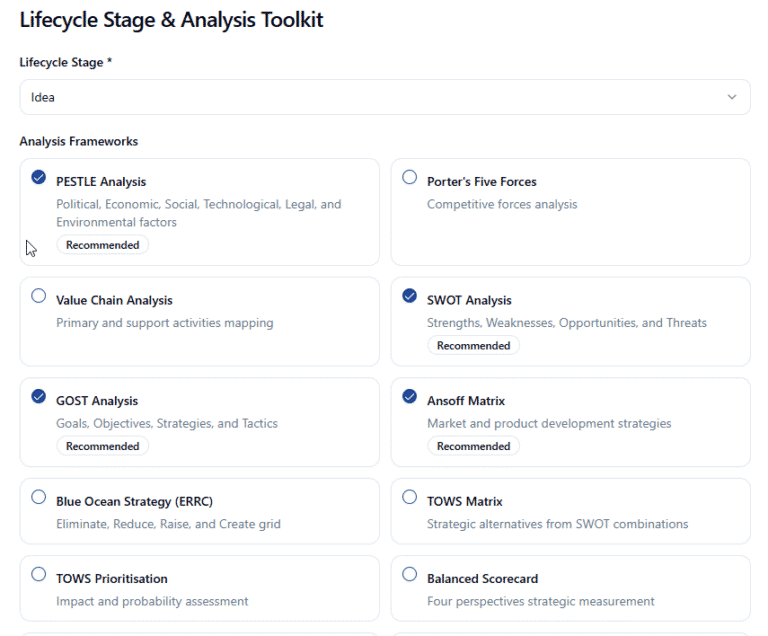
Today, platforms like StrategicAnalysisToolkit (SAT) are challenging this status quo. For $99 per month, these AI-driven platforms promise to guide users through sequential strategic frameworks, from PESTLE and Porter’s Five Forces to Blue Ocean strategy and Balanced Scorecards, compressing months of research into hours.
Can a subscription-based software platform truly replace the nuanced, battle-tested advice of a human consultancy?
To choose the right path, you must understand the economics, depth, and operational trade-offs of both options.
Key Takeaways
- Software Dematerializes Strategy Costs: a digital toolkit shifts corporate planning from a six-figure premium asset down to an operational utility. While consulting engagements cost up to a quarter-million dollars, an automated platform opens access to identical frameworks for just over eleven hundred dollars annually
- AI Offers Speed and Dynamic Adaptation: traditional consulting deliveries require two to three months of research, making the final presentation a snapshot of the past. Software processes market signals instantly, allowing leadership teams to rewrite strategic models in real time as conditions shift
- Internal Ownership Dictates Success: consultants act as independent project managers who manually gather data and moderate internal alignment. A software approach saves significant capital but demands higher internal labor, requiring a dedicated corporate champion to input data, validate insights, and drive execution.
How Do Cost, Speed, and Data Sourcing Directly Compare Across Both Models?
What Are the Results of an AI vs Consultant Head-To-Head Comparison?
| Feature | StrategicAnalysisToolkit.com | Traditional Strategy Consultancy |
|---|---|---|
| Financial Cost | $99 per month, $990 per year | $50,000 to $250,000+ per project |
| Time to Output | Hours to days | 6 to 12 weeks |
| Primary Driver | Internal team + AI orchestration | External team of dedicated analysts |
| Data Recency | Real-time web search integration | Bound to the project research window |
| Objectivity | High structural consistency; removes human bias | High external objectivity; vulnerable to corporate “groupthink” |
| Implementation | Self-guided change management frameworks | Varies; usually requires a separate execution contract |
Can $99 Deliver Genuine Enterprise-Level Value to SMEs and Corporations?
The starkest differentiator is cost. At $99 per month, an entire year of strategic planning on a platform like SAT costs less than a single billable hour from a senior partner at a top-tier consulting firm.
- For Startups and SMEs: The traditional consulting model is entirely out of reach. A software platform democratizes enterprise-level frameworks like TOWS matrices or Kotter’s 8-Step Change Plan giving smaller teams a structured methodology they otherwise could not afford
- For Mid-Market and Enterprise Teams: The software shifts strategy from a rare, high-stakes annual event to a continuous operational habit. Instead of spending six figures to test a single hypothesis, an internal team can run multiple What-If scenarios dynamically as market conditions shift
Why Does Real-Time Web Integration Outperform Traditional Linear Project Research?
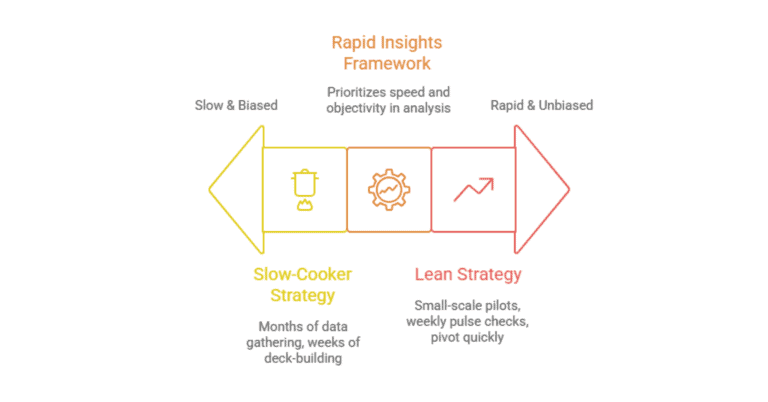
Traditional consultancies operate on a linear timeline: discovery, data gathering, synthesis, and final presentation. By the time a deck is delivered on week ten, the macroeconomic indicators captured during week two may already be outdated.
Platforms like SAT leverage real-time web search integration. When generating an external PESTLE or Porter’s Five Forces analysis, the underlying AI pulls current data from authoritative industry publications and statistical agencies.
Furthermore, software introduces downstream recalculation. If an unexpected threat emerges, you can alter a single variable in your SWOT analysis, and an AI-driven system can instantly project the ripple effects through your downstream frameworks, adjusting your Balanced Scorecard and implementation roadmaps automatically. With a traditional firm, rewriting the strategy mid-stream means extending the engagement and increasing the budget.
What Unique Organizational Value Do Human Consultants Provide That Software Cannot Replicate?
If software is cheaper, faster, and more dynamic, why do traditional consultancies still thrive? It comes down to where the labor and expertise sit.
The Human Premium: An AI platform is an exceptional copilot, but it is not an infallible expert. It requires high-quality inputs from your team. If your internal data is flawed or your strategic intent is vague, the software will simply generate highly structured, articulate mediocrity.
- Consultants provide political insulation and change management. Often, companies hire external consultants not because they lack internal data, but because they need an objective, authoritative third party to break internal deadlocks, deliver hard truths to a board, or rally siloed departments around a unified goal
- Software requires dedicated internal ownership. Using a tool like SAT means your internal leadership team must drive the process. You save $100,000, but you pay in internal focus, intellectual energy, and time
Which Model Aligns Best With Your Specific Organizational Budget, Talent Bandwidth, and Strategic Goals?
Under What Operational Conditions Should a Business Opt for a Self-Guided Digital Toolkit?
- You are an agile mid-market company, startup, or independent consultant who already understands your operational reality but lacks a structured framework to organize and pitch your strategy
- You want to run continuous, iterative planning sessions rather than a one-off annual review
- You have an internal champion (a COO, VP of Strategy, or founder) with the bandwidth to validate, edit, and own the AI-generated outputs
When Is a Six-Figure Investment in an External Human Consultancy Strictly Necessary?
- You are navigating a highly complex, multi-billion dollar corporate restructuring or M&A transaction where personal accountability and a “board-certified” external stamp of approval are legally or politically mandatory
- Your internal team is entirely maxed out operationally, and you require external “boots on the ground” to manually extract data from legacy corporate systems
Ultimately, the choice is no longer binary. Many modern strategy practices and corporate teams are blending both worlds: utilizing $99/month toolkits to automate the heavy lifting of framework generation, market research, and document formatting, while reserving human capital for what humans do best: nuanced validation, relationship building, and high-stakes decision-making.
Frequently Asked Questions
What strategic frameworks can an automated toolkit generate?
The platform guides teams through standard enterprise methodologies including PESTLE, Porter’s Five Forces, Blue Ocean Strategy, SWOT analyses, and Balanced Scorecards.
Is my internal corporate data safe using an online platform?
Security depends on individual provider terms, but most enterprise software platforms deploy private data silos that shield proprietary inputs from public model training.
Can an app completely replace human consulting teams?
No. Software manages data orchestration, drafting, and structure, but it lacks the human authority required to arbitrate political gridlock or convince a board of directors.
Who should manage the platform inside an organization?
The platform yields the best results when driven by internal leaders who understand corporate operations, such as a Chief Operating Officer, VP of Strategy, or Founder.
How does software stay accurate compared to a research team?
Automated toolkits utilize real-time web search integration to pull macroeconomic trends and market indicators directly from authoritative financial and industry sources.