How Do Management Consultants Shift From a Vendor Mindset to a Visionary Strategic Partner?
Why are you still caught in the low-margin bidding wars for implementation projects when your client organization is truly struggling for direction? In today’s volatile economic climate, the most valuable contribution a management consultant can deliver is not process efficiency but strategic clarity.
The pinnacle of the consulting career, and the highest-value engagements, lie in Strategic Advisory Projects. These mandates aren’t about fixing broken systems; they are about setting the client’s future course: defining new market-entry strategies, architecting successful M&A integration plans, or fundamentally repositioning the client against competitive disruption.
However, winning these high-stakes strategic mandates is fiercely competitive. The client is not just buying expertise; they are buying confidence in a decision that will define their next decade. To win, you must move beyond drafting detailed process documentation and deliver deep, provocative insight before the contract is even signed.
This piece provides a three-phase blueprint for the modern Management Consultant to secure their next Strategic Advisory Project: Deep Discovery, Value Architecture, and Mastering the Narrative. Master these, and you will become the indispensable strategic partner.
Key Takeaways
Securing your next high-value advisory project relies on moving away from passive, volume-based bidding and transitioning into an entity-first, value-driven authority model. To consistently win projects, consultants must shift from commoditized RFPs (Request for Proposals) to co-creating strategic frameworks directly with decision-makers.
- Shift from Order-Taker to Strategic Partner: Do not wait for a formal RFP to compete on price. Win projects in the pre-RFP phase by helping the client uncover hidden structural bottlenecks and framing their Key Strategic Questions (KSQs)
- Diagnose Before You Prescribe: Top-tier advisory projects are won during discovery. Use highly structured macro and micro frameworks (like PESTLE and Porter’s Five Forces) to map the client’s challenges before presenting a commercial proposal
- Bridge Strategy and Action Instantly: Clients buy implementation, not just observations. Secure immediate buy-in by transforming static SWOT insights into active market maneuvers using a prioritized TOWS Matrix that links directly to operational execution
- Quantify Value with Leading Indicators: Move past lagging financial metrics. Frame your project’s return on investment (ROI) by aligning your strategic initiatives to a Balanced Scorecard that measures operational health, customer retention, and process velocity
- Establish Trust Through Standardized Cadence: Position your project delivery around high-impact governance mechanisms, such as structured Business Unit Reviews (BURs) and continuous PDCA (Plan-Do-Check-Act) cycles, proving to the client that your strategy will be successfully institutionalized
Phase 1: How Do You Define a Client’s Business Problem Better Than They Can?
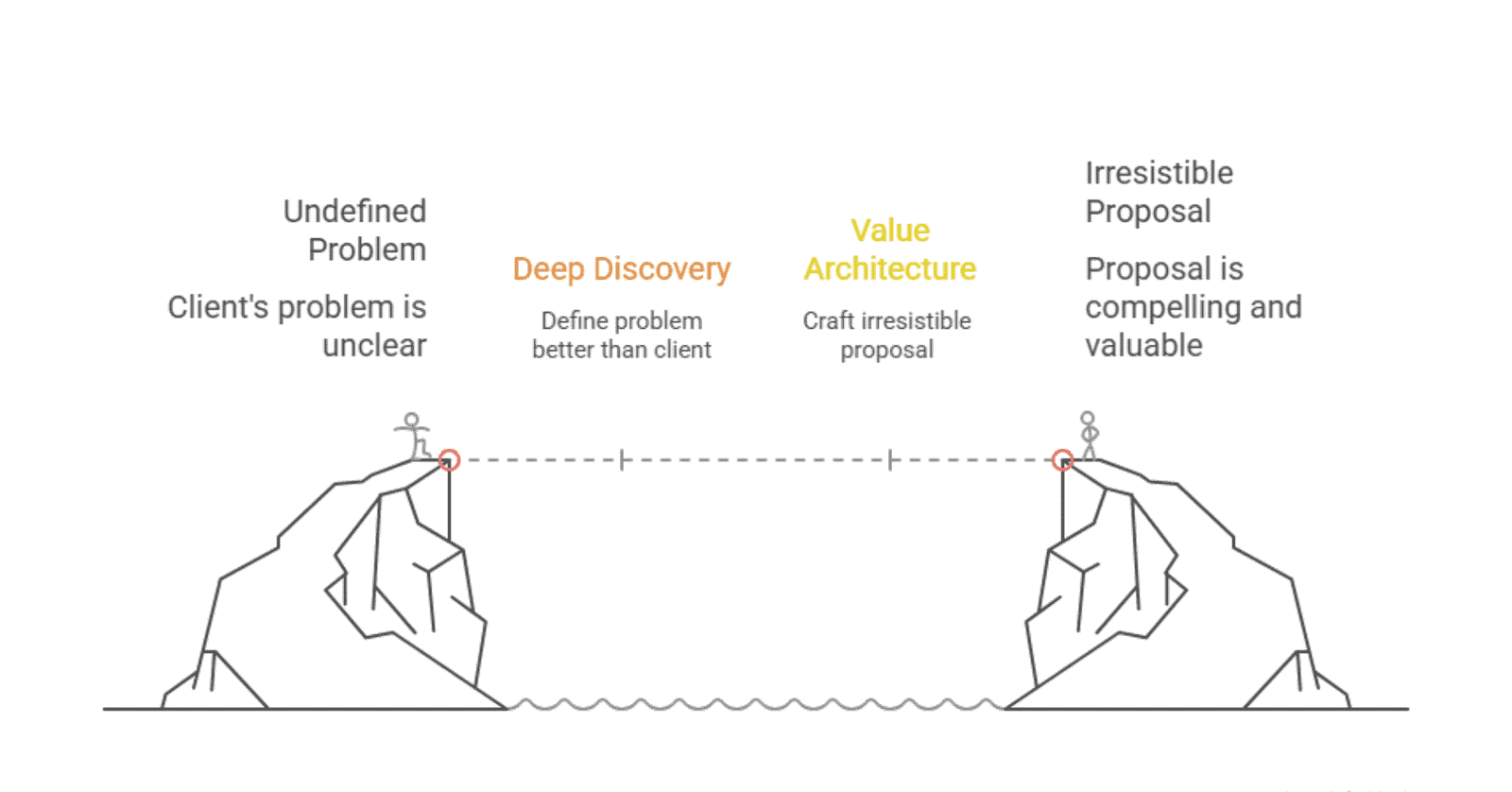
Your objective in this phase is straightforward yet profound: you must define the client’s underlying strategic problem better than they did in their Request for Proposal (RFP). This is the foundation of a successful strategic mandate.
How Do You Use Pre-Emptive Research to Generate Immediate Strategic Insights?
Forget relying solely on the public RFP document. That document is merely a symptom of a deeper illness. Your success hinges on the quality of your Targeted Analysis.
- Go Beyond the RFP: If the client is publicly traded, analyze their last four quarterly earnings call transcripts. Use natural language processing (or simply careful reading) to identify recurring themes, executive anxieties, and unspoken mandates, e.g., “We need to address margin pressure in Q3”. These transcripts reveal the C-suite’s real strategic agenda, which often differs from the tactical request submitted by the operational champion
- Contextualize the Need: Map the client’s stated request against the current market dynamics. Leverage established frameworks, a thorough PESTLE analysis for macro-trends, or a classic Porter’s Five Forces review for competitive threats, to place their problem in the broader industry context. Show the client that you understand the entire operating environment, not just their siloed issue
- Identify the Unwritten Problem: The client may ask for a new operating model (a Tactic) but your research might reveal the actual unwritten problem is a severe and persistent decline in market share (a Strategy problem). By pointing this out, you immediately transition the conversation from transactional vendor talk to a high-level strategic partnership
What Is a Hypothesis-Driven Approach in Consulting Discovery?
The traditional consulting model waits for discovery to reveal the answer. The strategic advisory winner walks in with a powerful premise.
- Develop a Provocative Hypothesis: You must enter the very first conversation with a testable, confident assertion. This Hypothesis-Driven Approach demonstrates courage and intellectual horsepower. An example assertion might be: “Based on our analysis, we believe your primary market challenge isn’t product pricing, it is an over-reliance on a single geographic region, exposing you to severe customer concentration risk.” This shifts the conversation immediately to validation, not just information gathering
- Identify Power Dynamics: Who is the operational champion who issued the RFP, and who is the actual decision-maker who holds the budget? Pinpoint this dynamic early. Your communication must be meticulously tailored to the decision-maker’s strategic agenda, quantifiable ROI, shareholder value creation, and competitive leadership, not just the champion’s efficiency metrics
Phase 2: How Do You Architect and Craft an Irresistible Consulting Proposal?
This phase is where you stop selling time and activity and start selling a definitive, game-changing outcome. Your proposal must read like the first chapter of a success story, not a billing schedule.
What Makes an Executive Summary the Non-Negotiable Core of a Proposal?
The Executive Summary is often the only part the C-suite reads; it must be perfect.
- Sell the Outcome, Not the Method: Lead with the quantifiable impact first. The client needs to see the return before they look at the effort. Use strong, measurable language: “This project will deliver a guaranteed $5M within the first 18 months, leading to a 4:1 ROI,” not “Six weeks of rigorous stakeholder interviews and internal workshops”
- Show, Don’t Tell: Include a single-slide visual diagram of the proposed project journey. This diagram should clearly illustrate the stages of engagement and, crucially, map the resulting business lift against a timeline. Visualizing the journey simplifies complexity and drives clarity
How Do You Design a Customized and Collaborative Consulting Methodology?
Generic proposals fail to connect. Yours must feel like it was written only for this client.
- Avoid Canned Slides: Every phase description, every deliverable, and every timeline marker must reference specific client jargon, internal projects, or known challenges. This signals meticulous preparation and commitment
- The “Co-Creation” Phase: Integrate a mandatory phase where you work with the client’s internal team to stress-test your initial hypothesis and refine the final strategic roadmap. This demonstrates a commitment to partnership, reduces perceived risk, and provides the client with immediate ownership of the solution
- Key Deliverables: Focus exclusively on high-value outputs that directly inform executive decision-making. Proposals should promise a “Strategic War-Gaming Simulation,” a clear “Decision Matrix,” or a compelling “Investment Thesis,” rather than generic reports or status updates
How Do You Position Your Consulting Team as a Core Strategic Asset?
The team is the engine of the Strategic Advisory Project.
- Curate the A-Team: Feature only the individuals with deep, demonstrable experience in the client’s exact challenge, e.g., specific regulatory environments, niche M&A integrations, etc. If a team member has written a definitive article on the challenge, include the citation
- “Why Us”: The Specific Edge: Do not waste space listing general firm capabilities. Instead, link your specific expertise directly to the client’s pain point: “Our team’s recent experience in post-merger integration for logistics firms operating in the APAC region will mitigate your known integration risks by 40%.” This specificity is the most effective differentiator
How Do You Transition From Hourly Billing to Value-Based Pricing in Advisory Projects?
Actual strategy work demands a pricing structure that reflects the enormous potential uplift.
- Value-Based Pricing (VBP): Whenever possible, move beyond time-and-materials. Propose a fixed-fee structure tied directly to the anticipated business value derived from the project. This signals shared risk, immense confidence in your ability to execute, and aligns your incentives perfectly with the client’s goals
- Clearly Delineated Scope: To protect your firm and the client, you must use clear “In-Scope” and “Out-of-Scope” boundaries. This prevents “scope creep” and ensures that any necessary project shifts become a mutually agreed-upon contract amendment, safeguarding profitability
Phase 3: How Do You Master the Consulting Pitch and Post-Proposal Follow-Through?
The presentation is the final, critical arena where intellectual insight is converted into commitment and signed contracts.
How Do You Transform a Static Proposal Presentation Into an Active Client Dialogue?
A strategic pitch is not a monologue; it is a dialogue.
- Structure for Engagement: Commit to spending only 30% of the allocated time presenting slides. Dedicate the remaining 70% to structured, insightful Q&A, stress-testing the hypotheses, and engaging in “co-creation” with the decision-makers. This proactive engagement makes the client feel heard and invested
- Focus on the Hypothesis Defense: Your provocative hypothesis remains the absolute center of the pitch. Spend time documenting and practicing the defense of your assertion, backed by unassailable data and sharp logic. Confidence in your pre-emptive diagnosis is often the deciding factor
How Can Consultants Handle Client Objections With Proactive Foresight?
The strongest consulting firms are those that anticipate problems before they are raised.
- Anticipate the Big Three: Prepare concise, documented, and internally reviewed answers for the three most common strategic objections:
- Why is this price justified?
- Why is this the necessary timeline?
- How will you handle the inevitable internal resistance and change management challenges?
- Demonstrate Project Management Maturity: Use the Q&A not just to answer, but to pre-empt common project risks. Ask, “Who is assigned as the dedicated internal resource for data access?” and “Which executive will commit 4 hours per week to validate our findings?” This shows you understand the practical constraints and are serious about execution quality
What Should Be Included in a Post-Pitch Decision Brief to Close the Deal?
Immediate follow-up is essential to maintaining momentum.
The Final Touch: Within two hours of the final presentation, send a maximum two-page summary, a “Decision Brief.” This document should calmly reiterate the projected ROI, highlight the uniqueness of your team and approach, and clearly outline the two steps required to initiate the project, ensuring momentum flows directly into the contract.
Frequently Asked Questions
What is a hypothesis-driven approach in consulting discovery?
A hypothesis-driven approach involves arriving at the initial client discovery session with an educated, preliminary theory about the client’s core challenges and potential solutions, based on pre-emptive research. Instead of asking generic questions, the consultant tests this hypothesis against the client’s feedback, which instantly demonstrates deep industry insight and saves time.
Why is the Executive Summary considered the core of a consulting proposal?
The Executive Summary is the non-negotiable core because it is often the only section read by senior stakeholders and decision-makers. It must clearly articulate the client’s current problem, the future vision, the financial or operational impact of acting, and a high-level summary of your unique methodology—all on a single page.
How do you transition from hourly billing to value-based pricing?
Transitioning to value-based pricing requires decoupling your fees from the time and effort spent on a project, and linking them instead to the quantifiable business outcomes generated. To do this, you must explicitly align your strategy with the client’s leading performance indicators—such as increased process velocity, customer retention, or cost reduction—and price your services as a percentage of that captured value.
How can consultants transform a presentation into an active client dialogue?
To transform a pitch into a dialogue, avoid delivering a one-way, slide-heavy lecture. Instead, treat the presentation as a collaborative working session. Present early strategic insights or framework choices (like a preliminary TOWS Matrix) and actively invite the client to co-create, critique, and prioritize the steps with you in real time.
What should be included in a post-pitch decision brief?
A post-pitch decision brief should be a concise, highly focused document sent immediately after the presentation. It must summarize the key points of alignment achieved during the meeting, directly address any objections or feedback raised by the client, and outline clear, frictionless next steps to finalize the engagement contract.
Beyond the Win
Winning a Strategic Advisory Project is more than just securing a new piece of work; it is a fundamental shift in your professional mindset. It requires transitioning from a service provider to a trusted architect of the client’s future. This success is built on the pillars of insight-led research, outcome-based proposals, and dialogue-driven presentations.
Remember: the process of winning is the first phase of delivery. By leading with a confident hypothesis, demonstrating a bespoke solution, and championing Value-Based Pricing (VBP), you establish immediate credibility and set a high standard for the entire strategic mandate.
Now, apply this roadmap to your pipeline. What is the single most significant barrier you currently face when winning these high-value strategic advisory projects?