
Evaluating strategic alternatives is the systematic process of comparing different business paths against specific success criteria, such as feasibility, suitability, and acceptability, to identify the optimal direction. By analyzing the implications of each choice, organizations can forecast impacts on resources, financial health, and competitive positioning before committing capital.
How Do You Move From Strategic Guessing to Decisive Decision-Making?
In business, gut instinct is a liability. Whether you are a startup founder seeking your first pivot or a C-suite executive managing a global portfolio, the challenge remains the same: Which path actually leads to the summit?
When you evaluate multiple strategic alternatives, you aren’t just looking for a good idea. You are looking for the optimal alignment between your capabilities and the market’s reality. Here is how to use formal frameworks to strip away emotion and find the winning play.
Why Is Strategic Context Essential for Setting a Business Foundation?
Before you can evaluate alternatives, you must understand the terrain. Most strategies fail because they ignore the environment.
- The PESTLE Analysis: This helps you filter alternatives based on macro factors (Political, Economic, Social, Technological, Legal, Environmental). If a strategic alternative relies on a regulatory environment that is about to shift, PESTLE identifies it early
- Porter’s Five Forces: This measures the temperature of your industry. Is the alternative viable if buyer power is at an all-time high?
How Do You Use the Ansoff Matrix to Generate Strategic Alternatives?
To evaluate alternatives, you first need a clean list of options. The Ansoff Matrix is a gold standard for this. It forces you to categorize your options into four quadrants:
- Market Penetration: Selling more of the same to the same customers
- Market Development: Taking current products to new territories
- Product Development: Building something new for your loyal base
- Diversification: The Blue Ocean move, introducing new products to new markets
Tip: Don’t just pick one. Use the Strategic Analysis Toolkit to run the numbers across all four quadrants at once.
How Can You Map Strategic Implications Using a Tows Matrix?
Once you have your alternatives, you need to understand their implications. The TOWS Matrix (the actionable cousin of the SWOT analysis) is your best friend here. It helps you ask:
- SO Strategies: How does this alternative leverage our Strengths to seize this Opportunity?
- WT Strategies: Does this alternative leave us too exposed to our weaknesses and external threats?
By running each alternative through a TOWS filter, you move from I think this will work to This works because it leverages our patented tech against a declining competitor.
What Are What-if Scenarios, and How Do They Stress Test Strategy?
The most dangerous part of a strategy is the implication you didn’t see coming. This is where What-if Scenarios come into play.
What happens to your chosen strategy if interest rates spike? What if a competitor slashes prices by 20%? The Strategic Analysis Toolkit lets you model these variables, giving you a pre-mortem of your strategy. You aren’t just choosing a path; you are choosing the path with the best risk-to-reward ratio.
Frequently Asked Questions
How do you move from strategic guessing to decisive decision-making?
By replacing intuition with structured, data-driven frameworks. Moving away from guesswork requires establishing clear evaluation criteria—such as feasibility, suitability, and financial viability—so every strategic alternative can be objectively scored and defended.
Why is strategic context essential for setting a business foundation?
Strategic context defines the internal realities and external market forces acting on your business. Without this foundational understanding, any alternatives you generate will lack alignment with your actual capabilities, risk tolerance, and market timing.
How do you use the Ansoff Matrix to generate strategic alternatives?
The Ansoff Matrix framework maps out four distinct growth vectors: market penetration, market development, product development, and diversification. By systematically analyzing each quadrant, leadership teams can brainstorm structured alternatives for expanding their core business.
How can you map strategic implications using a TOWS Matrix?
While a SWOT analysis simply identifies factors, a TOWS Matrix actively pairs them together (e.g., matching external opportunities with internal strengths). This allows you to map out real-world implications and formulate tactical strategies to exploit advantages or mitigate threats.
What are what-if scenarios, and how do they stress test strategy?
What-if scenarios are hypothetical situations—such as market downturns, aggressive competitor moves, or supply chain failures—used to model extreme outcomes. Running these scenarios serves as a final stress test to ensure your chosen strategy remains resilient under pressure.
How do you bridge the gap between strategic theory and execution?
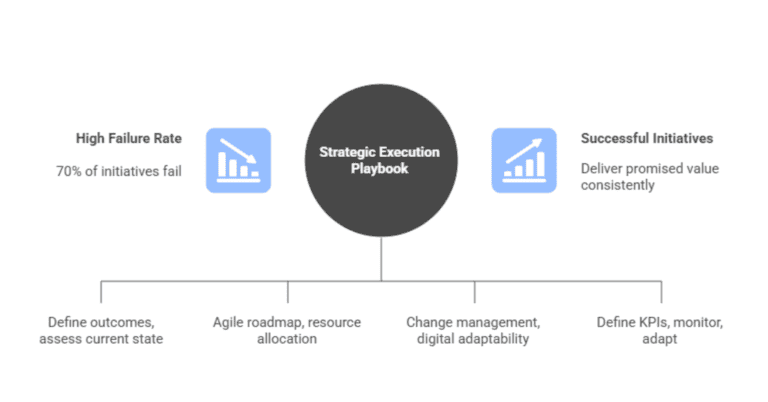
Bridging the strategy gap requires translating high-level concepts into clear operating models, resource allocations, and key performance indicators (KPIs). A strategy only succeeds when theoretical goals are backed by actionable timelines and accountable ownership.
How Do You Bridge the Gap Between Strategic Theory and Execution?
The problem with these frameworks isn’t the theory; it’s the effort. Drawing these matrices on a whiteboard is easy. The real challenge is keeping them updated, collaborative, and data-driven, where most teams fail.
The Strategic Analysis Toolkit automates the heavy lifting. It takes you from PESTLE to PDCA in a fraction of the time, delivering professional, boardroom-ready output that proves your strategy isn’t just a guess. It’s a calculated move.
Stop whiteboarding. Start winning. Explore the Strategic Analysis Toolkit today.