
If you are a consultant, executive, or business owner managing a growing portfolio, you already know the harsh truth: executing one strategic project is hard; executing five simultaneously is a logistical nightmare.
Most leaders rely on sheer willpower to keep multiple plates spinning. You jump from a market-entry analysis on Monday to a corporate restructuring initiative on Tuesday.
The result?
Cognitive overload, resource cannibalization, and the dreaded Admin Trap. You spend 30% of your billable hours building the same framework templates from scratch, leaving your data siloed in disconnected slide decks and spreadsheets.
When you treat every project as an isolated island, you aren’t scaling your strategy; you are just scaling your chaos. To handle multiple strategic projects efficiently, you need a centralized, sequential system. You need the Strategic Analysis Toolkit.
Here is the exact blueprint for managing simultaneous strategic projects with a proven, integrated framework.
Key Takeaways
- The Pitfall of “Siloed Islands”: Treating multiple strategic projects as isolated initiatives leads to cognitive overload, duplicated effort, and conflicting, broken strategies
- Build a Single Macro Truth: Eliminate redundant research by running a centralized PESTLE Analysis and Porter’s Five Forces scan. Apply these universal market pressures across your entire portfolio
- Prevent Resource Cannibalization: Use Value Chain and SWOT Analyses together to uncover operational bottlenecks and identify where competing projects are fighting for the exact same internal team or budget
- Kill Bias with Objective Scoring: Transition from observation to action using a TOWS Matrix. Use objective scoring data to rank, tie-break, and sequence your highest-ROI tasks
- Track Leading Indicators: Financials only tell you what happened yesterday. Implement a Balanced Scorecard to monitor forward-looking customer, internal process, and growth metrics in real-time
How Do You Centralize Macro-Environmental Research Across Multiple Strategic Projects?
When managing multiple projects, especially in the same industry or for the same client, the macro-environment doesn’t change from project to project. Yet many strategists build a new environmental scan for each initiative.
The Missing Link: PESTLE Analysis and Porter’s Five Forces. Instead of researching inflation rates or regulatory shifts five times, use the Toolkit’s Discovery and Foundation module to establish a single source of truth. By running a centralized PESTLE analysis (Political, Economic, Social, Technological, Legal, Environmental) and a Porter’s Five Forces scan, you map the battlefield once.
You can then apply these universal macro-threats and industry pressures across all your simultaneous projects. This eliminates analysis paralysis, ensures consistency, and cuts your initial research time in half.
How Do You Audit Internal Bandwidth When Executing Concurrent Projects?
The fastest way to fail at multiple simultaneous projects is to overcommit your internal resources. You might have a brilliant strategy for Market A and an innovative product launch for Market B, but if both require the same R&D team and marketing budget, one will fail.
The Missing Link: Value Chain Analysis and SWOT Analysis. You must move beyond surface-level planning. A Value Chain Analysis helps you pinpoint where your organization creates value and where bottlenecks occur. When paired with a rigorous SWOT Analysis across your project portfolio, you stop viewing initiatives in a vacuum. You suddenly see the intersections: Does a weakness in our outbound logistics threaten both Project X and Project Y? By using the Strategic Analysis Toolkit to house these frameworks in one digital interface, you prevent the Frankenstein Strategy trap, where isolated teams build conflicting plans.
How Do You Prioritize and Sequence Strategic Actions Objectively?
Having a list of strengths and market opportunities is just an observation. It is not a strategy. When managing multiple projects, the hardest decision isn’t figuring out what to do; it’s deciding what not to do right now.
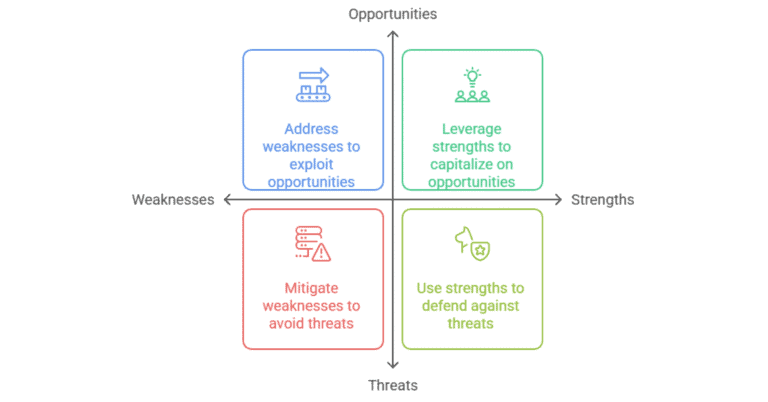
The Missing Link: The TOWS Matrix and TOWS Prioritization. While SWOT summarizes your current state, the TOWS Matrix outlines your future maneuvers. It forces your data to interact. How can you use a specific internal strength to capitalize on an external opportunity (S-O Strategy)?
More importantly, the Toolkit’s integrated TOWS Prioritization framework is the ultimate tie-breaker for the overwhelmed executive. It allows you to score and rank competing strategic initiatives. Instead of guessing which project deserves your focus today, you rely on objective, data-driven logic to sequence your execution. You eliminate cognitive bias and move forward with the highest-ROI tasks.
How Can a Balanced Scorecard Bridge the Execution Gap in Project Portfolios?
The graveyard of corporate strategy is filled with brilliant plans that were never monitored. When running multiple projects, Set and Forget syndrome is your biggest enemy. You cannot track the success of five initiatives by looking at the quarterly P&L statement alone. Financials are lagging indicators; they tell you what happened yesterday.
The Missing Link: The Balanced Scorecard. To manage multiple projects efficiently, you need a forward-looking dashboard. The Balanced Scorecard helps you track each initiative across four critical perspectives: Financial, Customer, Internal Process, and Learning & Growth.
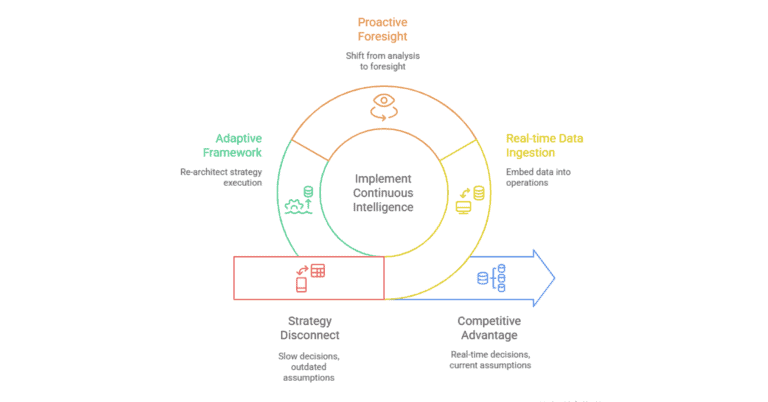
By unifying your execution metrics in the Strategic Analysis Toolkit, you create continuous intelligence. You can see at a glance whether Project A is meeting its customer satisfaction metrics while Project B is stalling in internal processes.
Quick-Reference Summary Table
| Strategic Challenge | The Solved Framework | What It Achieves |
| Duplicate Research | Centralized PESTLE & Porter’s | Establishes a single macro source of truth |
| Resource Overcommittment | Value Chain & SWOT Analysis | Identifies resource intersections and bottlenecks |
| Analysis Paralysis | TOWS Matrix & Prioritization | Uses objective scoring to sequence execution |
| Set-and-Forget Syndrome | Balanced Scorecard | Tracks forward-looking customer and internal metrics |
Frequently Asked Questions
How do you audit internal resource bandwidth for multiple initiatives?
To accurately evaluate your capacity, you must look beyond surface-level planning and utilize Value Chain Analysis paired with a portfolio-wide SWOT Analysis. A Value Chain Analysis pinpoints exactly where your organization creates value and uncovers operational bottlenecks, helping you identify if competing initiatives are inadvertently fighting for the exact same teams or budgets.
What is the “Frankenstein Strategy” trap?
The Frankenstein Strategy trap occurs when isolated, siloed teams build disconnected plans using static slide decks and spreadsheets. Without a centralized digital system, this approach causes data to become heavily siloed, leading to resource cannibalization, administrative waste, and conflicting strategic execution.
How do you prioritize and sequence strategic actions objectively?
You can move from passive data observation to objective prioritization by using a TOWS Matrix and the Strategic Analysis Toolkit’s integrated TOWS Prioritization framework. Rather than guessing which project deserves immediate focus, this framework allows you to score and rank competing initiatives mathematically based on how internal strengths intersect with external opportunities and threats, effectively removing cognitive bias.
How can a Balanced Scorecard bridge the strategic execution gap?
A Balanced Scorecard bridges the execution gap by serving as a forward-looking dashboard that tracks continuous intelligence across four critical pillars: Financial, Customer, Internal Process, and Learning & Growth. Because traditional financial metrics are lagging indicators that only show past results, the Balanced Scorecard allows managers to see precisely where an individual project is stalling in real-time before it impacts the bottom line.
Why Should You Transition From Managing Spreadsheets to Managing Strategy?
Handling multiple strategic projects doesn’t require more hours in the day; it requires better architecture. By replacing disconnected, static documents with a sequential, integrated workflow, you can move from surviving your workload to dominating your market.
Stop building the machine from scratch. Elevate your strategy from static plans to continuous intelligence. Streamline your workflow, eliminate analyst bias, and automate reporting with the Strategic Analysis Toolkit.