The Modern Educational Strategist: Leading with Logic, Not Luck
Today, the role of an educator has expanded. It is no longer enough to manage a curriculum; institutional leaders must now serve as educational strategists. Whether you are navigating declining enrollment, shifting government funding, or the rise of digital-first learning, the ability to apply rigorous business frameworks is what separates an institution that survives from one that thrives.
However, the sheer volume of data can be paralyzing. That is why professional strategists rely on a structured journey, from discovery through to continuous improvement.
Key Takeaways
If you are looking for a quick reference on how to apply strategic frameworks within an academic or institutional setting, here are the core pillars:
- Discovery requires external & internal views: Use PESTLE for macro-environmental trends (like funding or policy changes) and Value Chain Analysis to identify where your institution provides the most value to students
- Move from analysis to action with GOST: A SWOT analysis is only useful if it’s actionable. The GOST framework (Goals, Objectives, Strategies, Tactics) is the bridge that turns a “good idea” into a daily operational plan
- Balance is non-negotiable: In education, success isn’t just financial. The Balanced Scorecard ensures you are measuring student satisfaction and academic quality alongside institutional growth
- Strategy is a cycle, not a document: Using the PDCA (Plan-Do-Check-Act) cycle ensures that your strategy remains a “living” process that evolves based on real-time student outcomes and faculty feedback
- Execution hinges on Change Management: The best strategy fails without buy-in. Kotter’s 8-Step Model is the essential tool for overcoming institutional inertia and aligning staff with a new vision
Quick Reference: Which Framework for Which Problem?
| If your challenge is… | Use this Framework: |
| Declining enrollment or new competitors | Porter’s Five Forces / Ansoff Matrix |
| Identifying funding or regulatory risks | PESTLE Analysis |
| Connecting high-level vision to ground-level tasks | GOST Framework |
| Resistance to new administrative changes | Kotter’s 8-Step Change Model |
| Improving consistent academic quality | PDCA Cycle |
Strategic Frameworks for Education: Quick Reference Map
| Strategic Framework | Primary Educational Purpose | Best Used For… | Analysis Phase |
| PESTLE Analysis | Macro-environmental scanning | Identifying funding threats, demographic shifts, and AI policy impacts. | Phase 1: Discovery |
| Porter’s Five Forces | Competitive landscape analysis | Assessing threats from online universities, micro-credentials, or local schools. | Phase 1: Discovery |
| Value Chain Analysis | Internal operational auditing | Finding bottlenecks in student enrollment, academic delivery, or career services. | Phase 1: Discovery |
| SWOT Analysis | Baseline situational diagnosis | Mapping current institutional strengths against looming external market risks. | Phase 2: Analysis |
| GOST Framework | Deconstructing high-level vision | Breaking a broad “five-year vision” down into daily department-level tactics. | Phase 2: Analysis |
| Ansoff Matrix | Defining growth vectors | Deciding whether to launch new degrees or recruit non-traditional student pools. | Phase 2: Analysis |
| Blue Ocean Strategy | Creating uncontested markets | Designing unique, niche academic programs that traditional competitors don’t offer. | Phase 2: Analysis |
| TOWS Matrix | Action-oriented matchmaking | Using existing institutional strengths to actively capitalize on market opportunities. | Phase 3: Formulation |
| Balanced Scorecard | Holistic institutional health tracking | Measuring academic quality and student satisfaction alongside financial metrics. | Phase 3: Formulation |
| Kotter’s 8-Step Model | Overcoming institutional inertia | Managing faculty/staff buy-in and driving cultural adoption of a new strategy. | Phase 4: Execution |
| PDCA Cycle | Continuous quality improvement | Iterating and adjusting academic or operational processes based on live data. | Phase 4: Execution |
Phase 1: Discovery and Foundation
What Strategic Frameworks Are Used for the Discovery Phase in Education?
The foundation of any successful educational strategy requires a deep dive into the institution’s current state and external environment. To achieve this, we leverage PESTLE Analysis to evaluate macro-environmental factors like shifting government funding and technological disruptions. Simultaneously, Porter’s Five Forces helps analyze the competitive landscape, such as the rise of alternative credential programs, while Value Chain Analysis dissects internal operations to identify exactly where the institution creates or loses value for its students.
Every great strategy begins with an honest look in the mirror and a wide-angle lens on the world.
Using PESTLE Analysis, an educational strategist can map out the Political, Economic, Social, Technological, Legal, and Environmental factors affecting their school. Is a new regulation about to change your funding? Are demographic shifts reducing your local student pool?
To understand the competitive environment, we look to Porter’s Five Forces. This helps you analyze the threat of new online competitors or the bargaining power of students who have more choices than ever.
Finally, a Value Chain Analysis allows you to look internally. From admissions to alumni relations, where are you creating value, and where are you wasting resources?
Phase 2: Strategic Analysis
How Do You Align Educational Goals Using Strategic Analysis Frameworks?
Once the baseline data is gathered, the strategy must transition from broad concepts to structured alignment. We utilize the classic SWOT Analysis to map internal capabilities against external market realities, but immediately supercharge it with the GOST Framework to translate that high-level vision into specific Goals, Objectives, Strategies, and Tactics. To ensure the strategy remains dynamic and execution-focused, we lean heavily on the Ansoff Matrix and Blue Ocean Strategy to uncover entirely new, uncontested educational markets and student demographics.
Once the foundation is laid, it is time to synthesize those insights. The SWOT Analysis remains a staple, but for the educational strategist, it is only the beginning.
To ensure the strategy is more than a document in a drawer, we use GOST. This framework breaks down your high-level vision into specific Goals, measurable Objectives, clear Strategies, and everyday Tactics.
If your goal is growth, the Ansoff Matrix helps you decide: do you offer existing courses to new markets (Market Development) or create entirely new degree programs for your current students (Product Development)? If the competition is too fierce, a Blue Ocean Strategy can help you find uncontested market space, perhaps a specialized micro-credential that no other institution in your region offers.
Phase 3: Implementation Planning
Which Frameworks Help Leaders Choose the Right Educational Strategy?
Formulating the final strategy requires shifting from a long list of possibilities to actionable choices. A TOWS Matrix is deployed here to turn our earlier SWOT findings into proactive strategies (for example, using an institutional strength to maximize an external digital learning opportunity). These choices are then organized using the Balanced Scorecard, ensuring that academic quality, financial health, student satisfaction, and internal operational efficiency are all measured and balanced perfectly.
Strategy is nothing without execution. This is where many institutions fail, but the strategist uses the TOWS Matrix to bridge the gap. By pairing your Strengths with Opportunities and your Weaknesses with Threats, you create specific, actionable strategies.
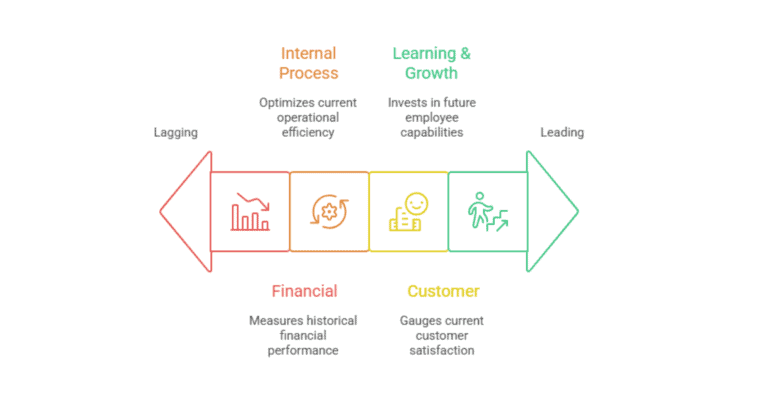
Because time and budget are finite, TOWS Prioritization ensures you tackle high-impact moves first. To keep the board and stakeholders informed, the Balanced Scorecard provides a holistic view of performance, tracking not only finances but also student satisfaction, internal process efficiency, and organizational learning.
Phase 4: Change and Improvement
How Do Educational Institutions Execute Strategy and Manage Change?
The finest strategy will fail without cultural adoption and disciplined execution. For the rollout, we implement Kotter’s 8-Step Change Model to build urgency, guide leadership, and overcome institutional inertia or faculty resistance. Once the strategy is live, the PDCA (Plan-Do-Check-Act) Cycle takes over as our continuous improvement framework, ensuring the strategy adapts in real-time as academic and operational data rolls in.
The hardest part of any strategy is the human element. Education is an industry built on tradition, and change often meets resistance. Kotter’s 8-Step Plan provides a roadmap for leading change, from creating a sense of urgency to anchoring new approaches in the institutional culture.
Strategy isn’t a one-and-done event. The PDCA Cycle (Plan-Do-Check-Act) fosters a culture of continuous improvement. Finally, the strategist uses What-if scenarios to prepare for the unexpected. What if enrollment drops by another 10%? What if a new grant is secured? Mapping these scenarios in an Executive Summary ensures leadership is never caught off guard.
Frequently Asked Questions
What is the best strategic framework for an educational institution facing declining student enrollment?
The combination of the Ansoff Matrix and Porter’s Five Forces is highly effective for addressing declining enrollment. Porter’s Five Forces allows leadership to analyze where the competition is winning (e.g., online universities, trade schools, or micro-credentials). Once the competitive landscape is understood, the Ansoff Matrix helps the institution decide whether to target new student pools (Market Development) or launch new types of degree or certificate programs (Product Development).
How do you apply Kotter’s 8-Step Change Model to schools and universities?
Applying Kotter’s Model in education requires a heavy focus on step one (creating urgency) and step two (building a guiding coalition). Because educational institutions often have deeply entrenched cultures and decentralized power (such as faculty senates), change cannot simply be mandated from the top down. Leadership must invite faculty, staff, and student representatives into the planning process early to co-create the vision, ensuring institutional buy-in before moving to full-scale execution.
Why should universities use a Balanced Scorecard instead of traditional corporate metrics?
Traditional corporate metrics focus almost exclusively on financial ROI and profit margins, which do not align with the mission of most educational institutions. A Balanced Scorecard expands this view by tracking performance across four equal pillars: Financial Health, Internal Operations, Student/Stakeholder Satisfaction, and Academic Innovation/Growth. This ensures that academic quality and student outcomes are never sacrificed for short-term budget cuts.
Your Secret Weapon: The Strategic Analysis Toolkit
While these frameworks are powerful, building them from scratch in spreadsheets and word processors is a monumental task. This leads to fragmented data, inconsistent formatting, and hundreds of lost hours.
The Strategic Analysis Toolkit was explicitly designed to solve this problem. It provides a seamless, integrated platform for conducting every analysis mentioned above. Instead of wrestling with templates, you can focus on the insights.
- Standardized Frameworks: No more reinventing the wheel with every report
- Visual Clarity: Turn complex SWOTs and PESTLEs into board-ready visuals
- Collaborative Power: Align your leadership team around a single source of strategic truth
Don’t leave your institution’s future to chance. Embrace the role of the educational strategist and empower your decision-making with the right tools.
Ready to transform your strategy? Explore the Strategic Analysis Toolkit now.