What Is the Ansoff Matrix?
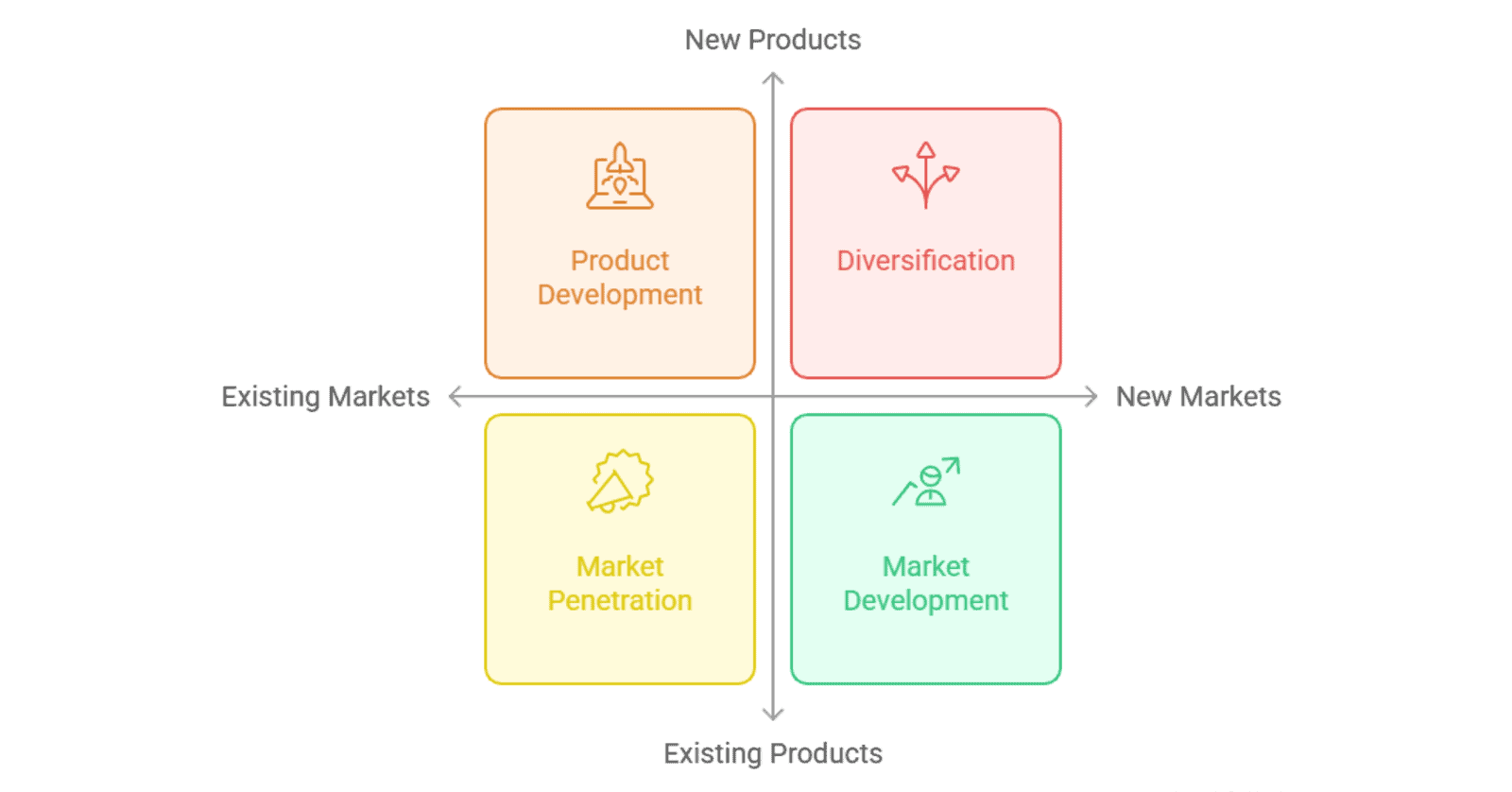
The Ansoff Matrix is a strategic planning tool that helps businesses identify growth strategies by mapping four options (Market Penetration, Market Development, Product Development, and Diversification) on a grid of current versus new products and markets.
What Is the Ansoff Matrix Used For?
Business leaders, strategists, and marketing managers use the Ansoff Matrix to evaluate and select the most appropriate growth strategy for their organization. It provides a structured way to assess four possible directions for expansion: selling more to existing customers, entering new markets, developing new products, or diversifying into entirely new territory, while making the associated risks of each path explicit and comparable. In practice, it is used during strategic planning sessions to challenge assumptions, prioritize investment decisions, and align leadership teams around a shared growth direction. It is equally useful for startups mapping their first moves as for established businesses weighing their next phase of expansion. Rather than replacing detailed market research or financial modeling, the Ansoff Matrix serves as a starting framework: it narrows the strategic conversation, surfaces trade-offs early, and ensures that growth decisions are made deliberately rather than by default.
Defining Your Growth Strategy
Every business, from a budding startup to a multinational corporation, faces the same fundamental challenge: how to grow. Growth isn’t just about getting bigger; it’s about sustainable evolution, staying relevant, and securing a future in an ever-changing market. But with countless paths to expansion, how do you choose the right one? How do you assess the risks and potential rewards of each direction?
Enter the Ansoff Matrix, also known as the Product-Market Expansion Grid.
Developed by Igor Ansoff, this powerful strategic tool provides a clear framework for businesses to identify and evaluate four primary growth strategies based on whether they use current or new products and target current or new markets. It’s a foundational concept for anyone looking to map out their future.
It’s an essential read for business owners, strategists, marketing managers, and product developers eager to make informed decisions about their company’s trajectory.
Deconstructing the Matrix: The Four Strategies
Let’s dive into each of the four quadrants, detailing the strategy, its typical tactics, and, critically, its associated risk profile. Understanding these distinctions is key to making strategic choices.
| Strategy | Product | Market | Risk Level | Best Used When |
|---|---|---|---|---|
| Market Penetration | Existing | Existing | Lowest | You have room to grow share in a market you already know |
| Market Development | Existing | New | Medium | Your product is proven and ready for a new audience or geography |
| Product Development | New | Existing | Medium | You understand your customers well and can solve more of their problems |
| Diversification | New | New | Highest | You are seeking entirely new revenue streams beyond your current business |
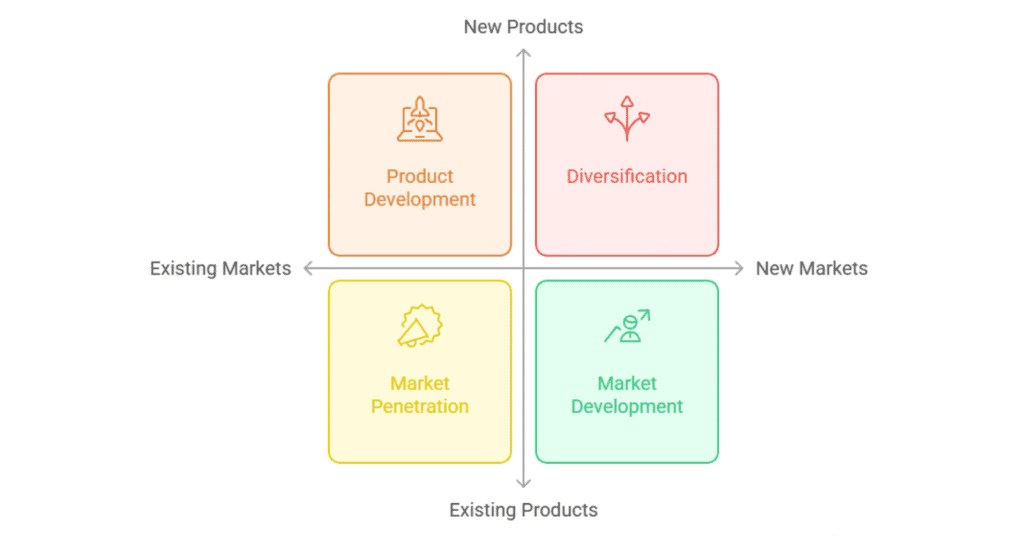
Quadrant 1: Market Penetration (Current Product, Current Market)
Market Penetration is the lowest-risk growth strategy in the Ansoff Matrix, focused on increasing sales of an existing product in an existing market by capturing a larger share of demand through pricing, promotion, or improved distribution, without requiring new product development or entry into unfamiliar territory.
- Strategy: This is arguably the most common and often the initial growth strategy. It focuses on increasing market share within your existing customer base by selling more of your current products to the customers you already have or can easily reach
- Tactics: Think aggressive pricing strategies, enhanced promotional campaigns (advertising, sales promotions), increasing distribution channels, or even acquiring competitors to consolidate market share
- Risk Profile: This quadrant represents the Lowest Risk. You’re dealing with known products in known markets, leveraging existing relationships and proven capabilities
Quadrant 2: Market Development (Current Product, New Market)
Market Development is a medium-risk growth strategy in which a business takes a proven product and introduces it to a new audience, whether by expanding into a new geography, targeting a different customer segment, or identifying a new use case, leveraging what already works while accepting the uncertainty of an unfamiliar market.
- Strategy: With this approach, you take your existing, successful products and introduce them to entirely new markets. The product remains the same, but the audience changes
- Tactics: This could involve geographic expansion (e.g., launching in a new country or region), targeting new customer segments (e.g., selling a B2C product to B2B clients), or identifying new use cases for your existing product that appeal to a different segment
- Risk Profile: Medium Risk. While your product is proven, you’re venturing into unfamiliar territory, with new customer needs, a changing competitive landscape, and evolving regulatory environments
Quadrant 3: Product Development (New Product, Current Market)
Product Development is a medium-risk growth strategy in which a business creates new or improved products for its existing customer base, capitalizing on established relationships and market knowledge while accepting the inherent uncertainty of launching something not yet tested in the market.
- Strategy: Here, the focus shifts to innovation. You develop new products or services to sell to your existing customer base. You leverage your understanding of your current customers’ needs and trust to introduce something new
- Tactics: This can manifest as launching improvements or variations of current products, bundling new services alongside your core offering, or even introducing entirely new product lines that cater to the same customer base’s broader needs
- Risk Profile: Also a Medium Risk. You know your customers well, but a new product’s success is never guaranteed. There’s always the chance it won’t resonate as expected or that development costs will outweigh returns
Quadrant 4: Diversification (New Product, New Market)
Diversification is the highest-risk strategy in the Ansoff Matrix, involving the simultaneous launch of a new product into a new market where the business has no established presence or customer relationships — a bold move that demands significant investment and tolerance for uncertainty, yet can unlock entirely new revenue streams and reduce dependence on existing markets.
- Strategy: This is the boldest leap. Diversification involves entering a new market with a new product. It’s about exploring entirely new business opportunities
- Tactics: Diversification can involve leveraging existing capabilities, technology, or brand reputation (e.g., a car manufacturer moving into electric-vehicle charging stations). Or it can be Unrelated, where you enter an entirely new industry with no obvious synergy (e.g., a food company buying a textile manufacturer)
- Risk Profile: This quadrant represents the Highest Risk. Everything is new and untested; both the product and the market. The learning curve is steep, and the potential for failure is significant. However, the rewards of successful diversification can be substantial, offering new revenue streams and reducing dependence on existing markets
Applying the Ansoff Matrix: A Practical Guide
Understanding the quadrants is one thing; applying them is another. Here’s a practical guide to using the Ansoff Matrix in your strategic planning:
Step 1: Analyze Your Current Position
Before you look outward, look inward. What are your core competencies? What is your current market share, and where are your products in their lifecycle? A clear understanding of your starting point is crucial.
Step 2: Evaluate Risk vs. Reward
Use the matrix to categorize and formally assess potential growth opportunities. The matrix isn’t just a classification tool; it acts as a risk gauge. For each potential strategy, ask:
- How well do we understand this market?
- How strong is our product/service in this context?
- What are the potential gains versus the investment and potential losses?
Step 3: Prioritize and Sequence
Rarely does a business pursue just one strategy. The most robust growth plans involve a balanced portfolio. You might use Market Penetration to achieve short-term revenue gains and stability, while simultaneously investing in Product Development for future innovation and exploring Diversification to drive long-term survival and new growth engines.
Case Study Examples
- Market Penetration: Consider a popular coffee chain that introduces a new loyalty program or limited-time promotional offers to encourage existing customers to visit more often and increase their average spend. They’re not changing their product or targeting new customers, just getting more from their current base
- Diversification: Think of Amazon. Starting as an online bookstore (Market Penetration), it gradually moved into selling a vast array of products (Product Development) and expanded globally (Market Development). Its venture into Amazon Web Services (AWS) was a prime example of diversification: a new product (cloud computing services) for a new market (other businesses needing scalable IT infrastructure). This unrelated diversification transformed Amazon into a tech giant beyond e-commerce
Moving from Strategy to Execution
The Ansoff Matrix is a powerful diagnostic tool that helps frame your strategic choices. It forces you to think systematically about where and how you want to grow. However, remember that the matrix is a starting point; it helps define the choice, but it doesn’t guarantee success.
The most successful businesses don’t stick rigidly to one quadrant. Instead, they strategically manage a mix of growth initiatives, navigate the associated risks, and balance short-term gains with long-term vision. By understanding where each potential growth path sits on the risk spectrum, you can make more informed, deliberate decisions that truly propel your business forward.
Now, it’s your turn: Which quadrant is your primary focus for the next 12 months, and why?
Frequently Asked Questions
What Is the Ansoff Matrix?
The Ansoff Matrix is a strategic planning tool Igor Ansoff developed in 1957 that helps businesses identify and evaluate growth strategies. It organizes four possible growth directions (Market Penetration, Market Development, Product Development, and Diversification) into a simple 2×2 grid based on whether products and markets are new or existing.
Who Created the Ansoff Matrix?
Igor Ansoff, a Russian-American mathematician and business manager, created the Ansoff Matrix and first published it in the Harvard Business Review in 1957. Ansoff developed the framework to give businesses a systematic way to think about growth strategy, and it remains one of the most widely used strategic planning tools today.
What Are the Four Quadrants of the Ansoff Matrix?
The four quadrants are Market Penetration (existing product, existing market), Market Development (existing product, new market), Product Development (new product, existing market), and Diversification (new product, new market). Each quadrant represents a distinct growth strategy with different levels of risk and resource requirements.
What Is the Lowest-Risk Ansoff Strategy?
Market Penetration is the lowest-risk strategy in the Ansoff Matrix because it involves selling existing products to existing customers in a market the business already understands. It requires no new product development or navigation of unfamiliar customer segments, making it the natural starting point for most growth plans.
What Is the Highest-Risk Ansoff Strategy?
Diversification is the highest-risk strategy because it requires entering a new market with a new product at the same time. The business has no established customer relationships or proven product fit to rely on, making both the investment and the outcome harder to predict. Despite the risk, successful diversification can open significant new revenue streams.
When Should a Business Use the Ansoff Matrix?
The Ansoff Matrix is most useful during strategic planning cycles, when leadership teams are deciding where to focus growth investment over the next one to three years. It is also valuable when a business has reached a plateau in its current market, is considering a new product launch, or is evaluating whether to expand into new geographies or customer segments.
What Is the Difference Between Market Development and Diversification?
Market Development involves taking an existing, proven product into a new market — the product stays the same while the audience changes. Diversification involves launching a new product into a new market, meaning both elements are unfamiliar. Market Development carries medium risk; Diversification carries the highest risk of the four strategies.
Can a Business Pursue More Than One Ansoff Strategy at Once?
Yes, and most successful businesses do. A common approach is to use Market Penetration to drive short-term revenue stability while simultaneously investing in Product Development for future growth. The matrix is most powerful when you use it to manage a portfolio of growth initiatives, not to choose a single strategy in isolation.