What is the GOST Framework?
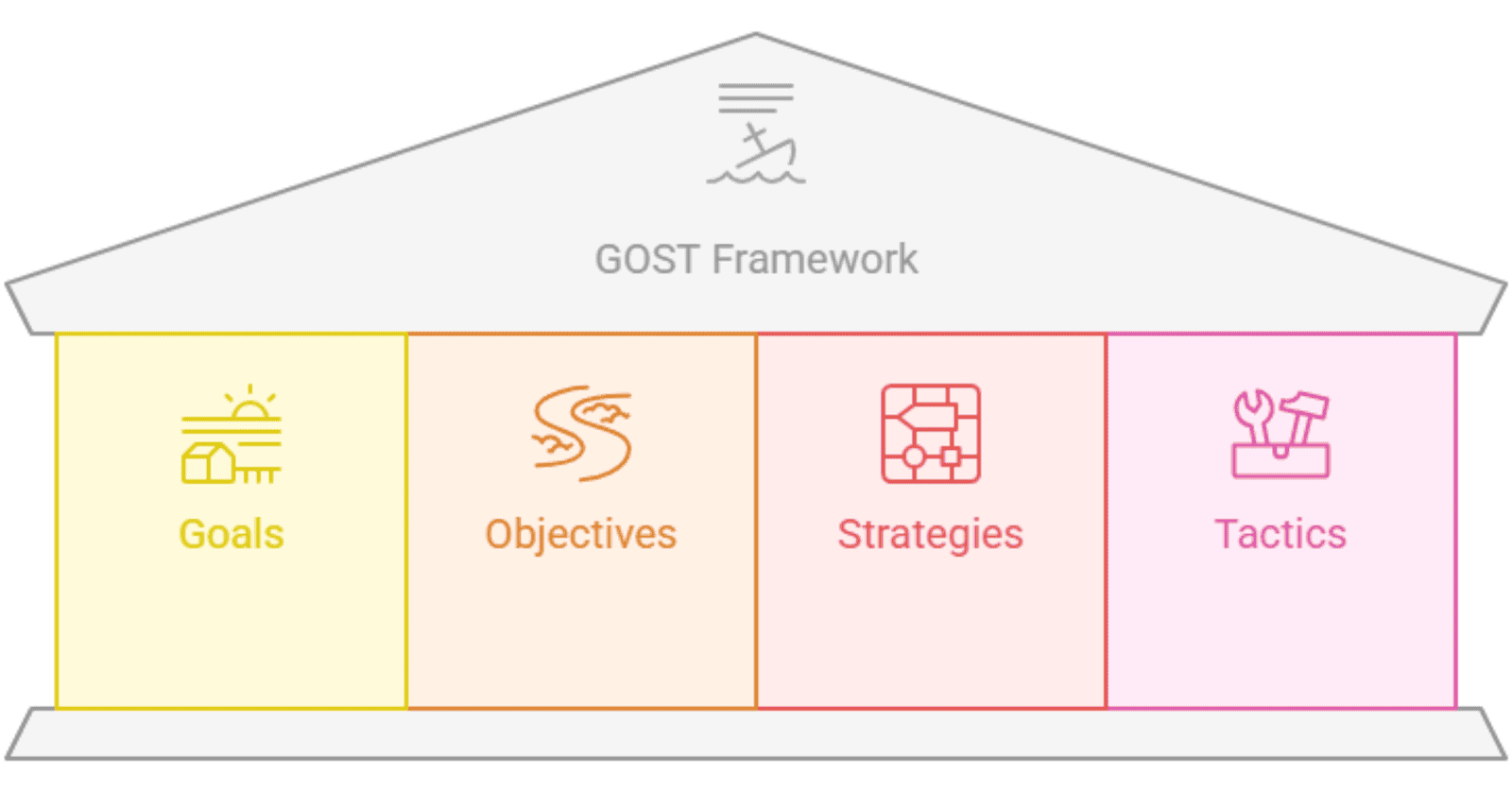
The GOST framework is a strategic planning tool used to align daily tasks with long-term vision. It stands for Goals (long-term aims), Objectives (measurable milestones), Strategies (the overarching approach), and Tactics (specific operational actions).
Why Do Corporate Strategies Fail Without the GOST Framework?
It’s a painful reality in the business world: carefully crafted strategies fail not because the ideas were bad, but because of poor execution and a critical lack of alignment. Teams become bogged down in “busy work,” high-level executives lose sight of daily operations, and the bridge between the boardroom vision and front-line activity collapses.
If your organization suffers from a disconnect between its grand vision and its daily tasks, you need more than just a plan; you need a reliable mechanism to connect the two.
Enter GOST analysis: a simple yet profoundly powerful framework for strategic alignment. GOST stands for Goals, Objectives, Strategies, and Tactics. It is a cascading structure that ensures every single action taken by your team supports a high-level corporate aim.
In this deep dive, we will break down the GOST framework, show you how to apply it, and empower you to move your business From Vision to Victory.
What Are the Four Components of the GOST Framework?
The power of GOST lies in its hierarchy. Each level informs the one below it and justifies the one above it. Let’s define the four components:
| Element | Horizon / Scope | Nature | Quick Example |
| G – Goals | Long-term (Years) | Qualitative & Aspirational | Become the market leader in sustainable software. |
| O – Objectives | Shorter-term (Months) | Quantitative & SMART | Increase market share from 15% to 25% in 18 months. |
| S – Strategy | Overarching Plan | The “How” (Approach) | Shift R&D budget exclusively to proprietary AI solutions. |
| T – Tactics | Daily/Weekly | Actionable & Operational | Launch a 3-month LinkedIn ad campaign targeting CTOs. |
What Is the Golden Rule of Cascading Alignment in GOST?
The defining feature of a successful GOST analysis is cascading alignment. Think of it as a funnel or a pyramid: every element at the bottom must be connected to and justified by the element above it.
This principle serves as a guardrail against wasted effort. If you cannot trace a Tactic directly up to a Strategy, Objective, and ultimately the Goal, it is a non-essential activity and should be eliminated.
The Upward/Downward Test:
- Does this Tactic support the chosen Strategy? (e.g., Does launching this ad campaign support the Strategy of focusing only on proprietary AI?)
- Does this Strategy put us on a path to meet the Objective? (e.g., Will this exclusive focus on AI realistically help us increase market share to 25%?)
- Does achieving the Objective move us closer to the Goal? (e.g., Will hitting 25% market share make us the recognized market leader?)
If the answer to any of these is “No,” you have a serious strategic misalignment. GOST forces accountability and coherence across all levels of the business.
Common Pitfall: Many organizations have fantastic Goals and Objectives, but their Strategies and Tactics are mismatched. They want to be the premium provider (Strategy), but their teams are executing a cost-cutting campaign (Tactic). GOST eliminates this contradiction.
How Do You Successfully Implement the GOST Framework?
Implementing GOST effectively requires discipline. As a business strategist, I recommend focusing on these four principles:
Why Must You Start With Goals When Implementing GOST?
Before writing a single Tactic, secure complete agreement on the long-term Goal. This ensures the entire organization is pulling in the same direction. Follow this by defining robust SMART Objectives that are challenging yet realistic. If you can’t measure it, you can’t manage it.
How Does Commitment Impact Your Choice of Strategy?
A Strategy is not a list of desirable things; it is a commitment to a specific path. When you choose to pursue a strategy of “superior customer service,” you simultaneously choose to forgo the strategy of “lowest-cost provider.” This clarity prevents teams from pursuing opposing goals simultaneously.
Who Should Be Assigned to Execute Specific GOST Tactics?
While Goals and Strategies can be owned by executive leadership, Tactics require clear, individual owners. Every action plan must be tied to a person, a budget, and a deadline. A Tactic without an owner is just a wish.
How Often Should You Review and Adjust Your GOST Framework?
GOST is not a one-time exercise; it’s a dynamic management system. Your Tactics and Strategies are hypotheses.
- Quarterly Check-ins: Are the Tactics working? Are they producing the results needed to hit the Objective?
- Annual Review: Are the Objectives still relevant to the current market and the long-term Goal?
Use your Objective metrics (the “M” in SMART) to drive your reviews. If a Tactic is failing to produce results, adjust the Tactic or the Strategy, but do not abandon the Goal.
Frequently Asked Questions
What Is the GOST Framework?
The GOST framework is a structured strategic planning methodology used by organizations to align high-level vision with daily operations. The acronym stands for Goals, Objectives, Strategies, and Tactics. By defining each element sequentially, a business ensures that its daily tasks directly support its ultimate long-term ambitions.
Why Do Corporate Strategies Fail Without the GOST Framework?
Most corporate strategies fail due to a disconnect between executive vision and frontline execution. Without a cascading framework like GOST, organizations often set vague goals without measurable benchmarks, or they engage in daily tactics that have no measurable impact on the company’s long-term direction. GOST bridges this gap by enforcing complete alignment from top to bottom.
What Is the Golden Rule of Cascading Alignment in GOST?
The golden rule of cascading alignment is that each layer of the framework must directly justify and support the layer immediately above it. Your objectives must quantify your goals, your strategies must outline the approach to hit those objectives, and your tactics must be the exact operational actions that execute the strategy. If a tactic does not directly serve a strategy, it should be eliminated.
How Do You Successfully Implement the GOST Framework?
Successful implementation requires senior leadership to clearly define the long-term vision (Goals) before allowing teams to develop the execution plans (Tactics). It also requires regular tracking, setting clear accountability metrics, and maintaining the discipline to say “no” to opportunities or actions that fall outside the agreed-upon strategy.
How Often Should You Review and Adjust Your GOST Framework?
While Goals and Strategies are typically long-term and should remain stable for 1 to 3 years, Objectives should be reviewed quarterly to ensure milestones are being met. Tactics are highly operational and flexible; they should be reviewed on a weekly or monthly basis and adjusted dynamically based on real-time performance and market changes.
How Does GOST Turn Strategic Ideas Into Real-World Impact?
The GOST framework offers unparalleled clarity, coherence, and measurable results. It removes the ambiguity that so often stalls execution. By systematically linking your broad, inspirational Goals to your daily, measurable Tactics, you ensure that every minute and every dollar spent directly contributes to your organizational success.
Stop planning in a vacuum and start building a connected, accountable strategy.