The MBA curriculum is a powerful crucible. It equips aspiring leaders with a formidable library of mental models, theories, and case studies. But ask any seasoned management consultant, and they will tell you the same truth: Theory is the map; reality is the terrain.
In the real world, strategy is not a static document you file away in a drawer. It is a living, breathing lifecycle. The challenge isn’t knowing what Porter’s Five Forces is; it’s knowing when to deploy it, how to interpret the data, and how to use it to convince a skepticism-filled boardroom to pivot.
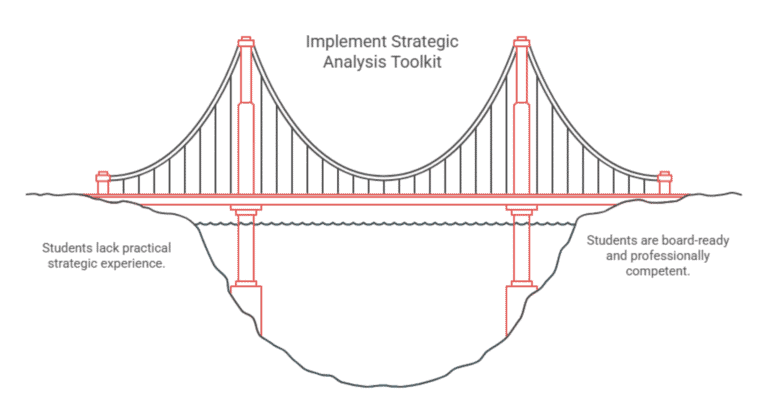
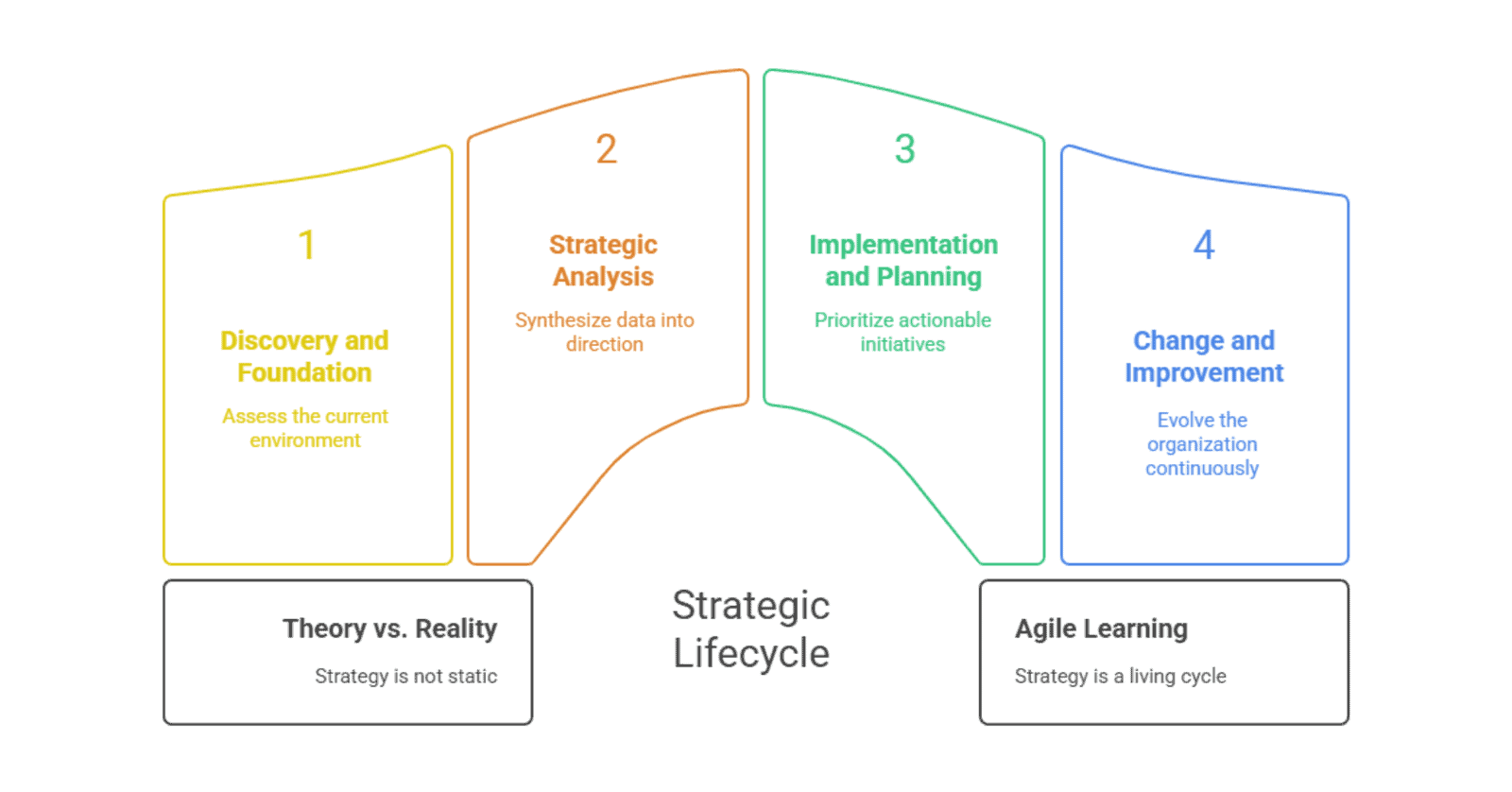
This guide bridges the gap between academic theory and consulting practice. We will walk through the strategic lifecycle, from Discovery to Continuous Improvement, using the core frameworks found in the Strategic Analysis Toolkit.
How Do the Strategy Frameworks Compare Across the Business Lifecycle?
| Phase & Framework | Best Used For | Key Real-World Action |
| Phase 1: PESTLE Analysis | Macro-environmental scanning | Weighting critical uncertainties (like regulatory or tech shifts) before they blindside you. |
| Phase 1: Porter’s 5 Forces | Industry attractiveness analysis | Assessing market profitability potential to back up Market-Entry or Market-Exit decisions. |
| Phase 1: Value Chain Analysis | Inward operational auditing | Dissecting internal activities to locate operational “margin leaks” and source your core differentiation. |
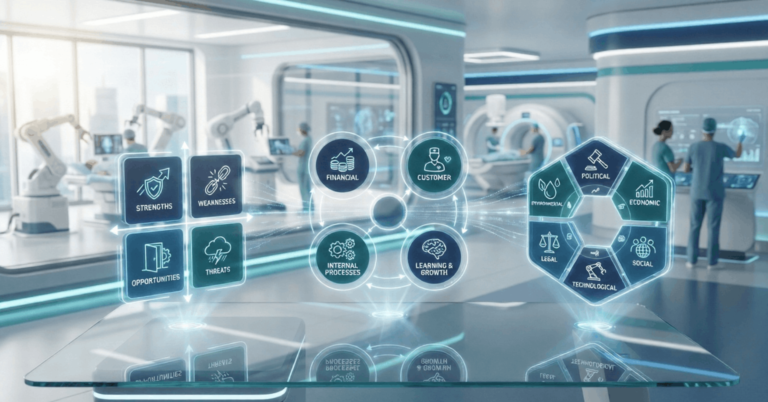
| Phase 2: SWOT Analysis | Situational synthesis | Connecting external market data with internal capabilities to build a cohesive strategic narrative. |
| Phase 2: Ansoff Matrix | Incremental growth risk profiling | Categorizing and managing risk when deciding to expand via products, markets, or diversification. |
| Phase 2: Blue Ocean Strategy | Disruptive innovation planning | Reconstructing market boundaries using the Four Actions Framework to find uncontested space. |
| Phase 2: GOST Framework | Strategy-to-operations translation | Breaking abstract corporate goals down into measurable objectives, strategies, and concrete tactics. |
| Phase 3: TOWS Matrix | Actionable tactical planning | Mashing up SWOT quadrants to generate immediate, high-priority project lists. |
| Phase 3: Balanced Scorecard | Strategic alignment & measurement | Moving past lagging financial indicators to measure operational health across four distinct lenses. |
| Phase 4: Kotter’s 8-Step Plan | Human-centric change management | Overcoming organizational resistance by building urgency and securing short-term cultural wins. |
| Phase 4: PDCA Cycle | Agile strategy optimization | Testing strategy as an ongoing hypothesis via continuous loops of planning, piloting, and scaling. |
Phase 1: Discovery and Foundation
Understanding the Environment.
Before you can decide where to go, you must relentlessly assess where you are. In consulting, we call this “situational awareness.” Two specific errors occur here: paralysis by analysis (collecting too much data) or inside-out thinking (ignoring the market).
How Do You Map the Macro-Environment Using PESTLE Analysis?
Most organizations are blindsided not by competitors, but by context. PESTLE Analysis (Political, Economic, Social, Technological, Legal, Environmental) is your radar for incoming storms.
The Real-World Application
Do not just list factors; weight them. A consultant uses PESTLE to identify the “critical uncertainties.” For instance, in the automotive industry, a Technological shift (EV batteries) and a Legal shift (carbon mandates) outweigh all other factors. Your strategy must first address these existential threats
How Is Industry Attractiveness Defined by Porter’s Five Forces?
Is this a game worth playing? That is the question Porter’s Five Forces answers. It assesses the profitability potential of a market by analyzing the bargaining power of suppliers/buyers, the threat of new entrants/substitutes, and competitive rivalry.
The Real-World Application
Consultants use this framework to justify Market-Entry or Market-Exit decisions. If Supplier Power and Competitive Rivalry are both high, margins will be mathematically compressed. You use this framework to tell a CEO: “Even if we execute perfectly, this industry structure prevents high ROI. We should look elsewhere.”
How Does Value Chain Analysis Deconstruct Competitive Advantage?
While Porter looks outward, Value Chain Analysis looks inward. It breaks your firm down into primary activities (Inbound Logistics, Operations, Marketing) and support activities (HR, Tech).
The Real-World Application
This is where you find the “margin leaks” and the “secret sauce.” A generic strategy fails because it tries to be good at everything. Value Chain Analysis allows you to spot the one link in the chain, perhaps a proprietary logistics algorithm or a unique procurement relationship, that drives your differentiation.
Phase 2: Strategic Analysis
Choosing a Path.
Once you have the data, you need to synthesize it into a coherent direction. This phase is about making choices, and more importantly, making trade-offs.
How Do You Synthesize a Business Situation Using SWOT Analysis?
SWOT (Strengths, Weaknesses, Opportunities, Threats) is the most recognizable framework in business, yet it is often the most misused.
The Real-World Application
A standard SWOT is just a laundry list. A strategic SWOT is a synthesis. It connects the insights from Phase 1 (PESTLE and Porter’s Five Forces: Opportunities/Threats; Value Chain: Strengths/Weaknesses) into a narrative. If your biggest Weakness aligns with a market Threat, you have a “burning platform” that demands immediate action.
How Do the Ansoff Matrix and Blue Ocean Strategy Generate Options?
Now that you know the situation, how do you grow?
- The Ansoff Matrix helps you categorize risk. Are we selling existing products in new markets (Market Development) or new products in new markets (Diversification)? It brings discipline to brainstorming
- The Blue Ocean Strategy challenges the premise of the competition entirely. Instead of fighting for a share in a “Red Ocean,” you apply the “Four Actions Framework” (Eliminate, Reduce, Raise, Create) to find uncontested market space
Tip: Use Ansoff for incremental growth planning and Blue Ocean for disruptive innovation workshops.
How Does the GOST Framework Translate Strategy Into Goals?
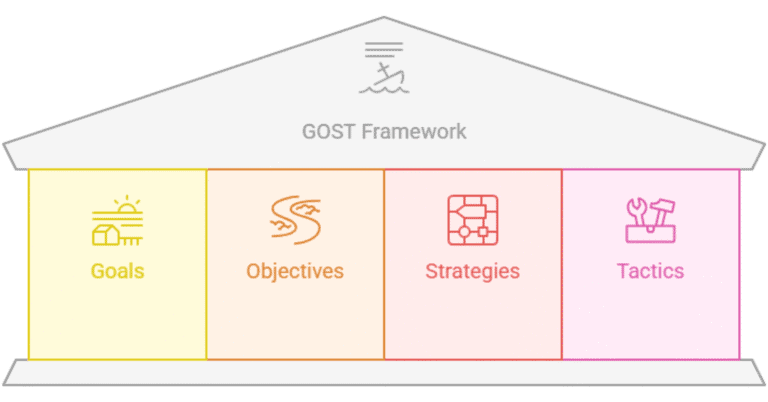
Strategy often dies because it is too abstract. The GOST Framework (Goals, Objectives, Strategies, Tactics) is the translation layer.
- Goal: Broad aim (e.g., “Become the market leader”)
- Objective: Quantifiable measure (e.g., “Achieve 30% market share by Q4”)
- Strategy: The approach (e.g., “Price leadership via supply chain automation”)
- Tactic: The specific action (e.g., “Implement ERP system in Q1”)
Phase 3: Implementation and Planning
Making it Happen.
The best strategy on a slide deck is worthless if it cannot be executed. This phase shifts from “thinking” to “doing.”
How Does a TOWS Matrix Prioritize Actionable Initiatives?
This is the advanced evolution of SWOT. The TOWS Matrix forces you to mash up the quadrants to create specific strategies:
- SO Strategies (Maxi-Maxi): How can we use our Strengths to exploit Opportunities?
- WT Strategies (Mini-Mini): How can we minimize Weaknesses to avoid Threats?
Real-World Application
TOWS is the bridge between analysis and the project list. It turns “We have a strong brand” (Strength) and “New market opening” (Opportunity) into a project: “Launch luxury sub-brand in Asia.”
How Does the Balanced Scorecard Align Organizational Execution?
Financial metrics are lagging indicators; they tell you what happened last month. To drive strategy, you need leading indicators. The Balanced Scorecard ensures you are measuring the health of the entire organization across four perspectives:
- Financial: (ROI, Cash Flow)
- Customer: (NPS, Retention)
- Internal Process: (Cycle time, Defect rates)
- Learning & Growth: (Employee sentiment, Skill acquisition)
Phase 4: Change and Improvement
Evolving the Organization.
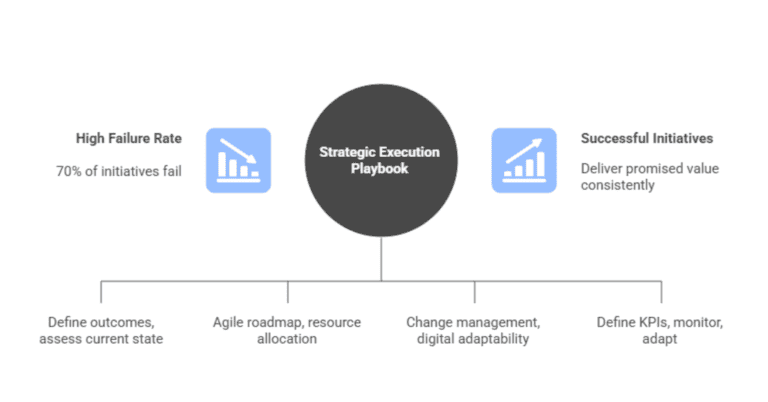
Implementation is not a one-time event; it is a cycle of friction and adaptation.
How Does Kotter’s Eight-Step Plan Drive Business Transformation?
Culture eats strategy for breakfast. If you don’t manage the human side of change, your strategy will fail. Kotter’s 8 Step Plan is the blueprint for change management.
The Real-World Application
Most companies skip Step 1: Creating a Sense of Urgency. They jump straight to implementation. A consultant uses Kotter’s framework to build a “Guiding Coalition” and generate “Short-Term Wins” to sustain momentum as initial excitement fades.
How Does the PDCA Cycle Institutionalize Operational Excellence?
Finally, we arrive at the engine of continuous improvement: PDCA (Plan, Do, Check, Act).
The Real-World Application
Strategy is a hypothesis. PDCA is the scientific method applied to business.
- Plan the change
- Do a small pilot
- Check the data (Did it work?)
- Act to scale it or kill it. This cycle turns a static strategic plan into an agile, learning organization
Frequently Asked Questions
What is the difference between an academic MBA strategy and real-world consulting practice?
Academic MBA strategy typically focuses on identifying and analyzing frameworks conceptually through historical case studies. In contrast, real-world consulting practice treats frameworks as dynamic tools to identify critical uncertainties, uncover operational margin leaks, and make immediate, data-backed business decisions like market entry or exit.
How do you turn a standard SWOT analysis into actionable strategic initiatives?
You can turn a standard SWOT analysis into actionable initiatives by pairing it with a TOWS Matrix. Instead of just listing items, a TOWS Matrix forces you to mash up the quadrants, such as combining an internal Strength with an external Opportunity (Maxi-Maxi strategy), to design concrete project lists and immediate next steps.
Why should a business use the GOST framework over standard goal setting?
A business should use the GOST framework because it acts as a translation layer that bridges the gap between abstract corporate strategy and daily operations. By breaking down planning into four distinct steps, Goals, Objectives, Strategies, and Tactics, it ensures that every high-level aim is tied to a quantifiable measure and a specific, timed action.
When should a consultant use the Ansoff Matrix versus the Blue Ocean Strategy?
A consultant should use the Ansoff Matrix when a company is focusing on disciplined, incremental growth planning within existing or known markets and products. Conversely, the Blue Ocean Strategy should be deployed during disruptive innovation workshops where the goal is to break away from traditional competition entirely and find uncontested market space.
Why is the PDCA cycle critical to the strategic lifecycle?
The PDCA (Plan, Do, Check, Act) cycle is critical because real-world strategy is an evolving hypothesis rather than a static document. By applying this continuous improvement cycle, an organization can run small pilots, analyze real-time data, and quickly pivot or scale initiatives, turning a rigid strategy into an agile, learning framework.
What Is the Ultimate Value of a Strategic Mindset?
Mastering business strategy is not about memorizing acronyms. It is about fluency. It is about knowing that when a client is struggling with internal inefficiencies, you reach for the Value Chain. When a startup is looking for a niche, it goes for a Blue Ocean. When a legacy firm resists modernization, you turn to Kotter.
These frameworks, available in the Strategic Analysis Toolkit, serve as navigational tools. They don’t drive the ship, you do. But without them, you are sailing blind.
Ready to apply these tools? Pick the one framework above that you use the least, and apply it to your current biggest challenge today. You might be surprised by what you find.