There is an uncomfortable truth in the world of business strategy: Good ideas are cheap; execution is everything.
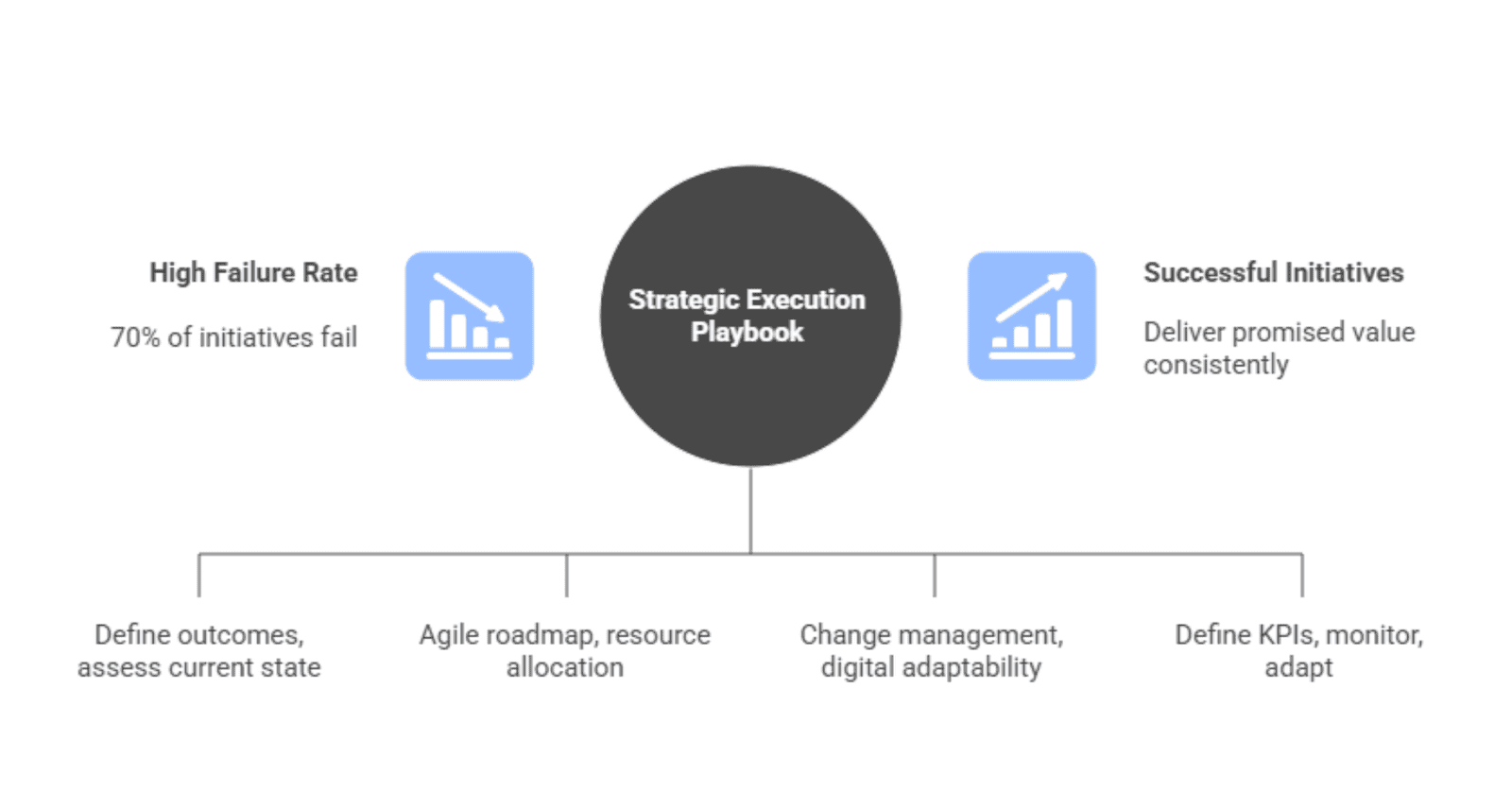
We are living in the golden age of digital tools. From AI-driven customer analytics to cloud-native supply chains, the technology exists to solve almost any business problem. Yet, research consistently shows that up to 70% of digital transformation initiatives fail to achieve their stated goals.
Why?
It is rarely because the technology didn’t work. It’s because the execution strategy was flawed.
Many organizations make the fatal mistake of treating Technology-Driven Strategic Initiatives as simple IT projects. They hand the roadmap to the CIO, set a launch date, and hope for the best. But a true strategic initiative is not about installing software; it is about driving a specific business outcome enabled by technology.
If you want to be part of the 30% that succeed, you need to bridge the gap between high-level strategy and ground-level implementation. This is your playbook for executing technology-driven strategic initiatives with precision.
Key Takeaways
- Focus on Business Outcomes Over Technology Features: Never begin an initiative by simply choosing a software platform. True strategic alignment requires defining clear, quantifiable operational or financial goals first, then selecting the technology that serves as a tool to achieve them
- Conduct an Honest Current State Assessment: Before deploying new solutions, perform a rigorous reality check of your organization’s existing environment. Identifying technical debt, legacy process bottlenecks, and internal skill gaps early prevents systemic roadblocks later
- Secure Active, Visible Executive Sponsorship: Successful digital transformation requires more than financial sign-off. Executive sponsors must actively advocate for the project, break down departmental silos, resolve resource conflicts, and drive the cultural shift from the top down
- Execute via a Phased, Agile Roadmap: Avoid the trap of massive, multi-year “waterfall” deployments that delay value. Instead, break strategic initiatives into iterative 90-day sprints to deliver minimum viable products (MVPs) quickly, maintain momentum, and allow flexibility to pivot
- Prioritize Change Management and the Human Element: Technology is only as good as its adoption rate. Address employee friction by anchoring your rollout to the four pillars of adoption: Communication, Training & Upskilling, Incentives, and Feedback Loops, to cultivate long-term digital adaptability
- Measure Success Through Outcome-Based KPIs: Shift from tracking activity milestones (e.g., “system launched”) to tracking lagging and leading business metrics (e.g., reduced sales cycle time or decreased customer churn). Continuously monitor post-launch data to learn, adapt, and optimize
Phase 1: How to Achieve Pre-Execution Alignment for Strategic Initiatives
Pre-execution alignment is the foundational stage where leaders define measurable business outcomes and verify organizational readiness before any technology is deployed.
Before a single line of code is written or a vendor is selected, the battle is often won or lost in the boardroom. The pre-execution phase is not about choosing the tech; it’s about defining the reality of your organization.
Why You Should Start with Business Outcomes Instead of Technology
Outcome-first planning ensures that technology serves as a tool to reach specific business goals, such as revenue growth or efficiency, rather than being the goal itself.
The most common trap is “solutioneering”, falling in love with a specific technology (e.g., “We need Generative AI!”) before defining the problem.
To succeed, you must identify your North Star. This measurable business objective validates the project’s existence.
- Bad Goal: “Implement a new CRM system by Q3.” (This is an activity, not an outcome)
- Good Goal: “Reduce customer churn by 15% and shorten the sales cycle by 20% within 12 months”
Tip: If you cannot draw a direct line between your initiative and one of your company’s top 3–5 corporate goals for the year, you should pause. Without that alignment, you will lose executive focus the moment a “fire” breaks out elsewhere in the business.
How to Conduct a Current State Assessment for Digital Readiness
A current state assessment is a critical reality check that identifies technical debt, skill gaps, and process bottlenecks that could impede the success of a new initiative.
You cannot map a route if you don’t know where you are starting. A Capability Gap Analysis is essential here. This involves an honest audit of three areas:
- People: Do you have the internal skills to manage this tech, or do you need to hire/outsource?
- Process: Are you automating a broken process? (As the saying goes, “Automating a bad process just yields bad results faster.”)
- Technology: What is your technical debt? Will legacy systems prevent integration?
How to Secure and Maintain Active Executive Sponsorship
Executive sponsorship involves senior leaders who provide the visible advocacy, budget authority, and cross-departmental influence necessary to overcome organizational inertia.
There is a massive difference between a sponsor who signs a check and a sponsor who champions the cause. You need the latter.
Technology initiatives often require cross-functional sacrifices. Sales may need to change how they enter data; Operations may need to learn a new interface. When resistance arises (and it will), you need a sponsor with the political capital to enforce the change. A coalition of leaders, typically involving the CIO, COO, and the head of the relevant business unit, is often more effective than a single sponsor.
Phase 2: How to Build a Strategic Execution Framework
An execution framework provides the structured roadmap, governance, and resource allocation required to turn a high-level strategy into a series of actionable steps.
Once alignment is secured, you move to the “How.” Traditional “Waterfall” project management, where you plan everything up front and deliver value two years later, is the death knell for modern tech initiatives. The market moves too fast for static roadmaps.
How to Build a Phased, Agile Roadmap Using 90-Day Sprints
A phased, agile roadmap breaks complex initiatives into manageable 90-day sprints, allowing for frequent value delivery and the flexibility to pivot based on feedback.
Adopt a Minimum Viable Product (MVP) mindset. Instead of trying to boil the ocean, identify the smallest chunk of value you can deliver quickly.
- Iterative Delivery: Break the initiative into 90-day sprints. Each sprint should deliver tangible value. This keeps momentum high and proves ROI to stakeholders early
- The Prioritization Matrix: Not all features are created equal. Plot your potential features on an Impact vs. Effort matrix. ruthlessly cut or defer low-impact, high-effort tasks
How to Manage Resource Allocation and Governance in IT Projects
Resource governance ensures that the right talent, technology, and capital are prioritized for the highest-impact tasks throughout the project lifecycle.
Silos are the enemy of speed. If your initiative involves a hand-off between the “Business Team” and the “IT Team,” you have already introduced friction.
Successful execution requires dedicated cross-functional teams. This means placing business analysts, developers, designers, and subject matter experts in the same (virtual) room, working toward the same KPIs.
Furthermore, establish a Steering Committee that meets monthly. Their job is not to micromanage tasks but to remove roadblocks and make rapid decisions on scope changes. If a decision takes three weeks to get approved, your initiative is already bleeding value.
How to Practice Proactive Risk Management in Complex Initiatives
Proactive risk management involves identifying potential technical or operational hurdles early and developing mitigation strategies before they derail the timeline.
Every project has risks. The amateurs hope they won’t happen; the pros plan for when they do.
- Technical Risks: What happens if the data migration fails? Have a rollback plan
- Dependency Risks: Are you waiting on a third-party vendor? Map out every dependency and have a contingency
- Adoption Risks: This is the biggest killer. If the system works perfectly but employees hate using it, the project is a failure
Phase 3: How to Manage the Human Element and Change Management
The human element of strategy focuses on the change management and psychological shifts required to ensure employees actually adopt and use new digital tools.
Here is the secret that tech consultants often charge millions to reveal: Technology problems are easy; people problems are complex.
You can buy the best software on the planet, but you cannot purchase adoption. Change management isn’t a “nice to have” HR activity; it is a critical workstream of your strategic initiative.
What Are the 4 Pillars of Successful Technology Adoption?
The 4 pillars of technology adoption, Communication, Training & Upskilling, Incentives, and Feedback Loops, form the blueprint for successful user transition to new systems.
To ensure your team embraces the new tool rather than finding workarounds, follow this structure:
- Communication (The “Why”): Most leaders communicate the “What” (“We are launching SAP”) but forget the “Why” and the “WIIFM” (What’s In It For Me). If you don’t explain how this change makes an employee’s life easier, they will resist it
- Training & Upskilling: A one-hour webinar is not training. Provide sandbox environments, peer-to-peer coaching, and “office hours” where users can ask questions without judgment
- Incentives: Does your performance review structure align with the new strategy? If you want sales reps to use a new CRM but only pay them on closed deals (regardless of data entry), they will never use it
- Feedback Loops: Create a mechanism for users to complain. When users feel heard, they become partners in the process rather than victims
How to Foster a Culture of Continuous Digital Adaptability
Digital adaptability is a cultural trait where an organization remains curious and resilient, viewing technological change as a continuous opportunity rather than a one-time event.
Executing a tech initiative is an opportunity to enhance your company culture. Encourage experimentation. If a sprint fails, celebrate the lesson learned rather than punishing the team. This psychological safety enables teams to innovate rather than play it safe and deliver mediocre results.
Phase 4: How to Measure and Scale Strategic Initiatives Over Time
Measurement and continuous improvement is the process of using real-time data to validate project success and refine strategies for long-term scalability.
The “Go-Live” date is not the finish line; it is the starting line.
How to Define Success Using Outcome-Based Strategic KPIs
Strategic KPIs (Key Performance Indicators) are quantifiable metrics—like ROI or cycle time reduction—that prove whether a technology initiative is meeting its business objectives.
You get what you measure. If you measure “On Time and On Budget,” you might end up with a project delivered on time but delivering zero value.
Shift your focus from Activity Metrics to Outcome Metrics:
- Activity Metric: “System uptime is 99.9%”
- Outcome Metric: “Order processing time reduced from 4 days to 4 hours”
- Outcome Metric: “Employee Net Promoter Score (eNPS) increased by 10 points”
Establish a baseline before you start. You cannot prove ROI without the “Before” picture.
How to Monitor, Learn, and Adapt Post-Deployment
The Monitor, Learn, and Adapt cycle uses post-launch performance data to identify optimization opportunities and inform the next iteration of the strategy.
Use real-time dashboards to keep the Steering Committee informed. Transparency builds trust.
Finally, conduct Post-Implementation Reviews (PIRs). What went wrong? What went right? Feed these insights back into the strategy. A technology-driven strategy is a living organism; it should evolve based on real-world data and user feedback.
Why Strategy is Nothing Without Successful Execution
Strategy is execution, which means that a brilliant plan is only valuable if it is successfully operationalized; the true competitive advantage lies in the ability to deliver results.
In the digital age, there is no such thing as a “pure business strategy” or a “pure IT strategy.” There is only one strategy, and it is almost always technology-driven.
The organizations that win in the next decade won’t be the ones with the flashiest AI tools or the most significant budgets. They will be the ones who master the art of execution. They will be the ones who align their teams, respect the human element of change, and relentlessly measure outcomes over activities.
A 70% failure rate is a daunting statistic, but it is not a destiny. By following this framework, you can ensure your technology initiatives deliver the value they promised.