
Aligning operations with strategy means ensuring that every team’s day-to-day activities, metrics, and budgets directly support the company’s overarching strategic goals. The gap between strategy and execution, the Execution Gap, is the primary reason well-crafted plans fail.
It’s the most frustrating scenario in corporate leadership: The executive team spends weeks crafting a brilliant, data-backed strategic plan. The vision is clear, the market opportunity is massive, and the board signs off.
Yet, six months later, nothing has changed fundamentally.
The sales team is pursuing the wrong leads, product development is stalled on low-priority features, and customer service is overwhelmed. The company is in constant motion, yet it is making zero progress.
If this sounds familiar, you don’t have a strategy problem. You have an alignment problem. You are suffering from the Execution Gap, the perilous void in which high-level strategic objectives fail to translate into frontline operational activities.
To win in today’s volatile market, you must ensure that every operational task, dollar, and hour is tightly aligned with your overarching strategy. Here is how to move from abstract boardroom theory to relentless operational execution using proven strategic frameworks.
Key Takeaways
- The Execution Gap is the reason strategies fail, not the strategy itself
- Value Chain Analysis identifies which operations create competitive advantage
- The GOST Framework cascades strategy from CEO to frontline worker
- The Balanced Scorecard links daily metrics to strategic goals
- The PDCA Cycle embeds continuous improvement into operations
The Agony of the Disconnect: Motion vs. Progress
In many organizations, operational teams operate in a vacuum. Without a clear line of sight into the macro-strategy, managers default to managing what is right in front of them, leading to the Vanity Metric Trap.
Imagine your new strategic objective is to position your company as a premium, high-touch boutique service. However, your customer service department still measures success by Average Call Handling Time. Your frontline workers are financially incentivized to rush high-value clients off the phone. Your operational activities are actively sabotaging your strategic objectives.
When operations and strategy disconnect, businesses face strategic drift, bloated budgets, and burned-out employees doing busy work. To fix this, you need a systematic bridge.
4 Frameworks to Connect the Boardroom to the Frontline
Bridging the Execution Gap requires a structured workflow. Using the Strategic Analysis Toolkit, you can deploy these four interconnected frameworks to ensure total alignment.
Value Chain Analysis: Map Your Value Engine
Before you can align your operations, you must understand them. Michael Porter’s Value Chain Analysis is a diagnostic tool that breaks down your business into its discrete operational activities (inbound logistics, operations, marketing, sales, and service).
This isn’t just an inventory; it’s an alignment test. By evaluating each link in the chain, you can ask: Does this specific operational activity give us a competitive advantage? If an activity doesn’t directly support your strategic objective (either by lowering costs or increasing differentiation), it’s operational waste. The Value Chain forces you to optimize or outsource activities that don’t matter and double down on those that do.
The GOST Framework: From Vision to Victory
Once you know where value is created, cascade your strategy downward. The GOST Framework is a four-level planning hierarchy (Goals, Objectives, Strategies, Tactics) that cascades executive strategy into frontline operational tasks.
GOST’s power lies in its strict hierarchy. The CEO owns the Goals (the broad destination) and Objectives (the measurable targets). The magic happens when department heads develop the Strategies (the approach), and frontline managers assign the Tactics (the daily tasks). With GOST, an entry-level employee doesn’t just have a task; they clearly understand how their specific tactic contributes to the CEO’s ultimate goal.
The Balanced Scorecard: Measure What Matters
You cannot manage what you do not measure, but measuring the wrong things is worse than not measuring at all. Traditional executive dashboards are like rearview mirrors, focusing solely on lagging financial metrics such as quarterly revenue.
The Balanced Scorecard solves this by translating your abstract strategy into operational terms across four perspectives: Financial, Customer, Internal Business Processes, and Learning & Growth. If your strategy is to innovate faster, the Balanced Scorecard ensures you track operational leading indicators, such as R&D cycle time or employee training hours, so your daily operations fuel your strategic ambitions.
The PDCA Cycle: Standardize Success
Strategy is not a static document; it is an ongoing hypothesis. As the market shifts, your operations must adapt. The PDCA Cycle (Plan, Do, Check, Act) embeds continuous improvement into your company’s DNA.
When an operational tactic fails to deliver the strategic result, you don’t rewrite the entire strategy. You use the PDCA loop to isolate the operational failure, tweak the process, validate the new data, and act to standardize the fix. This turns chaotic firefighting into calculated, strategic refinement.
The Missing Link: A Centralized Strategy Ecosystem
The fatal mistake most organizations make is treating these frameworks as isolated, static documents. A Value Chain sits in a slide deck. The Balanced Scorecard is buried in an Excel file. The GOST outline is lost in an email thread. When your strategic data is fragmented, operational alignment becomes impossible.
To align operational activities with strategic objectives, your strategy must be dynamic, centralized, and accessible.
This is exactly why we built the Strategic Analysis Toolkit.
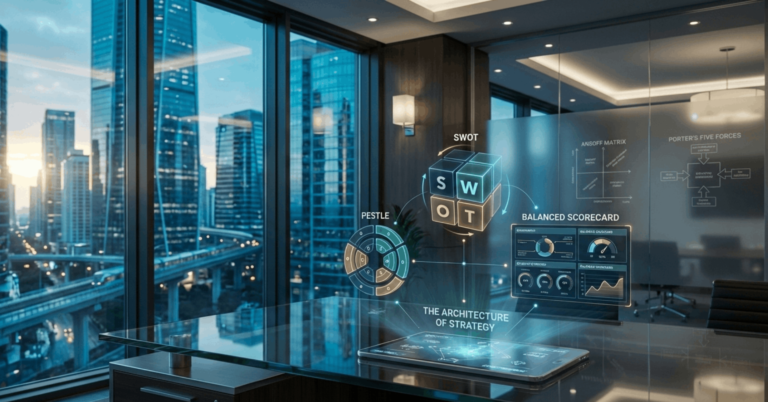
The Strategic Analysis Toolkit is a comprehensive strategic operating system that eliminates friction between planning and execution. It democratizes professional-grade consulting methodologies, letting you connect your external Discovery (PESTLE analysis, Porter’s Five Forces) directly to your internal Implementation (TOWS, Balanced Scorecard) within a single, seamless digital ecosystem.
Stop letting your brilliant strategies die on the vine of poor execution. Shift from static plans to continuous, aligned intelligence.
Start with the Strategic Analysis Toolkit today and turn your strategy into an unstoppable operational reality.
Frequently Asked Questions
What Is the Execution Gap in business strategy?
The Execution Gap is the disconnect between a company’s high-level strategic plan and its teams’ day-to-day operational activities. It’s why a well-crafted boardroom strategy can fail to produce real change; employees are busy, but their efforts aren’t aligned with the company’s actual goals.
How Do You Align Operations With Corporate Strategy?
Aligning operations with strategy requires a structured, top-down cascade. Start by mapping where your business creates value (Value Chain Analysis), then translate strategic goals into team-level tasks (GOST Framework), measure the right operational indicators (Balanced Scorecard), and continuously refine what isn’t working (PDCA Cycle).
What is the GOST Framework?
The GOST Framework stands for Goals, Objectives, Strategies, and Tactics. It’s a four-level planning hierarchy that cascades strategy from senior leadership down to frontline employees, ensuring every daily task connects directly to a broader organizational goal.
What Is the Balanced Scorecard and Why Does It Matter for Strategy Execution?
The Balanced Scorecard is a strategic measurement system that tracks performance across four perspectives: Financial, Customer, Internal Business Processes, and Learning & Growth. It prevents organizations from relying solely on lagging financial metrics, ensuring operational activities actively drive, not just reflect, strategic progress.
Why Do Most Strategic Plans Fail?
Most strategic plans fail not because the strategy is wrong, but because operational teams lack clear line of sight into it. Without structured frameworks to cascade goals, measure the right things, and continuously improve, teams default to managing what’s immediately in front of them rather than what actually matters strategically.
What Is Value Chain Analysis Used for in Strategy?
Value Chain Analysis breaks your business down into its discrete operational activities to identify which ones create competitive advantage and which represent waste. In the context of strategy execution, it acts as an alignment test — any activity that doesn’t support your strategic objective is a candidate for optimization or outsourcing.
What Is the PDCA Cycle?
The PDCA Cycle stands for Plan, Do, Check, Act. It’s a continuous improvement loop that allows organizations to test operational tactics, evaluate results against strategic outcomes, and standardize what works. It turns reactive firefighting into deliberate, strategy-driven refinement.
How Do I Know if My Operations Are Misaligned With My Strategy?
Common warning signs include teams hitting their KPIs while the company misses its strategic targets. At the same time, the company misses its strategic targets; metrics reward the wrong behavior (such as measuring call speed in a premium service business); budgets are allocated to low-priority activities; and employees can’t explain how their work connects to company goals.