
It is a harsh reality: success is often a threat to survival.
For mature businesses, decades of steady growth can quietly breed complacency. You build a strong foundation, optimize your supply chain, and capture your market share. But while your leadership team focuses on maximizing current efficiencies, the market shifts. A new technology emerges, consumer behavior pivots, and suddenly your tried-and-true operating model feels like a sinking ship.
If your organization is facing shrinking margins, sluggish growth, or the creeping sense that agile competitors are outmaneuvering you, you aren’t alone. You are experiencing strategic drift. Here is how mature businesses can break free of the success trap and stay fiercely relevant in a volatile economy.
Key Takeaways
- The Core Threat: Successful mature businesses often fall into the Success Trap—relying on decades of legacy processes while quietly succumbing to Strategic Drift (failing to keep pace with changing market environments)
- The Planning Pitfall: Traditional 5-year turnaround plans fail because they rely on Framework Fragmentation (e.g., marketing using SWOT on a whiteboard while finance relies on an outdated spreadsheet) instead of a unified strategy
- The Dynamic Solution: Organizations must pivot from static planning to Continuous Intelligence—a 4-step, interconnected strategic workflow:
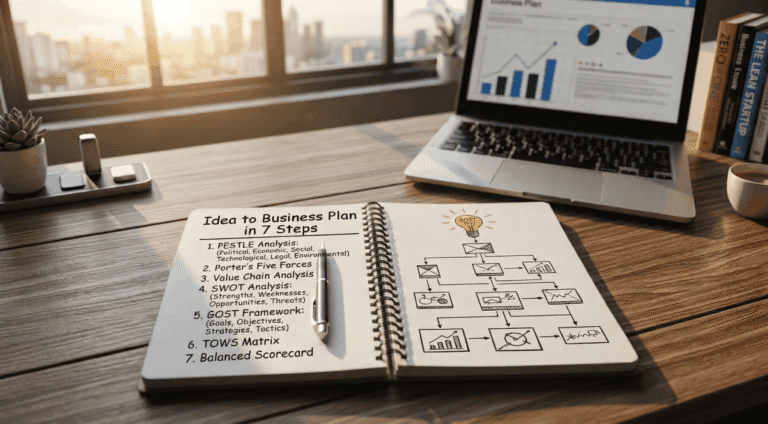
- Read the Terrain: Use PESTLE and Porter’s Five Forces to detect external tech and market shifts early
- Audit Internal Capabilities: Use Value Chain Analysis and SWOT to eliminate hidden operational bloat
- Discover Growth: Leverage the Ansoff Matrix and Blue Ocean Strategy to escape crowded, low-margin markets
- Bridge the Execution Gap: Deploy Kotter’s 8-Step Change Plan and the Balanced Scorecard to align daily KPIs with your overarching vision
What Are the Risks of Legacy Blind Spots and Framework Fragmentation?
When mature companies realize they are losing ground, their first instinct is often to plan a massive, reactive pivot. Leadership retreats off-site and returns with a thick, static PDF outlining a 5-year turnaround plan.
This is a recipe for failure. By the time the annual strategic plan is printed, the market has already moved. Furthermore, legacy companies often suffer from Framework Fragmentation. The marketing team uses a SWOT analysis posted on a whiteboard; the finance team relies on an outdated spreadsheet; the product team is chasing incremental features. There is no central nervous system connecting these insights.
This leads to the Sunk Cost Fallacy; pouring millions into dying, hyper-competitive Red Oceans simply because that is where the company has always operated. To survive, you must abandon fragmented, retrospective planning and adopt Continuous Intelligence.
How Can a Connected Strategic Workflow Solve Strategic Drift?
To navigate a shifting market, you don’t need to guess the future; you need a system that adapts to it. Here is the sequential, data-driven workflow that keeps mature businesses ahead of the curve.
Step 1: How Do You Read the Shifting Terrain Using PESTLE and Porter’s Five Forces?
Before you can change direction, you must understand the new battlefield. Relying on past performance data is like driving while looking in the rearview mirror.
- A PESTLE Analysis: Use this to scan the horizon. Are changing data privacy laws (Legal) or the rise of generative AI (Technological) about to make your core product obsolete?
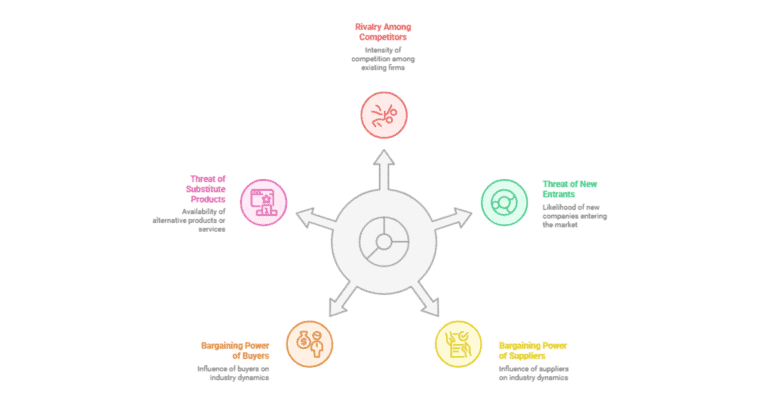
- Porter’s Five Forces: Re-evaluate your industry. Have barriers to entry dropped? Have suppliers gained new bargaining power?
Step 2: How Do You Audit Real Capabilities With Value Chain and SWOT Analyses?
Once you see the external threats, you must look inward with ruthless objectivity.
- Value Chain Analysis: Mature companies naturally accumulate operational bloat. A Value Chain Analysis pinpoints where you generate real value and where you burn cash on outdated processes
- A SWOT Analysis: Strip away executive bias and honestly map your internal strengths against the new external realities
Step 3: How Can the Ansoff Matrix and Blue Ocean Strategy Help Escape Red Oceans?
You cannot cut costs to achieve market dominance. You must find new growth..
- The Ansoff Matrix: Evaluate your growth alternatives systematically. Should you introduce a new product to your existing market or take your legacy product to an entirely new demographic?
- Blue Ocean Strategy: Stop fighting over shrinking, commoditized markets. Identify which factors your industry competes on that can be eliminated and what new value can be created to render your competitors irrelevant
Step 4: How Do You Bridge the Execution Gap Using Kotter’s Plan and a Balanced Scorecard?
The biggest threat to a mature business isn’t a lack of ideas; it’s the Execution Gap. Up to 70% of change initiatives fail because they are treated as IT upgrades rather than as shifts in human behavior.
- Kotter’s 8-Step Change Plan: Use this framework to create urgency, build a guiding coalition, and embed the new vision into your corporate culture
- The Balanced Scorecard: Ditch vanity metrics. Align your daily operational KPIs directly with your new strategic goals so every employee is rowing in the same direction
| Workflow Step | Core Frameworks Used | Primary Strategic Objective |
| Step 1 | PESTLE, Porter’s Five Forces | Identify external market threats & technological shifts. |
| Step 2 | Value Chain, SWOT Analysis | Uncover operational bloat and map true capabilities. |
| Step 3 | Ansoff Matrix, Blue Ocean Strategy | Escape hyper-competitive Red Oceans to find new demographics. |
| Step 4 | Kotter’s 8-Step, Balanced Scorecard | Bridge the execution gap by aligning operational KPIs. |
Frequently Asked Questions
What is strategic drift in mature businesses?
Strategic drift occurs when a mature company relies on legacy operations and decades of steady growth, quietly breeding complacency while the external market shifts. As new technologies or consumer behaviors pivot, the company’s tried-and-true operating model fails to keep pace, leading to shrinking margins and sluggish growth.
What is framework fragmentation and why does it cause failure?
Framework fragmentation happens when different teams within an organization use isolated, disconnected strategic tools—such as marketing using a SWOT analysis on a whiteboard while finance relies on an outdated spreadsheet. Because there is no central nervous system connecting these insights, it leads to a reliance on static plans and causes companies to pour millions into dying, hyper-competitive markets.
How can a business use continuous intelligence to stay relevant?
To stay relevant, a business must abandon retrospective, fragmented planning and adopt continuous intelligence through a connected strategic workflow. This involves an ongoing process of scanning external market forces, auditing internal capabilities with ruthless objectivity, identifying new growth opportunities, and directly aligning daily operational KPIs with strategic goals.
What frameworks help a business analyze external market shifts?
Businesses can read shifting market terrain by combining a PESTLE Analysis with Porter’s Five Forces. A PESTLE Analysis scans the horizon for macroeconomic shifts like legal changes or generative AI advancements, while Porter’s Five Forces re-evaluates industry barriers to entry and supplier bargaining power.
How do you bridge the strategy execution gap?
Bridging the execution gap requires treating change as a shift in human behavior rather than a simple operational upgrade. Organizations can bridge this gap by deploying Kotter’s 8-Step Change Plan to build a guiding coalition and embed a new vision into corporate culture, alongside a Balanced Scorecard to align daily employee KPIs directly with new strategic goals.
Why Should You Automate Your Strategic Evolution Process?
Here is the secret: executing this level of comprehensive, interconnected strategy is nearly It’s impossible to manage with scattered spreadsheets and isolated slide decks. The sheer friction of data management leads to Analysis Paralysis.
You need a centralized strategic operating system.
The Strategic Analysis Toolkit is designed for this. It democratizes professional-grade consulting methodologies, allowing you to seamlessly link your PESTLE findings to your Value Chain and cascade those insights directly into a Blue Ocean strategy and a Balanced Scorecard.
Stop wrestling with formatting and fragmented data. Move from static planning to dynamic execution.
Start your strategic analysis today and turn market disruption into your ultimate competitive advantage.