
It is a frustrating paradox in business leadership: your team is working harder than ever, your operational tempo is frantic, yet your revenue has flatlined. You have hit the dreaded growth plateau.
For many leaders, the immediate instinct is to push harder, increase ad spend, hire more sales reps, or launch a new feature. But hustle cannot fix a broken strategy. When a previously successful business stops growing, it is rarely due to a lack of effort. It happens because the organization relies on a playbook the market has already outgrown.
If your business is stuck in a cycle of motion without progress, you don’t need more meetings. You need a structured, objective, and deeply integrated strategic reset.
Why Did My Business Stop Growing?
Fast Track: Business growth typically stalls due to a “Strategy Disconnect”, relying on a playbook the market has outgrown while operations become fragmented. To fix a growth plateau, leaders must transition from intuition to a data-driven 4-step workflow: Diagnose external shifts (PESTLE), Identify margin leaks (Value Chain), Convert observations into strategy (TOWS), and Execute via aligned KPIs (Balanced Scorecard).
Why Your Company Feels Busy But Isn’t Growing (Motion vs. Progress)
In the early stages of a business, growth often masks operational flaws. You can power through inefficiencies with sheer willpower and market novelty. But as a business matures, the margin for error shrinks.
This is where the Strategy Disconnect occurs. Leadership teams spend a weekend offsite, draft a high-level vision, and assume the problem is solved. Yet six months later, nothing has changed. Why? Because the strategy is fragmented. Your market research lives in a static PDF, your operational budget is in an isolated spreadsheet, and your daily KPIs are disconnected from your overarching goals.
We call this the Frankenstein Strategy. A strategy that means an organizational approach where tactical business ideas are bolted together without a centralized framework. When external market forces shift, this lack of an integrated system leaves internal operations unable to adapt, causing business growth to stall.
How to Fix Stalled Business Growth Using a Strategic Analysis Workflow
To break through a growth plateau, you must transition from subjective intuition to a rigorous, data-driven workflow. You must connect the macro-environment to your internal operations and, ultimately, to your daily execution. Here is the exact framework progression used by top-tier consultants to reignite stalled growth.
Step 1: How to Use PESTLE Analysis to Diagnose External Market Threats
Growth often stalls not because of what you are doing but because the terrain beneath you has shifted. Are you fighting a battle you literally cannot win?
Before you adjust your internal operations, you must run a PESTLE analysis. This framework forces you to scan the Political, Economic, Social, Technological, Legal, and Environmental factors shaping your industry.
- Is a new data privacy law slowing down your marketing engine?
- Has a sociocultural shift made your core product feel outdated?
You cannot out-hustle a macro-environmental shift. By mapping the PESTLE factors, you identify the invisible forces capping your growth and adjust your sails accordingly.
Step 2: How to Identify and Fix Profit Margin Leaks with Value Chain Analysis
If the market is healthy but you still aren’t growing, the problem is inside the house. Many companies compete on price without understanding their cost drivers or differentiate without knowing where they add value.
A Value Chain Analysis allows you to dissect your organization into discrete activities. From inbound logistics to final customer service, where exactly are you creating undeniable value, and where are you simply burning cash? By mapping this out, you can strip away bloated support activities that are eating your margins and reinvest that capital into the primary activities that drive revenue.
Step 3: How to Turn SWOT Insights into Actionable Strategy Using TOWS
Every company has done a SWOT analysis. You list your Strengths, Weaknesses, Opportunities, and Threats on a whiteboard, take a photo of it, and never look at it again. This is Analysis Paralysis. Knowing you have a weakness doesn’t fix it.
To break a growth plateau, you must bridge the gap between observation and action using the TOWS Matrix. TOWS forces your static data to interact:
- Offensive Maneuvers (Strengths + Opportunities): How can we use our core competencies to aggressively capture a new market gap?
- Defensive Maneuvers (Weaknesses + Threats): How do we minimize our internal flaws to survive an upcoming industry disruption?
TOWS takes the abstract ideas from your SWOT and turns them into specific, actionable strategic initiatives.
Step 4: How to Align Execution and Overcome Strategic Gaps via Balanced Scorecard
The most brilliant TOWS maneuver will fail if your team doesn’t know how to execute it. If you are only looking at your quarterly P&L to measure success, you are driving while looking in the rearview mirror. Financials tell you what happened yesterday, not what will happen tomorrow.
To ensure your new strategy reignites growth, you must deploy a Balanced Scorecard. This system translates your high-level strategy into measurable, front-line objectives across four pillars: Financial, Customer, Internal Processes, and Learning & Growth. It ensures that every operational task, dollar, and hour is directly aligned with breaking your growth plateau.
| Strategic Step | Core Framework | Actionable Outcome for Stalled Growth |
| 1. External Diagnosis | PESTLE | Identifies macro shifts (tech, economic) capping market potential. |
| 2. Internal Audit | Value Chain | Isolates bloated support costs vs. primary value-driving activities. |
| 3. Strategic Pivot | SWOT to TOWS | Converts abstract observations into offensive or defensive maneuvers. |
| 4. Execution Alignment | Balanced Scorecard | Translates high-level goals into daily KPIs across 4 distinct pillars. |
Frequently Asked Questions
Why does a business suddenly stop growing even when the team is working hard?
A business plateau typically occurs due to a “strategy disconnect,” where the company relies on an outdated playbook while operations become fragmented. This creates a state of “motion without progress,” meaning your team is highly active and burning resources, but their daily efforts are no longer aligned with shifting market realities or profitable channels.
What is the difference between SWOT and TOWS analysis for business growth?
While a SWOT analysis simply lists your internal Strengths and Weaknesses alongside external Opportunities and Threats, a TOWS analysis is the actionable next step. TOWS pairs those factors together (e.g., matching a Strength with an Opportunity, or a Weakness with a Threat) to form explicit, offensive or defensive strategic maneuvers that you can actually execute.
How can leaders bridge the gap between strategic planning and daily execution?
To bridge the strategic execution gap, organizations utilize a Balanced Scorecard framework. This tool translates high-level corporate goals into daily, measurable KPIs across four distinct pillars: Financial performance, Customer satisfaction, Internal business processes, and Learning and organizational growth.
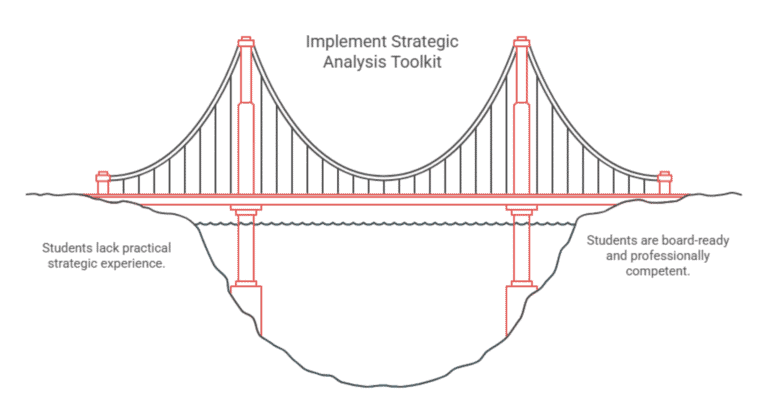
How to Automate Your Business Turnaround with the Strategic Analysis Toolkit
Understanding these frameworks is easy; connecting them in real time is the true challenge. Building these interconnected models manually takes weeks of administrative overhead—time a stalled business cannot afford.
This is where the Strategic Analysis Toolkit becomes your ultimate competitive advantage.
We have democratized professional-grade consulting methodologies. The toolkit is an integrated strategic operating system that centralizes your workflow. When you build your PESTLE analysis, the data flows seamlessly into your SWOT and TOWS matrix. When you define your strategy, it ports directly into your Balanced Scorecard.
Stop managing fragmented spreadsheets and start executing a unified vision. Sign up for the Strategic Analysis Toolkit today to eliminate analysis paralysis, align your team, and get your business growing again. Get your business growing again.