
What Is a TOWS Strategy?
A TOWS matrix is a strategic planning framework that turns the observations of a SWOT analysis into actionable plans. While SWOT identifies internal strengths/weaknesses and external opportunities/threats, TOWS cross-references these factors to generate four actionable strategies: Offensive (S-O), Defensive (S-T), Developmental (W-O), and Survival (W-T).
The strategy trap: why your SWOT is collecting dust.
Most leadership teams are familiar with the ritual: a whiteboard divided into four squares, a flurry of sticky notes, and a finalized SWOT analysis that looks impressive in a slide deck but never actually changes the company’s trajectory.
The problem isn’t the SWOT itself; it’s the analytical void that follows it. Identifying that you have a Strong Brand (Strength) and that there is Rising Market Demand (Opportunity) is an observation.
Strategy only begins when you ask:
Exactly how will we deploy our brand equity to capture that specific market share?
To bridge this gap, world-class strategists use the TOWS Matrix. While SWOT summarizes your current state, TOWS develops your future maneuvers.
What Are the Four TOWS Strategic Maneuvers?
The TOWS Matrix forces you to cross-reference your internal capabilities with external realities. By using the Strategic Analysis Toolkit, you can transform static lists into these four actionable pathways:
1. S-O: How Do Strengths-Opportunities (S-O) Strategies Function?
These are your Offensive moves. You are looking for ways to use your internal strengths to capitalize on external opportunities.
Example: If your strength is an efficient R&D team and the opportunity is a new green-energy subsidy, your S-O strategy is to fast-track a line of eco-friendly products.
2. S-T: How Do Strengths-Threats (S-T) Strategies Function?
These are Defensive moves. Here, you leverage your strengths to minimize the impact of external threats.
Example: If a new competitor is entering the market (Threat) but you have a loyal, long-term customer base (Strength), your S-T strategy might be a loyalty-exclusive rewards program to lock in your market share before the competitor gains traction.
3. W-O: How Do Weaknesses-Opportunities (W-O) Strategies Function?
These are Developmental moves. You aim to overcome internal weaknesses by taking advantage of external opportunities.
Example: If your weakness is an outdated digital presence, but there is an opportunity to reach a younger demographic via social commerce, your W-O strategy is to partner with a digital agency to overhaul your storefront for social integration.
4. W-T: How Do Weaknesses-Threats (W-T) Strategies Function?
These are Survival moves. They focus on minimizing weaknesses and avoiding threats. This often involves restructuring, outsourcing, or even exiting a specific niche to prevent a catastrophic failure.
Why Is Manual Strategic Planning Difficult?
While the logic of TOWS is simple, the execution is often messy. Mapping dozens of SWOT factors against each other leads to analysis paralysis. You end up with fifty possible strategies but no clear idea of which one to fund first.
Furthermore, strategy shouldn’t exist in a vacuum. A TOWS matrix is only effective if a rigorous PESTLE Analysis feeds it and a Porter’s Five Forces review, and then funneled into a Balanced Scorecard for tracking. Doing this in disparate Word documents or spreadsheets is where strategy goes to die.
How Can Execution Be Mastered Using the Strategic Analysis Toolkit?
This is where the Strategic Analysis Toolkit becomes your competitive advantage. Instead of wrestling with formatting and disconnected data, our platform provides a seamless, end-to-end strategic ecosystem.
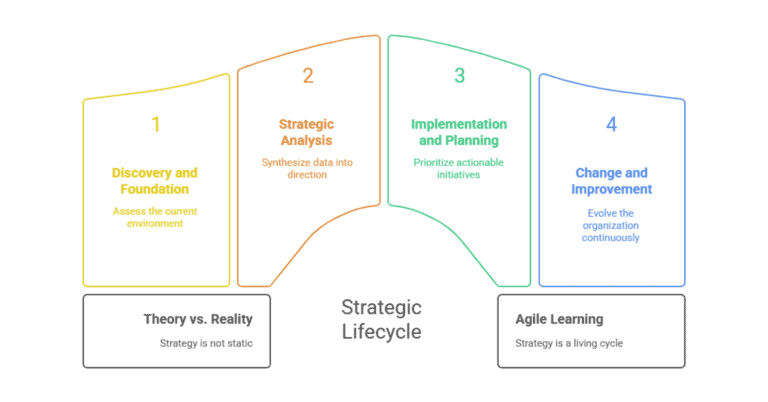
- Integrated Intelligence: Your SWOT and TOWS aren’t standalone files. They are part of a structured flow that includes Discovery and Foundation (Value Chain Analysis) and Change and Improvement (PDCA Cycle)
- TOWS Prioritization: Our toolkit doesn’t help you list maneuvers; it enables you to prioritize them. Identify which moves offer the highest ROI and align best with your GOST (Goals, Objectives, Strategies, and Tactics)
- Visual Clarity: Transition from brainstorming to Executive Summary views that are ready for board-level presentations
How Can Organizations Transition From Ideas to Impact?
Strategy is not a document; it is a choice of maneuvers. If you are tired of doing a SWOT and seeing no results, it is time to upgrade your process.
The Strategic Analysis Toolkit gives you the professional-grade frameworks, from Ansoff Matrix to Kotter’s 8-Step Plan, required not to plan, but to win.
Stop listing your problems. Start plotting your moves.
Explore the Strategic Analysis Toolkit Now.
Frequently Asked Questions
What is the main difference between SWOT and TOWS?
While a SWOT analysis identifies your internal strengths and weaknesses alongside external opportunities and threats, a TOWS matrix takes the next step by cross-referencing these factors to create actionable, strategic plans.
When should a company use a TOWS matrix?
A company should use a TOWS matrix immediately after completing a SWOT analysis, particularly when leadership needs to translate their observations into concrete strategic initiatives and prioritize which moves to fund and execute first.
Can TOWS be used without a SWOT analysis?
No, a TOWS matrix directly relies on the data generated during a SWOT analysis. You must first identify your internal and external factors before you can combine them to formulate Offensive, Defensive, Developmental, and Survival strategies.