What Is a Business Unit Review (BUR)?
A Business Unit Review is a scheduled, disciplined forum for assessing the operational health, strategic alignment, and future trajectory of a specific division, product line, or geographic unit. It is typically held monthly or quarterly, bringing unit leadership and corporate executives together.
Crucially, a BUR is not just a reporting meeting where slides are read aloud. It is an action-oriented strategic dialogue. The focus shifts from simply stating variances to debating root causes, aligning resources, making critical decisions, and committing to clear next steps.
Why Is a Structured Business Review Critical for Success?
Have you ever looked at your company’s year-end results and felt a nagging sense of underperformance? Perhaps the overall numbers were fine, but deep down, you knew certain divisions were coasting, missing targets, or simply struggling to scale best practices across the organization. You hit the budget, yet you sense your organization is far from reaching its true potential.
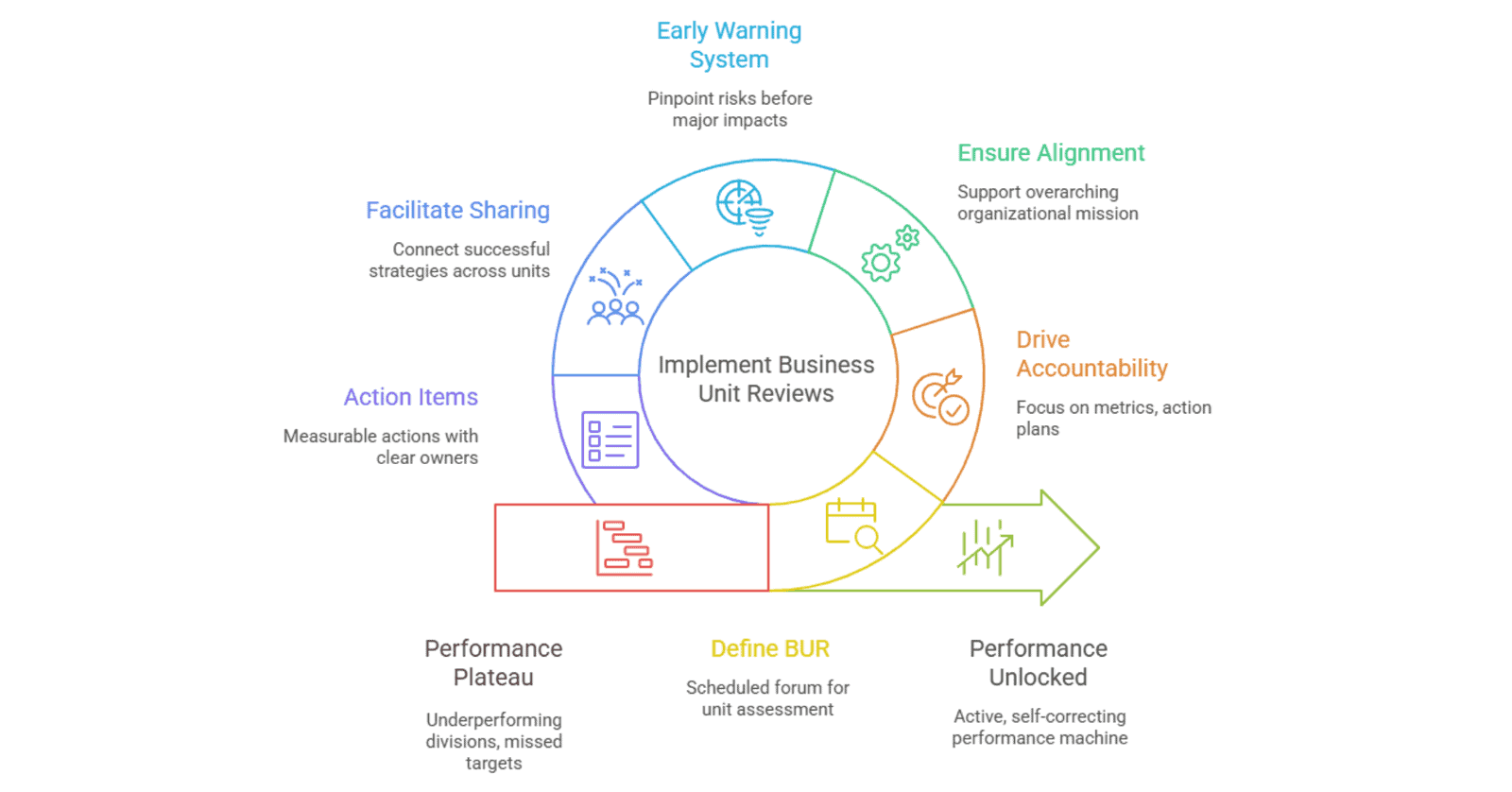
This is the performance plateau, a common challenge for successful companies that rely on traditional, high-level financial reporting to manage complex operations. While the quarterly P&L tells you what happened, e.g., “Sales were 10% below forecast”, it fails to tell you the critical why and, most importantly, how to fix it. It’s a rearview mirror, not a navigational map.
This is where the power of structured, recurring Business Unit Reviews (BURs) comes into play.
Why Are Strategic Performance Imperatives Vital for Growth?
Implementing regular, well-executed Business Unit Reviews is the single most effective way for an organization to drive unwavering accountability, ensure every unit is rowing in the same strategic direction, and unlock the significant performance that is often trapped within silos. If you want to move beyond surface-level reporting and into proper operational governance, the BUR is your blueprint.
Key Takeaways
- Strategic Over Operational: An effective Business Unit Review (BUR) is a forward-looking strategic forum, not a reactive, line-by-line financial line-item review
- The 5 Pillar Framework: Maximum alignment is achieved by structuring the agenda around five core pillars: Financial Health, Market Dynamics, Operational Metrics, Strategic Initiatives, and Risk Management
- Focus on Leading Indicators: Successful reviews prioritize leading operational indicators (like sales pipeline or project milestones) over lagging financial metrics to anticipate and fix problems early
- The 80/20 Preparation Rule: Eighty percent of a review’s value is determined before the meeting starts, relying on mandatory pre-read materials and strict adherence to a standardized agenda layout
- Accountability & Action: The ultimate output of a BUR is a clear, documented list of action items with designated owners and explicit deadlines to drive continuous performance improvement
Why Are Business Unit Reviews Essential for Corporate Success?
Relying solely on lagging financial indicators is a recipe for strategic drift. BURs provide the forward-looking, granular insight required for proactive management.
How Do Business Unit Reviews Drive Execution Accountability?
When a unit knows its performance metrics, project progress, and resource requests will be regularly scrutinized by the C-Suite, the nature of leadership within that unit changes. BURs focus senior leadership attention on specific unit metrics, forcing unit leaders to move past excuses, own their numbers, and present not just the problem, but a concrete action plan for improvement. This establishes a culture of radical transparency and high ownership.
How Do Business Unit Reviews Prevent Strategic Drift?
Large organizations often suffer from strategic fragmentation, in which individual units, seeking to maximize their own success, unintentionally end up working against the overarching corporate strategy.
For example, a marketing unit might spend heavily on a new channel, while the corporate strategy mandates investment in existing, profitable ones. The BUR process requires unit leaders to explicitly demonstrate how their unit priorities (projects, budget proposals, hiring) directly support the overarching organizational mission. This powerful check prevents the insidious strategic drift that erodes corporate value over time.
How Can a Business Review Serve as a Risk Early Warning System?
The biggest failures often start as minor, localized problems that go unnoticed until they’ve grown too large to contain. A key function of the BUR is to serve as an early warning system. By deep-diving into granular operational and execution metrics, not just the bottom line, the review pinpoints underperforming areas, resource bottlenecks, or execution risks before they translate into major financial impacts. Catching a significant supply chain issue or an unexpected spike in customer churn early can save millions.
How Do Corporate Reviews Facilitate Best Practice Sharing?
When corporate leaders review multiple business units, they gain a holistic view of what’s working and what’s not. The BUR acts as a cross-pollination platform. Senior leadership can quickly connect successful strategies from one unit to a struggling unit. For instance, if “Unit A’s sales funnel optimization strategy increased conversion by 15%,” the BUR provides the immediate opportunity to mandate the implementation of that exact strategy in “Unit B.” This is how you effectively scale success.
What Are the 5 Pillars of an Effective Business Unit Review Agenda?
The structural integrity of a BUR is defined by its agenda. To move past simple reporting, the review must consistently cover these five pillars, maintaining a laser-like focus on action over description.
How Do You Track Financial Performance Against a Corporate Plan?
This is the foundation, but the key is efficiency. Unit leaders must present a concise scorecard focusing on the variance between actual results and the plan.
- Key Metrics (KPIs): Revenue, Expense/Budget Variance, Gross Margin, Unit-level Profitability, and Working Capital/Cash Flow
- Focus: The discussion should immediately pivot to: “What are the top three drivers of this variance?” and “What is the committed, measurable plan to close the gap in the next 30/60/90 days?”
How Should Operational Performance Be Evaluated in a Review?
Financial results are lagging indicators. Operational metrics are leading indicators of future financial health. This section reveals the efficiency and quality of the unit’s core activities.
- Key Metrics: These must be unit-specific
- For a Sales Unit: Sales Cycle Length, Win Rate, Customer Acquisition Cost (CAC)
- For a Manufacturing Unit: Production Throughput, Scrap Rate, On-Time Delivery % (OTD)
- For an HR Unit: Employee Churn Rate, Time-to-Hire, Training Compliance
- Focus: Is the engine running efficiently? Are processes stable? Operational bottlenecks often explain financial shortfalls, and this section forces those to be addressed
How Do You Measure the Progress of Strategic Initiatives?
This pillar ensures the unit is actively building the future. The unit leader should present a progress update on the top 3-5 strategic projects critical to long-term growth (e.g., launching a new product line, implementing a new enterprise software system, entering a new market).
- Review: What milestones were hit/missed? What are the resource and timing risks?
- Focus: Are the unit’s resources (time, money, personnel) dedicated to the projects that will deliver the most long-term strategic value? This prevents the “urgent” from constantly overriding the “important.”
How Do You Forecast Future Risks and Market Opportunities?
The purpose of this segment is to look outward. What is the unit seeing on the horizon that the central office might miss?
- Risk: Identification of emerging market threats (competitors, new regulations, supply chain instability)
- Opportunity: Unforeseen market opportunities or customer needs
- The “Ask”: The unit leader must clearly state the critical support, resources, or decision-making authority needed from the central team to mitigate a risk or capture an opportunity. This is a crucial point of leverage for corporate leadership
How Do You Enforce Action Items and Accountability?
This is the most critical part of the entire review. A BUR without clear, assigned actions is just a status update.
- The Commitment: Every agreed-upon decision, required next step, and resource allocation must be captured as a concrete, measurable action item with a clear owner and a firm due date
- Focus: The following review must begin with a check-in on the status of every action item from the prior meeting. This is the mechanism that maintains accountability and ensures the review is a driver of change, not just conversation
What Are the Best Practices for Implementing a Business Review?
The success of a BUR relies less on the agenda and more on the discipline of its execution. Treat this review like the most critical strategic meeting on your calendar.
Why Is Meeting Preparation 80% of a Review’s Strategic Value?
The meeting time itself should be reserved for debate and decision, not data presentation. To achieve this, you must mandate a standardized pre-read package.
- Standardization: All units use the same template to facilitate quick comparison
- Concision: The packet should be short; a 1-3 page executive summary and 5-7 pages of supporting data charts maximum
- Timeliness: Send the materials out at least 48 hours in advance
- Rule of Engagement: Senior leaders must review the materials before the meeting. If they haven’t read the materials, the unit is not required to present them
Who Are the Right Participants for a Business Unit Review?
Keep the core group small and focused on decision-makers, not just observers. The typical core attendance should include the Unit Head, a dedicated Finance Representative, and the relevant C-Suite or VP Sponsors. Bringing in unnecessary attendees dilutes the focus and discourages honest dialogue.
How Can Executive Leadership Master Strategic Corporate Dialogue?
The Chair of the review (usually the CEO or CFO) must actively guide the conversation.
- Focus on the “Why” and “What Next”: Intervene quickly if the presenter reads the slides. Ask penetrating questions like: “We see the expense variance, but why did the forecasting miss it so badly?” or “Given this operational slowdown, what is the guaranteed action you are taking this week to fix it?”
- Maintain Constructive Tension: The goal is to challenge assumptions and push for better plans, not to criticize the people. The meeting should feel like a working session, not an inquisition
How Do You Standardize the Cadence and Rhythm of Business Reviews?
Consistency is paramount.
- Frequency: Determine the appropriate rhythm. High-velocity, high-risk, or turnaround units may require a Monthly BUR. A Quarterly review might best serve stable, mature units
- The Golden Rule: Never skip a session. Cancelling a BUR signals to the organization that the review process is optional, undermining the culture of accountability you are trying to build
Frequently Asked Questions
What is the primary purpose of a Business Unit Review?
The primary purpose of a Business Unit Review (BUR) is to evaluate the strategic alignment, operational performance, and risk landscape of a specific business division. Unlike a standard financial audit, a BUR serves as a forward-looking governance tool to ensure individual business units are successfully executing the broader corporate strategy.
How often should corporate leaders conduct a Business Unit Review?
A Business Unit Review should ideally be conducted on a monthly or quarterly cadence. High-growth, volatile, or underperforming business units benefit most from monthly reviews to allow for rapid course corrections, while mature, highly predictable divisions can be effectively managed on a quarterly cycle.
What is the difference between leading and lagging indicators in a business review?
Lagging indicators measure past performance, such as historical revenue, net income, or quarterly expenses, showing what has already happened. Leading indicators are predictive metrics, such as sales pipeline velocity, customer acquisition rates, or product development milestones, which signal future performance and give leadership time to proactively address operational issues.
How long should a standard Business Unit Review meeting last?
A standard, effective Business Unit Review should last between 90 minutes and 2 hours per business unit. To maintain this timeline, all participants must review the materials beforehand, allowing the meeting itself to focus 20% on presenting data and 80% on strategic discussion, problem-solving, and action items.
Who should attend a Business Unit Review?
A Business Unit Review should be attended by the executive leadership team (such as the CEO, CFO, and COO) and the specific Business Unit leader, along with their direct reports (including their heads of finance, operations, and sales). Keeping the attendee list tight ensures high-level accountability and focused strategic debate.
How Do You Shift Beyond Data Reporting to True Corporate Governance?
The implementation of rigorous, disciplined Business Unit Reviews transforms an organization from a passive, reporting entity into an active, self-correcting performance machine.
By moving past surface-level P&L metrics and diving deep into each unit’s financials, operations, strategic progress, and risks, your leadership team gains the clarity and control necessary to make timely, impactful decisions. This structured governance ensures that every dollar spent, every hour worked, and every decision made across your complex organization is deliberately aligned with your highest strategic goals.
Call to Action: Audit your current review process today. Are your standing meetings merely generating status updates, or are they consistently generating a list of measurable, accountable action items that drive material change?
The path to sustainable, high-level performance is not built on complex, esoteric strategy frameworks. It is built on the simple, disciplined habit of focused, action-oriented business unit governance. Start treating your BURs as your organization’s most critical strategic asset, and watch your trapped performance finally be unlocked.