Stop Guessing, Start Winning: How to Build a Systematic Competitive Intelligence Program
The market is a battlefield, and the vast majority of companies are fighting blind. They rely on gut feelings, anecdotal evidence from the sales team, and reactive maneuvers to respond to competitors’ moves. If a competitor’s new product launch has ever blindsided you, lost a crucial bid due to an unexpected pricing change, or watched a market trend emerge seemingly out of nowhere, you understand this pain.
The harsh reality? According to analyses by organizations such as the U.S. Chamber of Commerce, up to 60% of business failures could be prevented through proper, proactive market analysis and foresight. The most significant risk to your business isn’t necessarily internal; it’s the unknown forces lurking just beyond your line of sight.
This is where the discipline of Competitive Intelligence (CI) transforms your organization. CI is the engine that converts raw, scattered market data into strategic foresight; it is your ultimate, legal, and ethical competitive advantage.
A systematic approach to Competitive Intelligence is not optional; it is the indispensable engine for anticipating market shifts, identifying threats, and uncovering non-obvious opportunities for profitable growth.
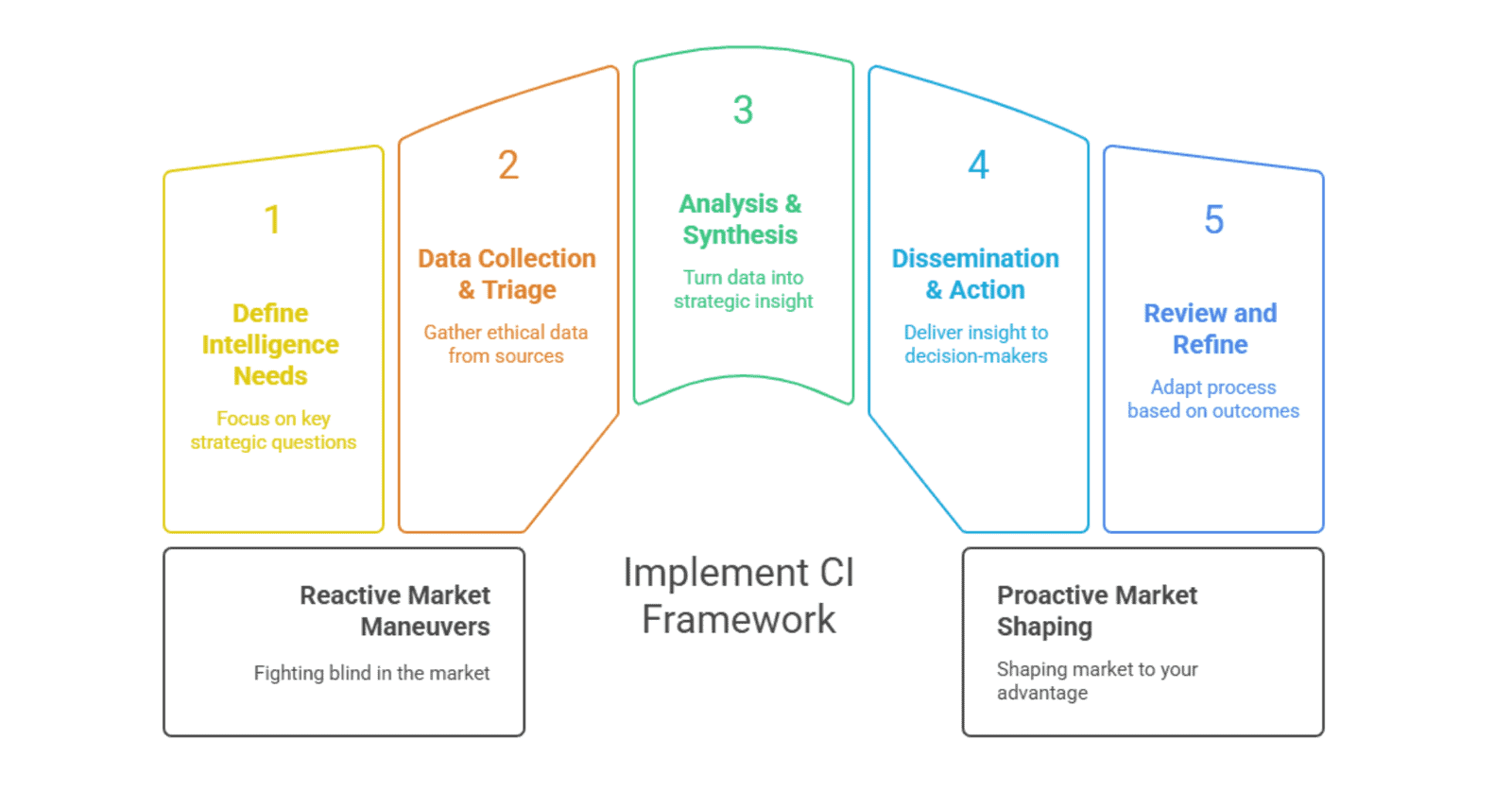
Over the next few minutes, we will walk you through a proven, systematic 5-step CI Framework used by leading consulting firms to help you build a robust intelligence program that guarantees you always know what your competitor is planning before they execute it.
Key Takeaways
Competitive Intelligence (CI) is a legal, ethical, and systematic process for transforming raw market data into actionable strategic insights. It is strictly separated from corporate espionage by its reliance on public, open-source information.
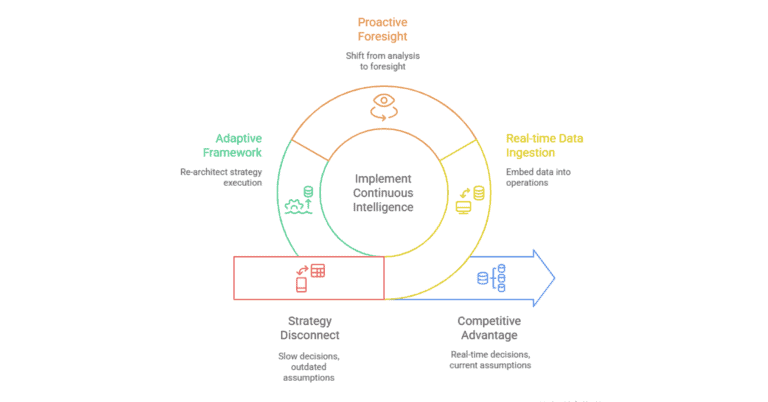
The 4 A’s Lifecycle: A robust CI program continuously cycles through four core phases: Acquisition (gathering data), Analysis (interpreting patterns), Action (disseminating insights), and Adaptation (refining the process).
The 5-Step Framework:
- Define Requirements: Align focus using Key Strategic Questions (KSQs) and Key Intelligence Topics (KITs).
- Collect Data: Triage primary (direct) and secondary (published) sources while assessing source confidence.
- Analyze & Synthesize: Apply structured strategic frameworks to build predictive competitor profiles.
- Disseminate: Deliver tailored, high-impact insights directly to executive decision-makers.
- Review & Refine: Audit the process and leverage automation technology to maintain a sustainable competitive advantage.
What Is Competitive Intelligence (CI)?
Competitive Intelligence (CI) is the systematic, legal, and ethical process of gathering and analyzing publicly available market data to anticipate competitor moves and drive strategic advantage.
What Is the Difference Between Competitive Intelligence and Corporate Espionage?
There is a persistent, harmful misconception that CI is synonymous with corporate spying or industrial espionage. This is false and must be firmly rejected.
- Competitive Intelligence (CI): The ethical, legal, and systematic collection and analysis of publicly available data. This includes press releases, financial reports, job postings, social media, product reviews, and public speaking engagements. Its singular goal is strategic advantage through legal insight
- Corporate Espionage: Involves illegal and unethical methods, such as the theft of trade secrets, hacking, bribery, or misrepresenting one’s identity. In the United States, this can lead to severe penalties under the Economic Espionage Act of 1996
Competitive Intelligence is about seeing and synthesizing what is public but invisible to the untrained eye; espionage is about stealing what is private and secured.
A successful Competitive Intelligence program operates entirely above board and within the letter of the law.
What Are the 4 A’s of the Competitive Intelligence Life Cycle?
All effective CI programs follow a continuous, systematic process. Think of CI as a loop, not a one-time project:
- Acquisition: Gathering legal and ethical data from primary and secondary sources.
- Analysis: Turning that raw data into clear, synthesized insight and implications.
- Action: Disseminating the insight to the right decision-makers in an actionable format.
- Adaptation: Reviewing and refining the entire process based on outcomes.
The ultimate strategic value of this cycle is anticipation. Your CI program should answer the critical question: “What is our competitor going to do before they do it, and what should our counter-strategy be?”
What Is the 5-Step Competitive Intelligence Framework?
This framework provides the structure necessary to transform random data collection into a predictable, high-value strategic asset.
How Do You Define Your Competitive Intelligence Requirements?
The biggest mistake companies make is collecting data first and asking questions later. A systematic CI program always starts with the business strategy.
What Are Key Strategic Questions (Ksqs) in Business Strategy?
Your CI efforts must be driven by the challenges and uncertainties keeping your executive team up at night. These are your Key Strategic Questions (KSQs).
- KSQ Examples:
- “How will Competitor X’s new partnership with a major distributor impact our Q4 market access?”
- “What is the true timeline and budget allocation for Competitor Y’s rumored entry into the Asia-Pacific market?”
- “How is the new regulatory environment going to affect our competitor’s supply chain efficiency versus ours?”
How Do You Identify Key Intelligence Topics (Kits)?
Group your KSQs into manageable themes, known as Key Intelligence Topics (KITs), which organize your collection efforts.
- Common KITs: Competitor Financial Health, Product Roadmap, Go-to-Market (GTM) Strategy, Talent Acquisition/Key Hires, Regulatory Vulnerabilities
The importance of this step cannot be overstated: If the intelligence you gather does not directly address a KSQ, it is noise, not intelligence.
How Do You Collect and Triage Data for Competitive Intelligence?
With your KSQs and KITs defined, you can now focus your data collection more efficiently.
What Are the Best Primary Sources for Competitor Data?
These involve human interaction and often yield the most valuable, nuanced insights:
- Win/Loss Analysis: Systematically interviewing prospects who chose a competitor to understand why they defected
- Conference and Trade Show Analysis: Observing competitor booth traffic, listening to their presentations, and legally engaging their sales representatives
- Key Informant Interviews: Legally and ethically speaking with former employees, current customers, and industry consultants
Which Public Secondary Sources Are Ethical for CI Gathering?
The digital age provides an ocean of free, public data, if you know where to look:
| Source Category | Data Insight Revealed |
| Financial Indicators | Strategy, investment focus, profitability, and cost structure (e.g., SEC/company filings, earnings call transcripts). |
| Product & Technology | Upcoming features, R&D priorities, and patent focus (e.g., Patent filings, open-source contributions, technical forums). |
| Personnel & Direction | Geographic expansion, technology stack, and strategic direction (e.g., Job postings, LinkedIn profiles of key hires/departures). |
| Market Sentiment | Customer pain points and product weaknesses (e.g., Social media sentiment, online product reviews, Reddit forums). |
How Do You Measure Source Confidence in Market Analysis?
Not all data is equally reliable. Implement a rating system for source confidence (e.g., A: Confirmed by three independent sources; D: Unverified social media rumor) to ensure your analysis is built on a solid foundation.
How Do You Analyze and Synthesize Competitor Information?
Raw data is useless. Analysis is the alchemy that turns data into gold.
Which Strategic Frameworks Are Used to Interpret Competitor Data?
You must apply proven analytical frameworks to uncover non-obvious conclusions:
- SWOT Analysis (Applied to the Competitor): Understanding a competitor’s internal Strengths, Weaknesses, market Opportunities, and external Threats allows you to predict their likely actions
- War Gaming: A crucial exercise where executives role-play as key competitors to simulate potential future moves. Example: If Competitor Z launches a disruptive new AI feature, what is our immediate, mid-term, and long-term response?
- Benchmarking: Systematically comparing feature sets, pricing models, and GTM channel efficiency
How Do You Build an Actionable Competitor Profile?
The goal is to create a structured, living document for each key competitor that synthesizes all gathered data into a cohesive narrative. This profile includes: Strategic Goals, Core Competencies, Assumptions about the Market, Organizational Culture, and Likely Future Moves.
The most critical part of this step is synthesizing the “So What?”: Every finding must conclude with a clear, actionable implication for your company.
How Should Competitive Intelligence Be Shared and Acted Upon?
The most insightful analysis is worthless if it sits in a report on a shared drive. Intelligence must be delivered to the right person, in the correct format, at the right time.
What Is the Best Format to Deliver Intelligence Reports to Executives?
Intelligence must be custom-packaged for the audience to drive action:
- For the Sales Team: Create concise, easily searchable Battle Cards. These detail the competitor’s weaknesses, key talking points, and how to position your solution as superior
- For Executive Leadership: Deliver short, high-level Strategic Alerts focused on proactive decision-making (e.g., “The data suggests Competitor X will pivot to a subscription model in Q2. Recommendation: Launch a one-time purchase option now to capture high-volume customers.”)
- For Product/R&D Teams: Provide detailed Feature Benchmarking Reports and gap analyses to inform the product roadmap
How Do You Measure the Impact of a CI Program?
A systematic program measures its return on investment (ROI). Track metrics like: Competitive Win Rate, time-to-market reduction for new features based on CI, and avoidance of strategic missteps.
How Do You Review and Refine a Market Analysis Process?
Competitive Intelligence is a marathon, not a sprint. The cycle must be perpetual.
How Do You Perform a Competitive Intelligence Process Audit?
The market and your competitors are constantly evolving, so your questions must evolve, too. Review your Key Intelligence Topics (KITs) and Key Strategic Questions (KSQs) quarterly. Are you still asking the right questions?
How Do You Build a Feedback Loop for Strategic Intelligence?
Always follow up on the intelligence that led to a decision. If a competitor made a move that contradicted your forecast, you have a critical learning opportunity. Analyze why your forecast was wrong, and adjust your sources or analytical frameworks accordingly.
What Tools Can Automate the Competitive Intelligence Process?
Invest in the right tools (CRM plugins, dedicated CI platforms) to automate the low-value tasks, the routine scraping and collection of public data, freeing your analysts to focus on high-value, human-driven synthesis and interpretation.
Why Is Competitive Intelligence a Sustainable Competitive Advantage?
Competitive Intelligence is not an obscure function; it is a fundamental strategic capability. It shifts your business from a state of reaction (always playing catch-up) to a position of proaction (shaping the market to your advantage).
The cost of ignorance always outweighs the cost of intelligence. With up to 20% of startups failing in their first year and the average corporate lifespan shrinking, the risk of not knowing your market is exponentially higher than the investment required for a systematic CI program.
It’s time to stop fighting blind and start making data-driven decisions that anticipate the future.
Frequently Asked Questions
What is Competitive Intelligence (CI)?
Competitive Intelligence is the systematic, legal, and ethical process of gathering, analyzing, and transforming public market data into actionable strategic insights. It helps organizations anticipate competitor actions, identify market vulnerabilities, and make data-driven decisions to maintain a sustainable competitive advantage.
Is Competitive Intelligence legal?
Yes. Competitive Intelligence is entirely legal and ethical because it relies strictly on open-source intelligence (OSINT), public records, and ethical primary research. It draws a sharp line against corporate espionage, which involves illegal activities such as theft, hacking, misrepresentation, or violating non-disclosure agreements (NDAs).
What are the 5 steps of a Competitive Intelligence framework?
A systematic CI framework consists of five continuous steps:
1. Define Intelligence Requirements: Aligning the scope using Key Strategic Questions (KSQs).
2. Data Collection & Source Triage: Gathering raw data from verified primary and secondary sources.
3. Analysis & Synthesis: Applying strategic frameworks to turn raw data into predictive competitor profiles.
4. Dissemination and Action: Delivering tailored, impactful insights to executive decision-makers.
5. Review and Refine: Auditing the process and using automation technology to adapt the system.
What is the difference between a KSQ and a KIT?
While both drive the intelligence process, a Key Strategic Question (KSQ) is the broad, high-level uncertainty facing executive leadership (e.g., “Should we enter the European market?”). A Key Intelligence Topic (KIT) is the specific, granular category of information required to answer that KSQ (e.g., “What are the regulatory compliance costs for competitors in Germany?”).
What are the 4 A’s of the Competitive Intelligence lifecycle?
The 4 A’s represent the continuous operational lifecycle of intelligence:
– Acquisition: Collecting raw data from ethical sources
– Analysis: Evaluating data to extract meaningful trends and insights
– Action: Disseminating the insights to stakeholders to drive strategic moves
– Adaptation: Upgrading the intelligence collection process based on feedback and results
Your Next Step
Don’t try to implement this entire framework overnight.
Start simple: Identify your top three market threats and your top three Key Strategic Questions (KSQs) for the next six months. Assign a clear data collection and analysis plan to each, and take the first step toward building your systematic competitive edge.