What Is the Silent Killer of Non-Profit Impact?
Non-profit leadership is where “busy” is the default setting. Your team is juggling donor galas, grant reports, volunteer coordination, and front-line service delivery. But there is a haunting question that keeps executive directors awake at 2:00 AM: Are we actually moving the needle, or are we just running in place?
In my years with organizations, I’ve discovered a silent killer of impact: Mission Creep. It’s the slow, almost imperceptible drift away from an organization’s core purpose in pursuit of a “good” opportunity that isn’t the right opportunity.
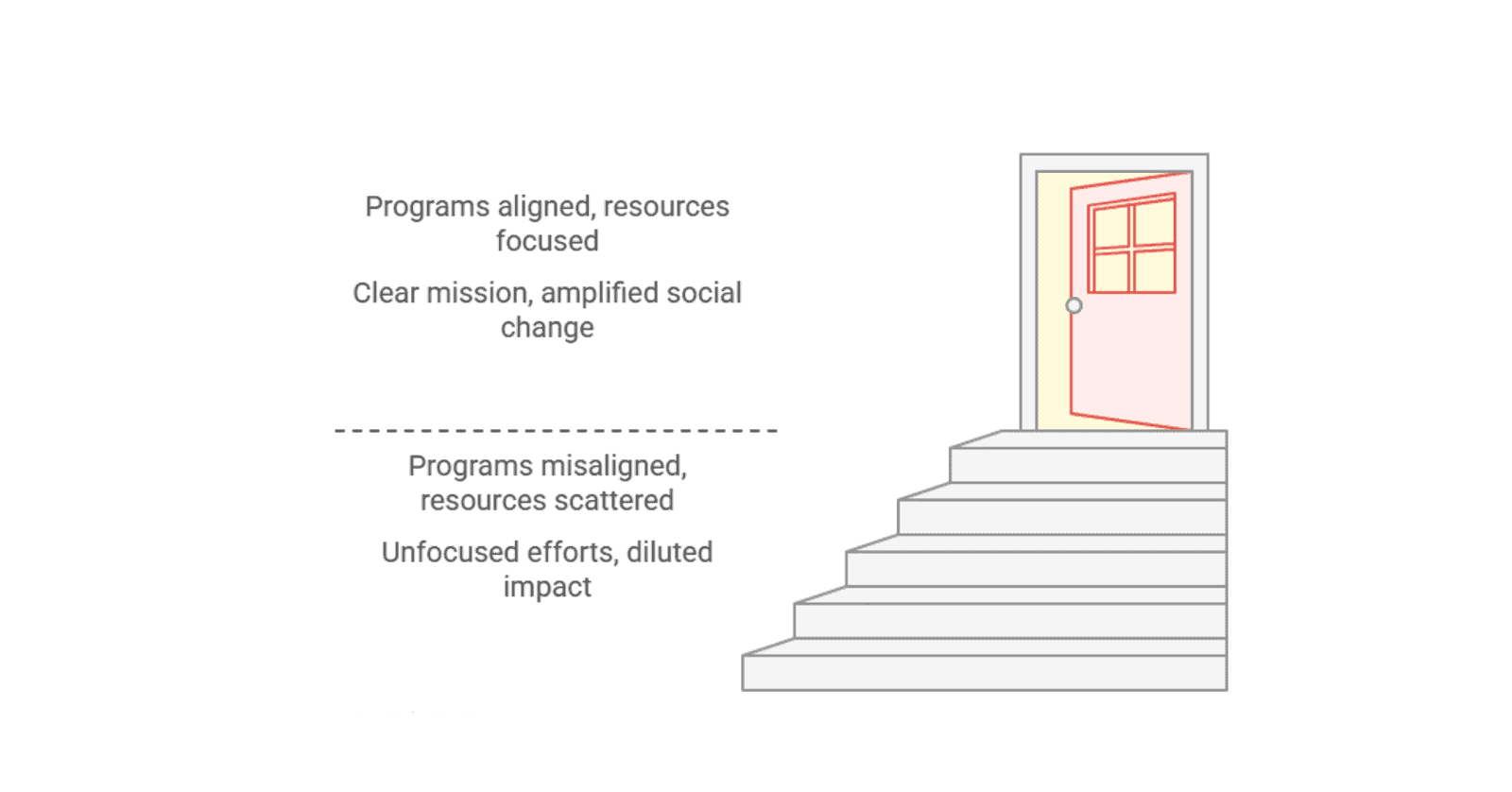
When your programs are out of alignment with your mission, you don’t just lose efficiency; you lose your “North Star.” This guide explores how to audit your portfolio, sharpen your focus, and ensure that every dollar and hour spent is a direct investment in your ultimate goal.
Quick Summary: How Do You Align Non-Profit Programs With Your Mission?
- Re-Anchor Your Mission: Explicitly separate your Vision (future state) from your Mission (daily “how”).
- Audit Your Portfolio: Categorize existing programs using a Program Strategy Matrix (assessing Mission Impact vs. Financial Sustainability).
- Implement a Mission Filter: Apply a 3-question gatekeeper rubric to screen all new funding opportunities and programs.
- Prune and Pivot: Intentionally exit “Drain” programs to free up critical resources for high-impact “Stars.”
What Is Mission Creep in Non-Profit Organizations?
Mission creep often arrives disguised as a gift. It looks like a $50,000 restricted grant for a project that is slightly outside your wheelhouse, or a board member’s passionate plea to address a tangential social issue.
The problem is that non-profits operate in a state of radical scarcity. Unlike a for-profit corporation that can raise venture capital to expand into new verticals, a non-profit’s resources, staff energy, donor attention, and operational budget are usually fixed. When you say “yes” to a program that is only 60% aligned with your mission, you are effectively stealing resources from the programs that are 100% aligned.
True strategic success isn’t about the volume of activities; it’s about program-mission fit.
How Do Non-Profits Define Their Strategic Direction?
Before you can align your programs, you must have a crystal-clear understanding of what you are aligning to.
What Is the Difference Between a Non-Profit Mission and Vision Statement?
Many organizations confuse these two, leading to strategic muddle.
- Vision: The “What If.” It is the future state you hope to create (e.g., “A world without childhood hunger”)
- Mission: The “How.” It is your specific lane in the race (e.g., “Providing nutritious school lunches to underserved districts in Metro Chicago”)
How Do You Know If Your Mission Statement Is Working?
Ask your board and senior staff to write down the organization’s mission from memory. If you get five different versions, you have an alignment problem at the foundation. Is your mission statement a “relic”, a dusty paragraph written ten years ago, or is it a living document that guides daily choices? If your mission is too broad (e.g., “Helping people in need”), it cannot be used as a filter. You must narrow your focus to broaden your impact.
How Do You Conduct a Non-Profit Program Portfolio Audit?
To achieve alignment, you must treat your programs like a dynamic portfolio. I recommend using a Program Strategy Matrix to evaluate each initiative across two axes: Mission Impact and Financial Sustainability.
| Program Category | Mission Impact | Financial Sustainability | Strategic Action |
| The Stars | High | High | Invest & Scale: Expand these high-performing champions. |
| The “Heart” Programs | High | Low | Subsidize: Keep them alive using surplus organizational funds. |
| The “Bread & Butter” | Low | High | Refine: Leverage for funding, but improve their impact story. |
| The Drains | Low | Low | Exit: Systematically phase out to liberate resources. |
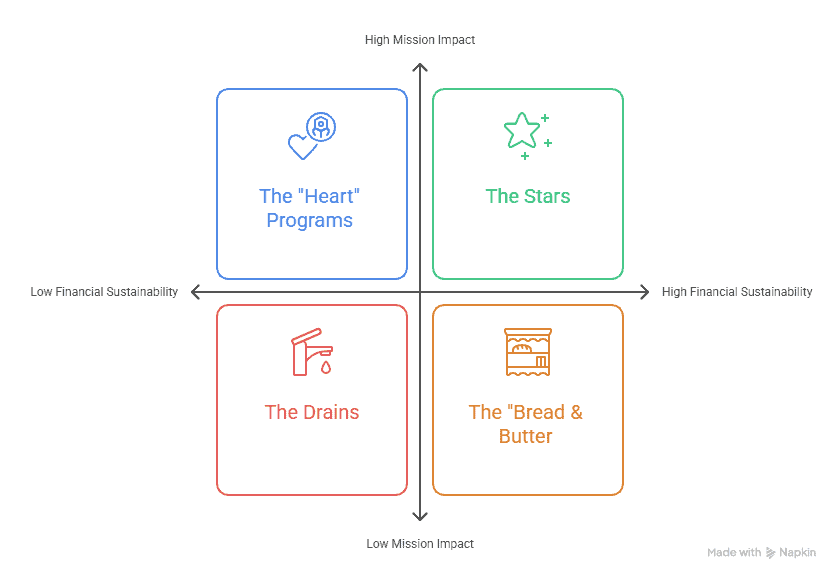
What Are the Four Categories of a Non-Profit Program Portfolio?
- The Stars: These programs are the “holy grail.” They directly fulfill the mission and are self-sustaining or even profitable (e.g., a workforce development program that sells the goods it produces).
- The Heart Programs: These are often the “purest” expression of your mission, but are expensive to run and hard to fund. They require constant subsidization from “Bread & Butter” programs or general donations.
- The Bread & Butter: These might be legacy events or services that bring in steady cash or high visibility but don’t actually move the needle on the core problem.
- The Drains: These are programs that have lost their way. Perhaps the community’s needs have changed, or a competitor is doing it better. In the non-profit world, “killing” a program feels like a failure, but in strategy, it is a resource liberation.
How Do You Use a Mission Filter for Non-Profit Decision-Making?
Once you’ve audited your existing programs, you need a gatekeeper for new ones. I advise my clients to implement a Mission Filter Rubric. Before any new initiative is approved, it must pass these three questioning steps:
- Define Demographics: Verify if the initiative directly addresses your target demographic’s most urgent needs. If it doesn’t align with your core community, the answer must be no.
- Assess Competitive Advantage: Analyze whether your organization has the unique infrastructure, expertise, and community relationships to execute this program better than anyone else.
- Calculate Opportunity Cost: Identify what existing programs or resources you are saying “no” to by saying “yes” to this new initiative.
How Do You Implement Mission Alignment Across Daily Operations?
Strategy is useless if it stays in a PDF on a shelf. To ensure alignment, you must bake it into your operations.
- KPIs and OKRs: Move beyond “vanity metrics” (e.g., number of people served) to “impact metrics” (e.g., percentage of people who stayed out of poverty for 12 months). Use Objectives and Key Results (OKRs) to link daily tasks directly to the mission
- A Culture of “Push-Back”: Empower your staff to question leadership. If a new project feels like a distraction, the culture should allow a program manager to ask, “How does this help us achieve our North Star?”
- Budgetary Alignment: Show me your budget, and I’ll tell you your strategy. If 80% of your mission involves “Advocacy,” but 80% of your budget goes to “Direct Service,” you aren’t aligned. Your spending must mirror your priorities
What Are the Main Challenges to Maintaining Program-Mission Alignment?
The path to alignment is paved with difficult conversations.
- Managing Donor Expectations: We often fear that saying “no” to a donor will alienate them. In reality, sophisticated donors respect an organization that knows its limits. You can say: “That is a wonderful project, but it falls outside our current strategic focus. However, I can introduce you to Organization X, which specializes in that area.”
- The “Legacy” Trap: Staff members often have deep emotional ties to programs they built. To navigate this, focus the conversation on the beneficiaries, not the staff. Ask: “Is this program the most effective way to serve our community today, or are we doing it because we’ve always done it?”
- Agility: The world changes. A mission-aligned program in 2020 might be irrelevant in 2025. Set a quarterly “Alignment Pulse” meeting to review your portfolio
Why Is Strategic Focus Important for Non-Profit Success?
In the non-profit sector, we are often taught that more is better. More programs, more staff, more zip codes served. But experienced strategists know that focus is a force multiplier.
When your programs are perfectly aligned with your mission, your marketing becomes clearer, your fundraising becomes more persuasive, and your impact becomes undeniable. You stop being a “jack of all trades” and start being a master of social change.
Frequently Asked Questions
What is mission creep in a non-profit organization?
Mission creep is the slow, almost imperceptible drift away from a non-profit organization’s core purpose. It typically happens when leadership pursues a “good” opportunity—such as a restricted grant or a tangential project—that is not the right opportunity for their specific goals.
What is the difference between a non-profit mission and a vision statement?
A non-profit vision statement describes the “What If,” representing the future state the organization hopes to create (e.g., “A world without childhood hunger”). A mission statement defines the “How,” which is the specific lane the organization occupies to get there (e.g., “Providing nutritious school lunches to underserved districts”).
How do you audit a non-profit program portfolio for mission alignment?
You can audit a program portfolio by using a Program Strategy Matrix that evaluates every initiative across two specific axes: Mission Impact and Financial Sustainability. Programs are then categorized into Stars, Heart Programs, Bread & Butter, or Drains to determine if they should be scaled, subsidized, refined, or phased out.
What are “Drain” programs, and how should a non-profit handle them?
Drain programs are initiatives that provide both low mission impact and low financial sustainability. They often persist because killing a program feels like a failure, but strategically, these programs should be systematically phased out to liberate resources for higher-impact work.
What questions should a non-profit mission filter rubric answer?
Before approving any new initiative, it should pass a three-question rubric: Does it address our target demographic’s most urgent needs? Do we have a unique competitive advantage to execute it better than anyone else? What existing priorities or resources are we saying “no” to by taking this on?
What Is the Next Step to Ensure Your Programs Align With Your Mission?
Pick one program in your current portfolio that feels “heavy” or distracting. Apply the Mission Filter Rubric to it this week. Does it truly belong?