
To scale a business without losing culture, embed values directly into operations using four core frameworks: Value Chain Analysis (protecting key activities), GOST (aligning daily tasks to goals), Balanced Scorecard (tracking non-financial metrics), and Kotter’s 8-Step Plan (managing organizational change).
Why Does Business Growth Threaten Organizational Culture?
Every successful business leader dreams of the hockey stick growth curve. You’ve found product-market fit, capital is flowing in, and your team is expanding rapidly. But as you add headcount, open new offices, and formalize departments, an unsettling feeling creeps in.
The agility is gone.
The unified vision feels fragmented. The magic that defined your early days is slowly being replaced by corporate bureaucracy and internal friction.
This is the Scaling Paradox: the very actions required to grow a business are the very forces that threaten to destroy its culture.
What Are the Signs of Cultural Breakdown During Scaling?
In the early days, culture is easy. It is enforced organically by the founders sitting in the same room with the team. But when you scale from 20 to 200 employees, osmosis no longer works.
If you don’t purposefully architect your culture alongside your operations, an accidental culture will form. It usually looks like this:
- Siloed Departments: Marketing doesn’t talk to Sales; Product Development ignores Customer Success.
- The Vanity Metric Trap: Teams focus solely on hitting numerical targets, abandoning the core values that define your brand.
- High Turnover: Early employees leave because it just doesn’t feel the same anymore.
Revenue might be up, but if your customer experience is degrading and your best talent is leaving, your growth is a house of cards. You are treating scaling as a purely financial exercise when it is fundamentally a strategic alignment challenge.
Which Strategic Frameworks Protect Culture While Scaling?
Most leaders try to fix cultural dilution with superficial tactics, ping-pong tables, forced happy hours, or vague mission statements posted on the wall. These fail because culture isn’t a perk; it is an operational mechanism.
To scale smart, you must embed your culture into your daily operations through rigorous, objective business frameworks. Here is how to use the Strategic Analysis Toolkit to hardwire your DNA into your growth plan.
How Does Value Chain Analysis Protect Company Culture?
Culture matters only if it creates value. Using a Value Chain Analysis, you can systematically dissect your company’s internal activities to identify exactly where your culture drives your competitive advantage.
Is your edge rooted in hyper-responsive customer service (Outbound Logistics & Service)?
Is it rooted in a collaborative R&D environment (Technology Development)?
By mapping this out, you identify the critical operational nodes where culture must be fiercely protected during expansion.
How Does the GOST Framework Keep Employees Aligned?
As you scale, the gap between the CEO’s vision and the frontline worker’s daily tasks widens into an Execution Gap. To close it, you need the GOST Framework (Goals, Objectives, Strategies, Tactics).
GOST forces you to translate abstract cultural Goals into measurable Objectives, then cascade them into the precise Strategies and Tactics your new hires execute every day. When a new employee understands how their specific task supports the overarching vision, culture scales naturally.
How Can a Balanced Scorecard Track Cultural Health?
If you are only looking at your P&L statement, you are driving by looking in the rearview mirror. Financials tell you what happened yesterday, not the health of your team today.
To ensure your culture survives scaling, deploy the Balanced Scorecard. This framework shifts your focus from purely financial KPIs to a holistic view. By tracking metrics in the Internal Processes and Learning & Growth perspectives (e.g., employee retention, internal promotion rates, cross-departmental collaboration), you get an early warning system if your culture begins to crack under the weight of growth.
How Does Kotter’s 8-Step Plan Manage Scale-Up Transitions?
Scaling a company is not business-as-usual; it is a massive structural transformation. To prevent change fatigue, manage your growth with Kotter’s 8-Step Change Plan.
Kotter’s model treats transformation as a human behavior challenge rather than an engineering problem. It ensures you build a guiding coalition of cultural ambassadors, communicate the vision relentlessly, and ultimately anchor new approaches in the culture (Step 8), making your foundational values permanent fixtures in your new, larger organization.
How Can You Automate and Streamline Your Scaling Strategy?
Growing a business is hard enough. You shouldn’t have to spend your time building complex framework templates from scratch or watch your cultural strategy collect dust in disconnected spreadsheets.
To scale smartly, you need a centralized, dynamic strategic environment.
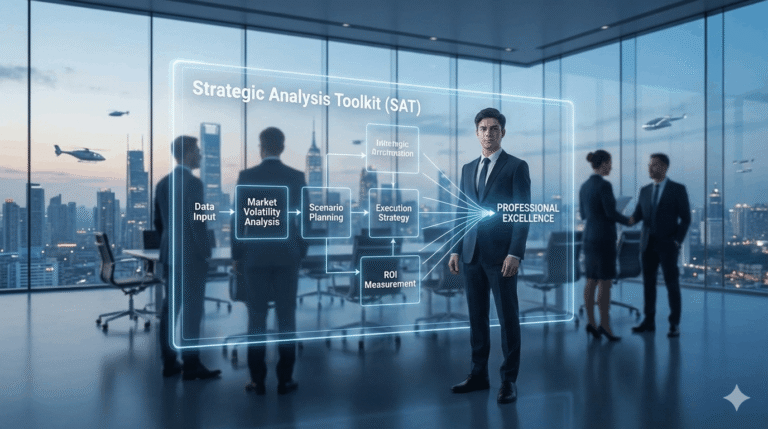
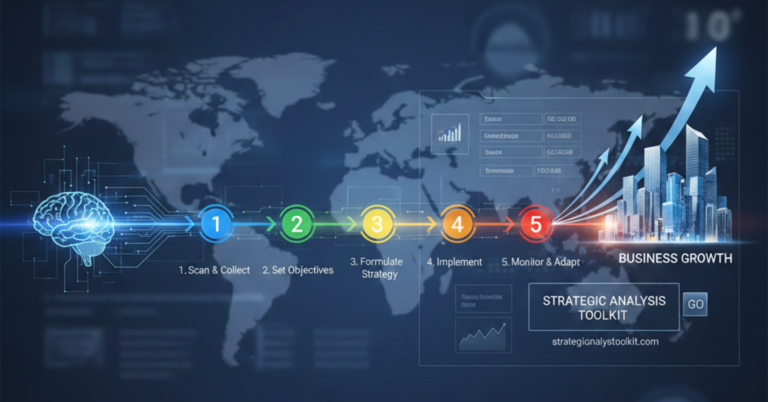
The Strategic Analysis Toolkit democratizes professional-grade consulting methodologies. It integrates your Value Chain Analysis with your GOST execution plan and your Balanced Scorecard, all in one seamless, portable platform.
Don’t let your culture be a casualty of your success. Shift from intuition to data-driven execution. Master your growth strategy today with the Strategic Analysis Toolkit.