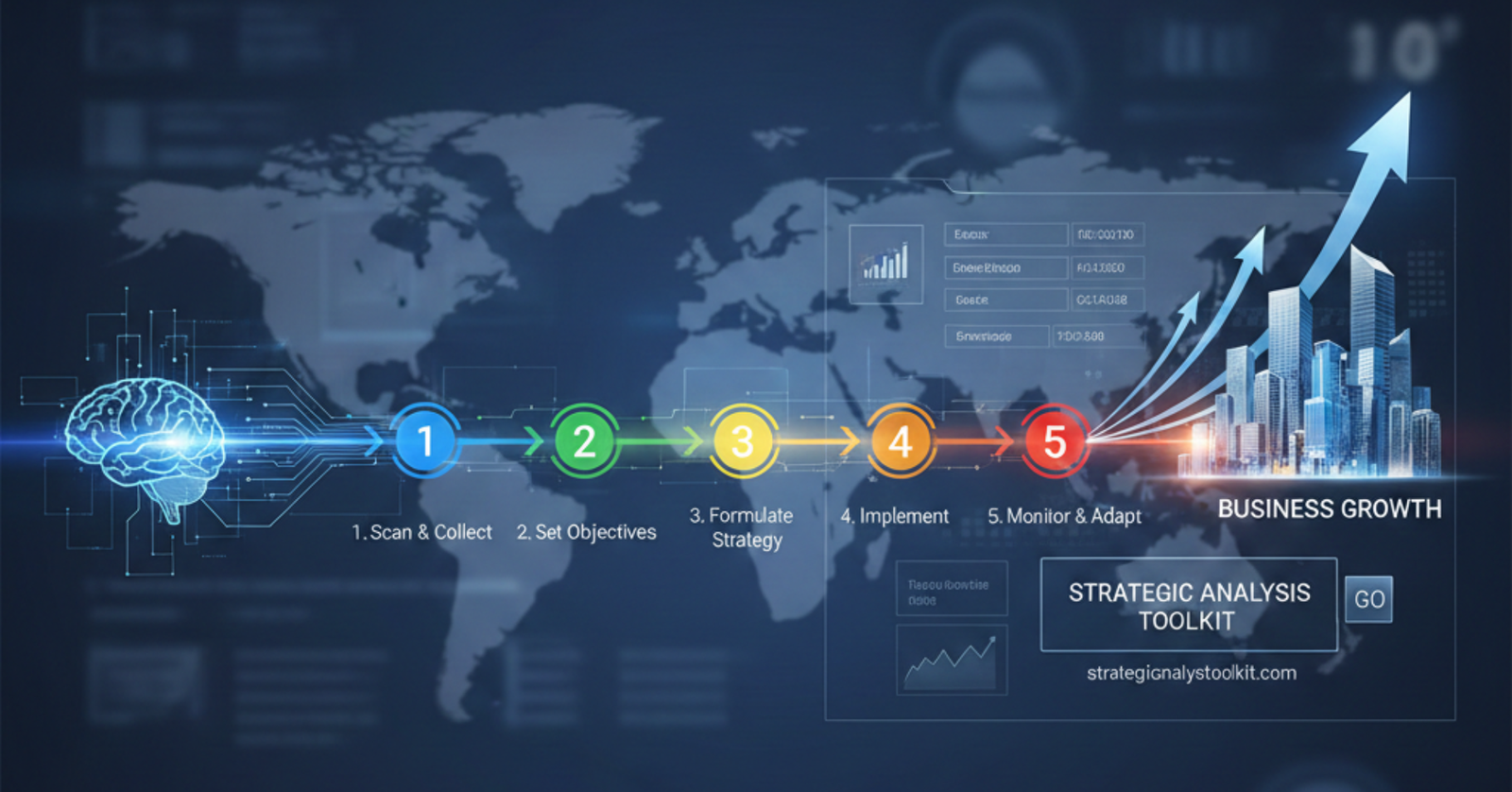
Achieving consistent growth often feels like navigating a labyrinth without a map. Many businesses, despite significant effort and resources, end up stuck in a cycle of plateaus and missed opportunities. The truth is, sustainable business growth isn’t a matter of luck or sheer force; it’s the direct result of a well-defined, guided strategic workflow. This isn’t just about having a plan; it’s about having a proven system that takes you from ambition to execution and beyond.
Imagine a world where every strategic decision is informed, every action is aligned, and every resource is optimized for growth. That’s the power of a guided workflow, and it’s exactly what the Strategic Analysis Toolkit delivers.
What Are the Key Takeaways of the Business Growth Workflow?
- Data-Driven Baseline: Sustainable growth begins with a rigorous situational analysis using proven frameworks like PESTLE, SWOT, and Porter’s Five Forces to assess your current market position
- Structured Strategy Alignment: Successful scaling requires aligning clear, long-term strategic visions with localized, operational objectives through the balanced scorecard framework
- Agile Execution over Rigid Planning: Transitioning from planning to action relies on breaking down high-level strategic objectives into clear, accountable milestones for individual teams
- Continuous Feedback Loops: Strategy is never static. True organizational resilience comes from establishing continuous monitoring systems that allow leadership to adapt tactics in real time based on performance data
- Integrated Tooling: Utilizing unified strategic frameworks, rather than disjointed spreadsheets, reduces execution friction and keeps cross-functional teams aligned on the same growth metrics
Why Does Business Growth Stall? Understanding Common Pitfalls
Before we dive into the solution, let’s acknowledge the common hurdles that often derail growth efforts:
- Lack of Clear Direction: Without a precise vision and measurable objectives, businesses often drift aimlessly, reacting to market changes rather than proactively shaping their future
- Analysis Paralysis: Too much data, too many frameworks, and too many opinions can lead to overwhelm, making it impossible to distill insights into actionable strategies
- Inconsistent Application: Brilliant strategies can fail if they’re not consistently applied across the organization, often due to poor communication or fragmented efforts
- Siloed Thinking: Departments operating independently, without a unified strategic vision, can inadvertently undermine overall business goals
- Failure to Adapt: The market is constantly evolving. Businesses that don’t have mechanisms to monitor, evaluate, and adapt their strategies quickly will inevitably fall behind
These challenges highlight a fundamental need for structure and guidance in the strategic process.
What Is the Solution? A Guided Workflow for Strategic Growth
A structured, step-by-step workflow is the antidote to these growth-stalling problems. It brings clarity, focuses your efforts, enhances efficiency, and builds an agile foundation for continuous adaptation. The Strategic Analysis Toolkit isn’t just a collection of tools; it’s your integrated platform for executing this very workflow.
Let’s break down the essential steps:
Step 1: How Do You Assess Your Current Position Through Situational Analysis?
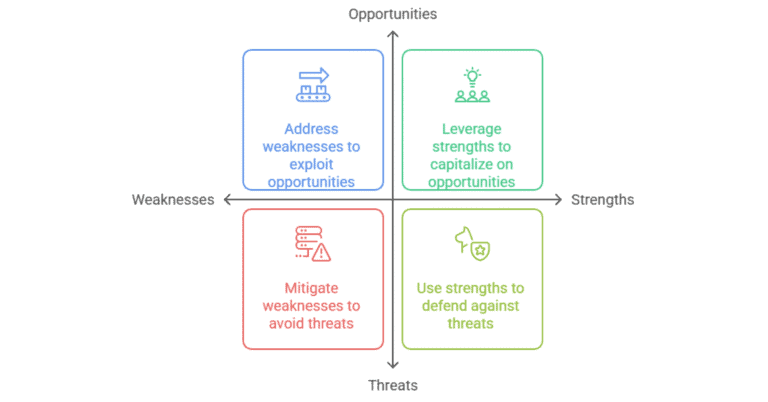
You can’t plot a course forward without knowing where you stand. This crucial first step involves a deep dive into your internal capabilities and the external environment. What are your unique strengths? Where are your weaknesses? What market opportunities are emerging, and what threats loom on the horizon? Understanding your competitive landscape and macro-environmental factors of Political, Economic, Social, Technological, Legal, and Environmental (PESTLE) provides the foundational insights you need.
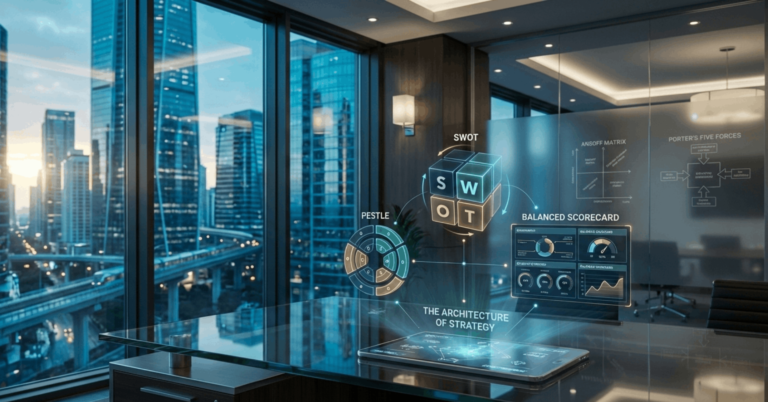
The Strategic Analysis Toolkit provides intuitive templates and guided prompts for essential frameworks like SWOT, PESTLE, and Porter’s Five Forces. It simplifies complex analysis, allowing you to gain immediate clarity on your current standing and identify critical areas for focus.
Step 2: How Do You Define Your Vision and Objectives for Strategic Planning?
With a clear understanding of your current position, the next step is to articulate where you want to go. This involves crafting a compelling vision for the future and translating that vision into concrete, measurable objectives. Vague aspirations won’t cut it. Your goals need to be SMART: Specific, Measurable, Achievable, Relevant, and Time-bound.
The Toolkit guides you through goal-setting frameworks, transforming abstract ambition into actionable and inspiring targets.
Step 3: How Do You Develop Your Action Plan for Strategy Formulation?
Now, it’s time to bridge the gap between your objectives and the specific actions required to achieve them. This phase involves brainstorming strategic initiatives, prioritizing them based on impact and feasibility, and allocating resources effectively. It’s about designing the how; the specific strategies that will propel you towards your goals.
Leverage the Strategic Analysis Toolkit’s strategy canvas and action planning templates to develop a robust roadmap. It ensures that every proposed action directly contributes to your strategic objectives, preventing wasted effort and misaligned initiatives.
Step 4: How Do You Implement and Execute a Strategy to Ensure Operational Alignment?
Even the most brilliant strategy is useless without effective implementation. This is where plans turn into reality. Successful execution demands clear communication, defined responsibilities, and seamless collaboration across your team. It’s about operationalizing your strategy, ensuring that daily activities and projects are aligned with your overarching goals.
The Strategic Analysis Toolkit provides features that support seamless execution, from project management functionalities to tracking dashboards, ensuring every effort contributes meaningfully to your strategic goals.
Step 5: How Do You Monitor, Evaluate, and Adapt Through Performance Management and Iteration?
Business growth is an ongoing journey, not a destination. This final, continuous step involves regularly monitoring your progress against key performance indicators (KPIs), evaluating the effectiveness of your strategies, and being prepared to adapt. The market shifts, new data emerges, and competitors innovate – your approach must be agile enough to evolve.
With the Strategic Analysis Toolkit, you can track KPIs, generate insightful reports, and even perform scenario planning. This ensures you stay ahead of the curve, making data-driven decisions and iterating on your strategy for continuous, sustainable growth.
Frequently Asked Questions
What is a strategic growth workflow?
A strategic growth workflow is a structured, step-by-step framework that businesses use to transition from high-level planning to operational execution. It begins with a comprehensive situational analysis and moves systematically through vision definition, plan formulation, and operational execution, concluding with continuous performance monitoring and adaptation.
Why do traditional business growth strategies fail?
Most business growth strategies stall because of a disconnect between planning and execution. Organizations often fail to establish a clear baseline of their current market position, set ambiguous goals that lack measurable key performance indicators (KPIs), or fail to build continuous feedback loops that allow them to adapt to changing market conditions in real time.
How does situational analysis improve strategy formulation?
Situational analysis uses data-driven frameworks—such as SWOT, PESTLE, and Porter’s Five Forces—to evaluate an organization’s internal capabilities and external market environments. By defining an accurate, objective baseline of where the business stands today, leadership can formulate realistic action plans and avoid misallocating resources.
What role does performance management play in the growth workflow?
Performance management acts as the continuous feedback loop of the growth workflow. By utilizing tracking tools like the Balanced Scorecard, businesses can monitor operational metrics in real time, evaluate whether their execution aligns with their strategic vision, and quickly iterate their tactics before growth stalls.
How does the Strategic Analysis Toolkit accelerate business scaling?
The Strategic Analysis Toolkit simplifies organizational growth by centralizing disparate strategic frameworks into a single, cohesive workflow. Instead of managing fragmented spreadsheets, teams gain access to an integrated system that aligns situational analysis, objective tracking, and execution milestones across all cross-functional departments.
Why Is the Strategic Analysis Toolkit Your Ideal Growth Partner?
The Strategic Analysis Toolkit isn’t just software; it’s a comprehensive, guided system designed to empower your business growth. It consolidates all the critical tools and frameworks you need into one intuitive platform, saving you countless hours, reducing errors, and significantly improving your decision-making capabilities.
It provides:
- An All-in-One Platform: Say goodbye to scattered spreadsheets and disparate documents
- A Guided Process: Never feel lost or overwhelmed; follow a straightforward, proven workflow
- Time and Resource Savings: Streamline your strategic activities and focus on impact
- Improved Decision-Making: Access data-driven insights at every step
- Enhanced Collaboration: Foster a unified strategic vision across your organization
Stop guessing and start growing with a structured, intelligent approach. The Strategic Analysis Toolkit transforms complex strategic analysis into an understandable, actionable, and repeatable workflow, guiding you to sustainable business success.
Transform your business strategy today. Explore the Strategic Analysis Toolkit