
Your strategy is only as good as your ability to communicate it.
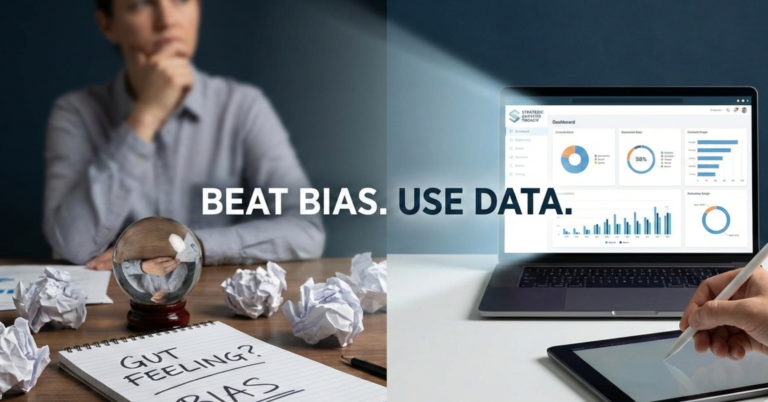
You can spend weeks crunching data, but if your findings are buried in messy spreadsheets or disjointed slides, your insights will never become action.
The most successful consultants and executives know a secret: Insight isn’t the data itself; it’s the story the data tells. To move from raw analysis to a presentation-ready report that wins over a Board of Directors, you need a structured path through the most powerful frameworks in business history.
| Strategy Phase | Core Frameworks | Primary Executive Objective |
| Discovery | PESTLE, Porter’s 5 Forces, Value Chain | Analyze macro & micro environments |
| Synthesis | SWOT, GOST, Ansoff, Blue Ocean | Define strategic positioning & growth paths |
| Implementation | TOWS Matrix, Balanced Scorecard | Prioritize initiatives & set 360° metrics |
| Change Management | Kotter’s 8-Step, PDCA Cycle | Ensure execution & continuous feedback |
What Frameworks Build a Rock-Solid Strategic Foundation?
Before you can propose a solution, you must demonstrate that you understand the problem. This begins with the Discovery and Foundation phase.
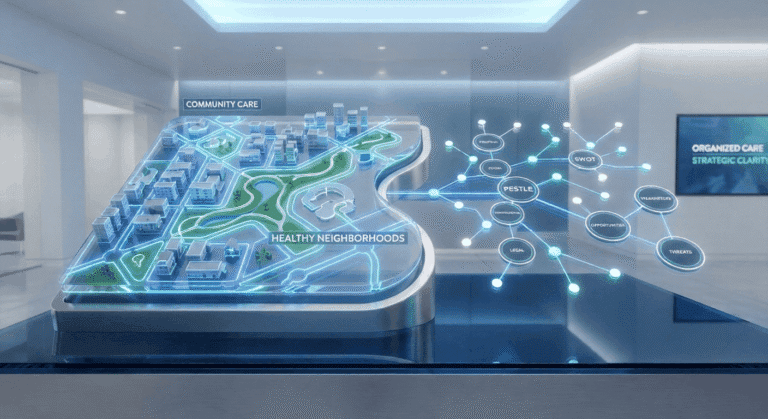
Using PESTLE Analysis, you demonstrate mastery of the macro-environmental factors, Political, Economic, Social, Technological, Legal, and Environmental, that shape the industry. You then zoom in on the micro-environment with Porter’s Five Forces to analyze competitive rivalry and bargaining power. Finally, an internal Value Chain Analysis identifies exactly where your organization creates value and where it leaks margin.
When these are presented clearly, stakeholders stop questioning your data and begin trusting your perspective.
How Do You Synthesize Data with Strategic Analysis?
Once the foundation is laid, you must filter that data into a coherent strategy. This is where many analysts falter, yet the Strategic Analysis Toolkit streamlines the transition.
- SWOT Analysis: A classic for a reason, but only valuable when concise.
- GOST (Goals, Objectives, Strategies, Tactics): This framework bridges the gap between a high-level vision and on-the-ground execution.
- Ansoff Matrix & Blue Ocean Strategies: These help you present growth opportunities. Whether you are pursuing market penetration or creating Blue Oceans of uncontested market space, these visuals make the where-to-play and how-to-win choices clear.
How Do You Move into Implementation Planning?
A strategy without an implementation plan is a wish list. To turn analysis into a report that executives can approve, you need to show how the work will be done.
The TOWS Matrix turns your SWOT into actionable strategies, e.g., How do we use our Strengths to capitalize on this Opportunity? Because you can’t do everything at once, TOWS Prioritization is essential to show stakeholders that you have a disciplined, tiered approach to execution.
Finally, the Balanced Scorecard ensures your report isn’t about hitting the numbers. It balances Financials with Customer, Internal Process, and Learning/Growth perspectives, providing a 360-degree view of performance.
How Can Organizations Navigate Change and Continuous Improvement?
The final hallmark of a presentation-ready report is a plan for what happens after the strategy is launched.
Executives fear the failed rollout. You can alleviate this by incorporating Kotter’s 8-Step Plan for leading change, ensuring the human element of the strategy is managed. For operational longevity, integrating the PDCA Cycle (Plan-Do-Check-Act) demonstrates that your strategy is a living, breathing process of continuous improvement.
Most, high-level reports should include an Executive Summary and What-If Scenarios. By modeling different outcomes, you demonstrate that you haven’t built a Plan A but have prepared the organization for any contingency.
Why Should Leaders Stop Formatting and Start Leading?
The biggest barrier to delivering these insights isn’t a lack of knowledge; it’s the time required to format, align, and design these frameworks into a professional report.
If you spend 80% of your time fighting with PowerPoint shapes and only 20% on actual thinking, you are underutilizing your expertise. That is why we built the Strategic Analysis Toolkit.
The Strategic Analysis Toolkit (SAT) is designed for the modern consultant who needs to move from analysis to insight. Our platform offers:
- Automated Frameworks: From PESTLE to the Balanced Scorecard, our tools handle the heavy lifting.
- Presentation Ready Output: Generate clean, professional reports ready for the boardroom.
- Logical Workflow: Follow the path from Discovery to Change Management within a single, seamless environment.
Don’t deliver a report; deliver a breakthrough.
Join the Strategic Analysis Toolkit today and transform your analysis into insight.