The Founder’s Trap: Ideas Are Cheap, Execution is Expensive
Every great business begins with a shower thought, that sudden burst of inspiration when a market gap becomes obvious. You rush to write it down, adrenaline pumping, convinced you’ve found the next unicorn.
But here is the plain, honest truth:
Ideas are cheap. Execution is everything.
According to venture capital data, the top reason startups fail isn’t running out of money; it’s creating a solution for a problem that doesn’t exist. This is known as the Founder’s Fallacy. Too many leaders confuse their passion with market validation. They go straight from a quick idea to building a product, relying on gut feeling instead of using objective data.
If you’re creating a business plan with disconnected spreadsheets, a photo of a whiteboard on your phone, and a 10-page Word document, you’re not developing a strategy. You’re assembling a Frankenstein Strategy, and investors can sense it from a mile away.
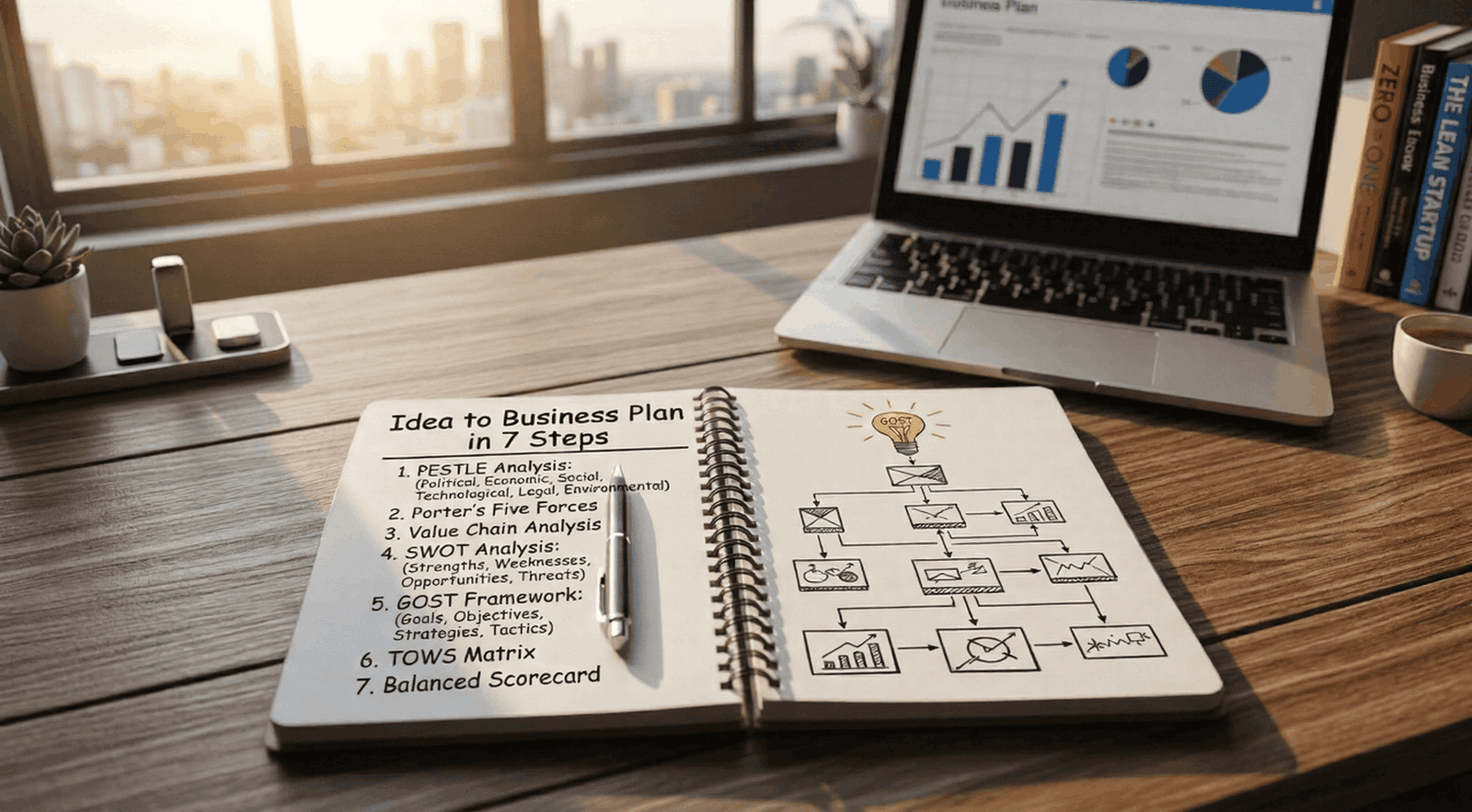
To turn a raw idea into a funded, sustainable business, you need a structured, interconnected Roadmap: Here is the 7-step strategic path to validate your idea and build a bulletproof plan. business plan.
Key Takeaways
- Structure Drives Success: Moving a raw business idea into a viable plan requires shifting from creative brainstorming to disciplined, structured strategic frameworks
- Outside-In Validation First: Always analyze the external market before looking inward. Use PESTLE to understand global macro-trends and Porter’s Five Forces to measure direct industry competition and profit potential
- Optimize Internal Operations: A great idea fails without operational execution. Value Chain Analysis identifies exactly where your business creates unique customer value and where it wastes capital
- The Bridge from Strategy to Action: A SWOT Analysis is just a static snapshot. You must use a TOWS Matrix to actively weaponize your strengths against market threats and turn vulnerabilities into advantages
- Execution Requires Metrics: High-level goals are meaningless without daily tracking. The GOST Framework breaks long-term visions down into daily tactics, while a Balanced Scorecard ensures you measure more than just your bank account (tracking customer satisfaction, internal processes, and team growth)
How Do You Turn a Business Idea into a Structured Business Plan?
Step 1: How Do I Use a PESTLE Analysis to Validate My Business Idea?
Before focusing on your competitors, assess the macro-environment. Is the world truly ready for your idea? A PESTLE analysis compels you to consider the Political, Economic, Social, Technological, Legal, and Environmental factors influencing your success.
If your app depends on data scraping, a legal change in data privacy could shut down your business overnight. PESTLE helps you avoid building a brilliant ship in a drying ocean.
Step 2: How Do I Analyze Competitors Using Porter’s Five Forces?
Once you determine that the macro-environment is viable, you need to assess the specific industry. Are you navigating a bloody Red Ocean of fierce competition?
Porter’s Five Forces helps you measure industry attractiveness. It guides you to identify the bargaining power of your future suppliers and buyers, the threat of new entrants, the risk of substitute products, and the level of competitive rivalry. This framework clearly shows how tough it will be to protect your profit margins.
Step 3: What Is a Value Chain Analysis and How Does It Optimize My Business Operations?
Now, consider your approach. How will you actually build, market, and deliver this idea?
A Value Chain Analysis breaks down your business into specific primary and support activities. It helps you identify exactly where your business creates unique value (differentiation) and where resources might be wasted. Investors don’t just want to know what you sell; they want to understand how you deliver it better than anyone else.
Step 4: How Do I Write an Effective SWOT Analysis for a Business Plan?
You’ve collected the data. Now it’s time to synthesize it. A SWOT Analysis (Strengths, Weaknesses, Opportunities, Threats) serves as your baseline snapshot.
However, don’t fall into the trap of turning this into a static list. Your SWOT should be a clear summary of the insights from Steps 1-3. Your Strengths and Weaknesses come directly from your Value Chain, while your Opportunities and Threats are derived from your PESTLE and Porter’s analyses.
Step 5: How Do I Translate My Vision into Daily Actions Using the GOST Framework?
A vision without structure is just a daydream. The GOST Framework (Goals, Objectives, Strategies, Tactics) turns your high-level shower thoughts into everyday operational tasks.
- Goals: The ultimate destination (e.g., Become the #1 local provider).
- Objectives: The measurable milestones (e.g., Capture 20% market share in 12 months).
- Strategies: The broad approaches to achieve those objectives.
- Tactics: The daily, actionable steps your team will take.
GOST aligns your whole future organization, making sure that every dollar spent supports the overall mission.
Step 6: What Is a TOWS Matrix and How Does It Turn SWOT Data into Action?
A SWOT analysis shows you your current position, but a TOWS Matrix guides your next steps.
By matching your internal Strengths and Weaknesses with your external Opportunities and Threats, you create highly targeted strategic moves. For example, how can you leverage a specific internal Strength to take advantage of a significant market Opportunity (an S-O Strategy)? TOWS transforms observation into a proactive execution plan.
Step 7: How Do I Measure Launch Success Using a Balanced Scorecard?
Finally, how will you know if your business plan is working once you launch? If you only look at your bank account, you are driving while looking in the rearview mirror.
The Balanced Scorecard helps you measure success across four key areas: Financial, Customer Satisfaction, Internal Processes, and Learning & Growth. It offers early-warning signs so you can make adjustments before a small issue turns into a major financial crisis.
Which Strategic Framework Should You Use? A 7-Step Breakdown
| Step | Framework | Primary Purpose | Key Output |
| 1 | PESTLE Analysis | Macro-environment audit | Identified external risks & regulations |
| 2 | Porter’s Five Forces | Industry & competitor health | Assessment of market profit margins |
| 3 | Value Chain Analysis | Internal operations audit | Identification of unique value/wasted spend |
| 4 | SWOT Analysis | Strategic data synthesis | 360-degree baseline snapshot of the business |
| 5 | GOST Framework | Goal alignment | Measurable milestones and daily tactics |
| 6 | TOWS Matrix | Action planning | Proactive tactical moves leveraging strengths |
| 7 | Balanced Scorecard | Launch performance dashboard | Continuous tracking of finances & growth |
Frequently Asked Questions
Why do most business ideas fail before reaching the business plan phase?
Most ideas fail due to a lack of objective validation. Entrepreneurs often rush into internal logistics without using external frameworks like PESTLE or Porter’s Five Forces to check market viability, regulatory hurdles, or intense competitor positioning beforehand.
What is the difference between a SWOT analysis and a TOWS matrix?
A SWOT analysis is a passive brainstorming tool used to list internal strengths/weaknesses and external opportunities/threats. Conversely, a TOWS matrix is an actionable tool that combines those data points to build proactive strategies, such as using a strength to minimize a threat.
How do I know if my business idea is actually market-validated?
Market validation occurs when external data proves a real customer demand exists and a profit margin is achievable. This is confirmed when macro-trend analysis (PESTLE) shows no roadblocks and industry competitive analysis (Porter’s Five Forces) indicates clear room to capture value.
Why should I use the GOST framework instead of just setting standard business goals?
The GOST framework bridges the gap between high-level vision and daily execution. While standard goals only outline what you want to achieve, GOST strictly forces you to map those high-level goals directly down to specific objectives, broad strategies, and everyday operational tactics.
How does a Balanced Scorecard help a brand-new startup launch successfully?
A Balanced Scorecard prevents early-stage startups from focusing exclusively on revenue. By tracking four distinct areas, finances, customer satisfaction, internal operational efficiency, and organizational growth, it gives founders a holistic, 360-degree dashboard to measure true launch health.
Stop Guessing, Start Executing
Turning a shower thought into an investor-ready business plan doesn’t have to take six months of painful, fragmented research.
The Strategic Analysis Toolkit aims to streamline strategic planning. Instead of managing multiple templates and risking analyst bias, our platform consolidates this specific 7-step process into a single, seamless, interconnected environment.
When your PESTLE data automatically informs your SWOT, and your SWOT flows directly into your TOWS plan, you stop just formatting documents and start building your empire.
Ready to turn that shower thought into reality? Stop guessing and start analyzing. Sign in to the Strategic Analysis Toolkit today and build your roadmap to growth.