In business, speed is often cited as a competitive advantage. However, speed without direction is merely activity. The absolute gold standard is velocity, speed with a specific destination.
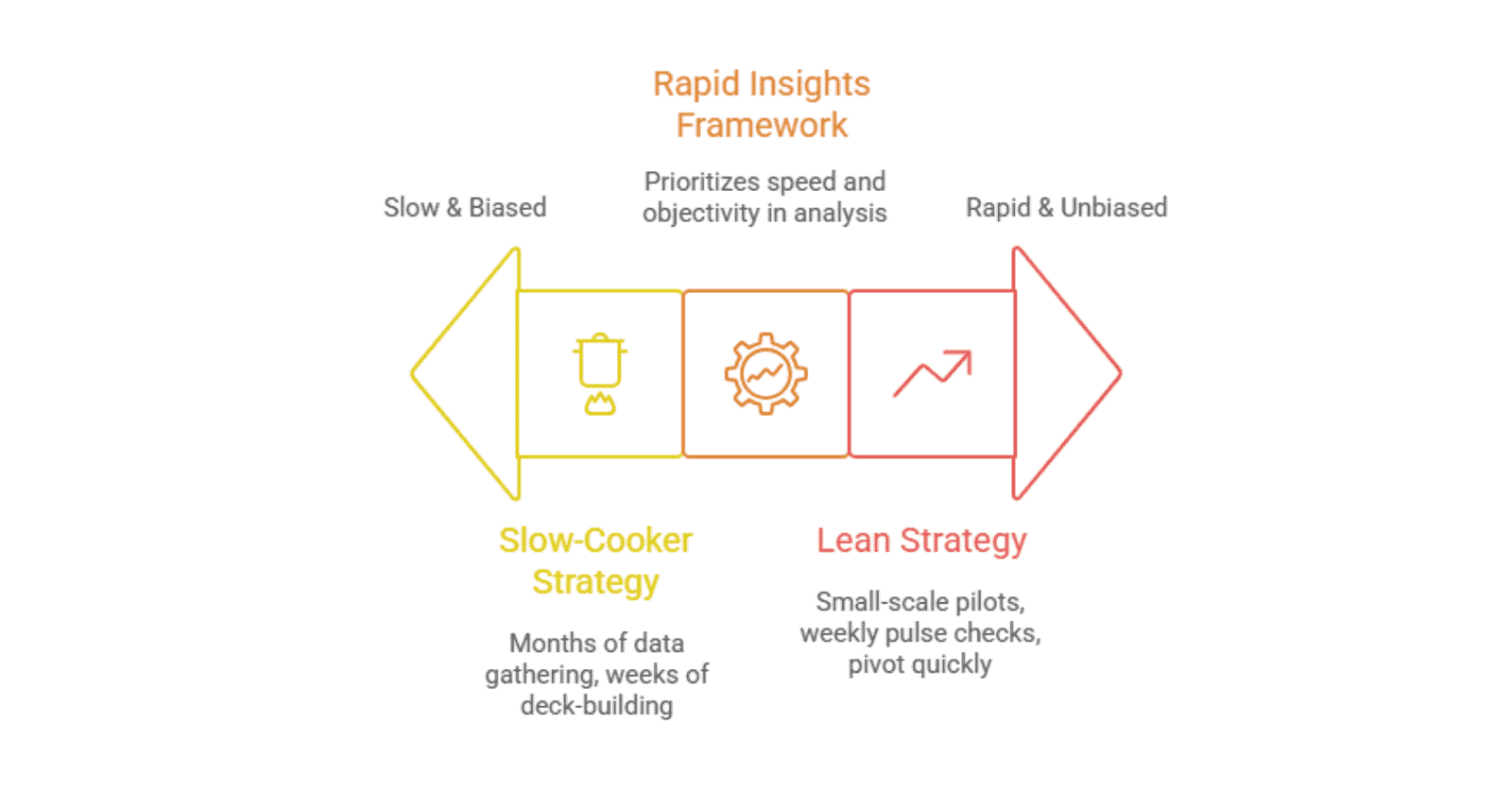
For years, the corporate world has relied on a slow-cooker approach to strategy: months of data gathering, weeks of deck-building, and hours of committee meetings. By the time the strategy is served, the market has moved, a competitor has pivoted, or the consumer’s needs have evolved.
The culprit? A combination of Analysis Paralysis and Analyst Bias.
To win in the modern economy, leaders must shift from a perfect information mindset to a rapid insight framework. This guide explores how to accelerate your strategic engine while stripping away the cognitive biases that lead even the smartest analysts astray.
Key Takeaways
- Speed Requires Direction: “Slow-cooker” strategy building is outdated. Modern business requires high velocity to prevent market shifts from rendering strategies obsolete before they even launch
- Acknowledge the Hidden Tax of Bias: Data is rarely neutral. Strategies are frequently derailed by cognitive pitfalls like Confirmation Bias (cherry-picking facts), the Narrative Fallacy (inventing false cause-and-effect), and Sunk Cost Bias (refusing to abandon a failing path)
- Implement a Rapid Insights Framework: Accelerate decision-making without sacrificing rigor by applying the 80/20 Data Filter (focusing on the critical few metrics), time-boxing discovery phases, and using inverse hypothesizing (stress-testing an idea by trying to prove it will fail)
- Use Practical Circuit Breakers: Protect your organization from biased recommendations by utilizing Red Teaming (assigning a chief skeptic), conducting Strategic Pre-Mortems (imagining project failure beforehand to identify risks), and performing Blind Data Analysis
- Adopt Lean Strategy Execution: Transition from massive planning decks to a Minimum Viable Strategy (MVP). Establish predetermined “kill-switches” to safely exit failing pilots and conduct frequent pulse checks to pivot based on real-world feedback
Why Is Data Not Always Objective?
We like to believe that data is neutral. It isn’t. Data is a mirror that often reflects the expectations of the person holding it. In strategic consulting, Analyst Bias is the hidden tax that devalues your research.
What Is the Confirmation Engine?
The most common pitfall is Confirmation Bias. This occurs when an analyst starts with a conclusion (We should enter the European market) and subconsciously filters the data to support that conclusion. They highlight the growing GDP in Poland but ignore the regulatory hurdles in Germany. The result is a strategy that feels robust but is built on a foundation of cherry-picked facts.
What Is the Narrative Fallacy?
Humans are wired for stories. The Narrative Fallacy leads analysts to weave random market fluctuations into a tidy, logical tale of cause and effect. We see a spike in sales and attribute it to our new marketing campaign, ignoring the fact that a competitor’s website was down for three days. This bias creates a false sense of security and predictability.
How Does Sunk Cost Bias Affect Research?
If an analyst spends four weeks researching a specific technological path, they are psychologically incentivized to recommend it. Admitting the path is a dead end feels like admitting those four weeks were wasted. This leads to Strategy Inertia, where companies continue to invest in failing directions because they’ve already come this far.
What Is the Rapid Insights Framework?
To bypass these biases, organizations need a framework that prioritizes speed and objectivity. Here is how you can get rapid insights without sacrificing rigor.
How Do You Apply the 80/20 Data Filter?
The Pareto Principle applies perfectly to strategic analysis. 20% of your data will provide 80% of the strategic value. The remaining 80% of the data is often noise that provides diminishing returns and slows down decision-making.
Action: Before starting any research, identify the Critical Few metrics. What are the three numbers that actually move the needle? Focus your rapid analysis there.
What Is Inverse Hypothesizing?
Standard strategy asks: How do we prove this works? Rapid, unbiased strategy asks: What would have to be true for this to fail?
By attempting to falsify a hypothesis rather than prove it, you bypass the confirmation engine. If you can’t find a reason why the strategy will fail after a 48-hour stress test, you have a much stronger foundation for moving forward.
How Should You Time-Box the Discovery Phase?
Work expands to fill the time allotted. If you give a team three months to build a strategy, they will take three months. If you give them two weeks, they will be forced to ignore the noise and focus on the signals. Time-boxing creates a healthy analytical urgency that prevents over-modeling.
What Are Practical Tools to Neutralize Bias?
Once you’ve accelerated the process, you need circuit breakers to catch bias before it reaches the C-suite.
How Can Red Teaming Institutionalize Dissent?
In the military, a Red Team is tasked with playing the role of the enemy to find weaknesses in a plan. In business strategy, you should assign one person (or a small group) the role of the Chief Skeptic. Their only job is to poke holes in the lead analyst’s logic. This institutionalizes dissent and ensures that the final strategy has survived a rigorous internal assault.
How Do You Conduct a Strategic Pre-Mortem?
Popularized by psychologist Gary Klein, the pre-mortem is the opposite of a post-mortem. Before the strategy is launched, the team gathers and imagines a future where the project has failed miserably. They then work backward to determine why it failed.
Was it a competitor’s price cut? * Was it a supply chain breakdown? By imagining failure first, analysts are freed from the optimism bias that often plagues new initiatives.
Why Is Blind Data Analysis Important?
To prevent the Narrative Fallacy, try reviewing data blind. Strip away the brand names or the specific business units and look at the raw performance metrics. Does the Growth Strategy still look like a good idea when you don’t know it belongs to your favorite product line? This forces the analyst to judge the data on its merit, not its name.
How Can Lean Strategy Move Teams From Plan to Experiment?
The antidote to analyst bias is the market itself. In the time it takes to build a 100-page deck, you could have launched a small-scale pilot.
What Is the MVP Strategy?
Minimum Viable Product (MVP) is a staple of software development, but it’s rarely applied to strategy. Instead of a global rollout, create a Minimum Viable Strategy. Test the core assumption in one region or with one customer segment.
How Do You Define Kill-Switches?
To avoid Sunk Cost Bias, define your exit criteria before you start. If the pilot doesn’t reach X% conversion within Y weeks, the strategy is killed. By setting these benchmarks in advance, you remove the emotional difficulty of admitting a strategy isn’t working.
When Should You Pivot or Persevere?
Strategy is no longer a set it and forget it annual event. High-velocity firms hold Pulse Checks weekly or bi-weekly. This allows them to pivot based on real-world feedback rather than sticking to a biased analyst’s three-year forecast.
How Does Strategy Act as a Living Muscle?
In the modern business landscape, the expert is no longer the person with the most data, but the person who can most quickly turn data into an unbiased, actionable insight.
Reducing analyst bias isn’t just about being fair; it’s about survival. Every biased assumption is a hidden risk. Every week spent in unnecessary analysis is a lost opportunity.
What Is Your Challenge Today?
Look at your current strategic initiatives. Pick one sacred cow assumption, the one everyone agrees on, and assign a Red Team to try to dismantle it by Friday. You might find that your most certain strategy is actually your most biased.
Strategy is a living muscle. It needs to be flexible, fast, and, above all, honest. Stop building monuments to your own assumptions and start building a framework for rapid, unbiased growth.
Frequently Asked Questions
What is analyst bias in business strategy?
Analyst bias refers to cognitive blind spots that distort strategic research. Common examples include confirmation bias (cherry-picking data to support a predetermined conclusion), the narrative fallacy (creating false cause-and-effect stories), and sunk cost bias (sticking to a failing path because of the time already invested).
What is the Rapid Insights Framework?
The Rapid Insights Framework is a methodology designed to accelerate decision-making while neutralizing cognitive bias. It relies on techniques like the 80/20 data filter to focus on critical metrics, time-boxing the discovery phase to create urgency, and inverse hypothesizing to stress-test ideas by trying to prove they will fail.
How does a Strategic Pre-Mortem work?
Before a strategy is launched, the team gathers and imagines a future where the initiative has failed miserably. They then work backward to determine what caused the failure. This exercise frees analysts from optimism bias and helps identify hidden risks early.
What is the role of a Red Team in business strategy?
A Red Team, or “Chief Skeptic,” is an individual or small group tasked with playing the role of the enemy. Their only job is to poke holes in the lead analyst’s logic, institutionalizing dissent to ensure the final plan has survived rigorous internal scrutiny.
Why is it important to define kill-switches?
Kill-switches are predefined exit criteria set before a strategy or pilot begins. Establishing these benchmarks in advance removes the emotional difficulty of admitting a project isn’t working, helping organizations safely abandon failing initiatives and avoid sunk cost bias.