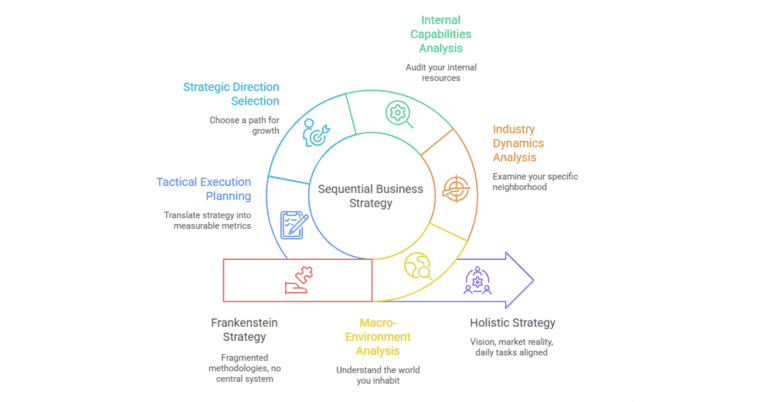

In corporate leadership, the difference between a visionary leader and a struggling manager isn’t the quality of their ideas; it’s the rigor of their methodology. Most executives rely on intuition; the best rely on a system.
To shift from reactive decision-making to proactive market leadership, you need a structured strategy. The Strategic Analysis Toolkit (SAT) provides this structure, guiding you through the four critical pillars of organizational excellence.
Phase 1: Discovery and Foundation
Before a general goes to war, they survey the terrain. In business, this is your Discovery phase. High-level strategic thinking begins with three distinct lenses:
- PESTLE Analysis: You must account for the Political, Economic, Social, Technological, Legal, and Environmental factors that shape your market’s future.
- Porter’s Five Forces: This framework helps you quantify competitive intensity and identify where power truly lies, with your suppliers, your buyers, or your rivals.
- Value Chain Analysis: Internally, where are you creating value, and where are you losing margin? This analysis identifies the primary and support activities that give you a competitive edge.
Phase 2: Strategic Analysis
Data without synthesis is just noise. The second phase of the SAT methodology focuses on distilling your discoveries into a clear direction.
While every executive is familiar with a SWOT analysis, the SAT elevates it by integrating it with GOST (Goals, Objectives, Strategies, and Tactics). This ensures your high-level vision is supported by granular, achievable steps.
Furthermore, we help you define your market posture: Are you seeking growth in existing markets via the Ansoff Matrix, or aiming to make the competition irrelevant by creating a Blue Ocean? The Blue Ocean Strategy is the hallmark of the world’s most innovative firms, and the SAT gives you the tools to find your own uncontested market space.
Phase 3: Implementation Planning
The Strategy-Execution Gap is where most businesses fail. You have a plan, but how do you execute it?
The SAT uses the TOWS Matrix, the sophisticated cousin of SWOT, to turn your internal strengths and external opportunities into specific strategic plays. By using TOWS Prioritization, you ensure your team isn’t spread too thin, focusing only on the Big Wins that move the needle.
Finally, we anchor these plans in the Balanced Scorecard. This ensures you aren’t just looking at lagging financial indicators but also focusing on customer satisfaction, internal processes, and the learning and growth of your human capital.
Phase 4: Change and Improvement
Strategy is not a set-it-and-forget-it exercise. It is a living, breathing evolution.
Transformation requires buy-in, which is why we incorporate Kotter’s 8-Step Plan for leading change. By creating a sense of urgency and anchoring new approaches in the culture, you ensure your strategy survives the first 90 days.
To maintain momentum, the PDCA Cycle (Plan-Do-Check-Act) creates a continuous improvement loop. Coupled with Executive Summaries and What-if Scenarios, the SAT empowers you to stay agile. When the market shifts (and it will), you will have already modeled the What-if, allowing you to pivot while your competitors are still reeling.
Conclusion: Become a Strategic Architect
Strategic thinking is a muscle, and the Strategic Analysis Toolkit is your gym. By using these world-class frameworks in a single, streamlined platform, you eliminate planning friction and maximize the impact of your leadership.
Stop guessing. Start analyzing. Lead with the SAT.
Would you like to begin your first analysis? Explore the Strategic Analysis Toolkit today.