
Every business leader fears the signs: shrinking margins, increasing customer churn, and a multi-quarter revenue decline. When the numbers turn red, the boardroom atmosphere shifts from confident to panicked.
The instinctive reaction is almost always tactical. You cut the marketing budget, freeze hiring, or suddenly discount your core product.
Here is the harsh reality: You can’t cut your way to growth
Responding to a decline with random, disconnected tactics leads to a guaranteed death spiral.
If your business is declining, you don’t have a tactical problem; you have a strategic disconnect.
To orchestrate a successful turnaround before it’s too late, you must shift from panic-driven action to data-driven progress. Here is the precise, framework-driven blueprint to save your business.
Stop the Bleeding: Diagnose the Real Threat
Most turnaround efforts fail because leadership concentrates on the symptom (falling revenue) instead of addressing the root cause (market misalignment). To save the business, you must first understand the landscape.
- Scan the Horizon with PESTLE Analysis: Is your decline due to an internal failure, or has the world simply moved on? A PESTLE Analysis prompts you to examine the Political, Economic, Social, Technological, Legal, and Environmental changes. If a new technology has made your core product obsolete, no amount of budget-cutting will save you. You must pivot.
- Assess the Threat with Porter’s Five Forces: Who is eroding your margins? Porter’s Five Forces will reveal if the bargaining power of your suppliers has silently increased, or if the threat of new, nimble substitutes is shrinking your market share.
- Audit Your Internals with Value Chain Analysis: Once you understand the market dynamics, look internally. A Value Chain Analysis removes corporate vanity and shows you precisely where your operations are losing capital and where your competitive edge has weakened.
Pivot from Paralysis to Action
Data without synthesis is just noise. Many leadership teams lock themselves in an offsite, create a massive SWOT analysis, and then let it gather digital dust in a static slide deck. This Analysis Paralysis’ can be deadly during a turnaround.
To succeed, you need to bridge the gap between observation and action. This is where the TOWS Matrix becomes your most powerful tool. While SWOT shows your current state, TOWS helps develop your future strategies.
By combining your internal Strengths and Weaknesses with your external Opportunities and Threats, you generate immediate, actionable turnaround plans. Will you leverage a core strength to seize a sudden market opportunity (an S-O strategy)? Or do you need to urgently build a defensive moat to protect a critical weakness from an aggressive competitor (a W-T strategy)?
Execute the Turnaround
A brilliant turnaround strategy on paper means nothing if your team won’t execute it. Turnarounds are traumatic for company culture. Morale is low, and resistance to change is high.
- Align the Team with Kotter’s 8-Step Plan: You cannot force a turnaround through sheer executive willpower. Kotter’s 8-Step Change Plan offers a psychological blueprint for transforming your organization. It begins with creating a genuine sense of urgency and progresses toward embedding structural change into the corporate DNA.
- Monitor Real Recovery with the Balanced Scorecard: If you only look at your P&L to assess the turnaround, you’re relying on rearview mirror data. Financials show what happened yesterday. To truly gauge progress, use a Balanced Scorecard. This tool tracks leading indicators, customer satisfaction, internal process efficiency, and team learning, which help ensure future financial success.
The Missing Link: Automate Your Turnaround
When time is limited and money is running out, you can’t spend six months creating separate spreadsheets and manual slide decks. You can’t afford the Frankenstein Strategy, where your PESTLE analysis is stored in one folder and your Balanced Scorecard in another.
To carry out this sequential turnaround, you need an integrated strategic operating system.
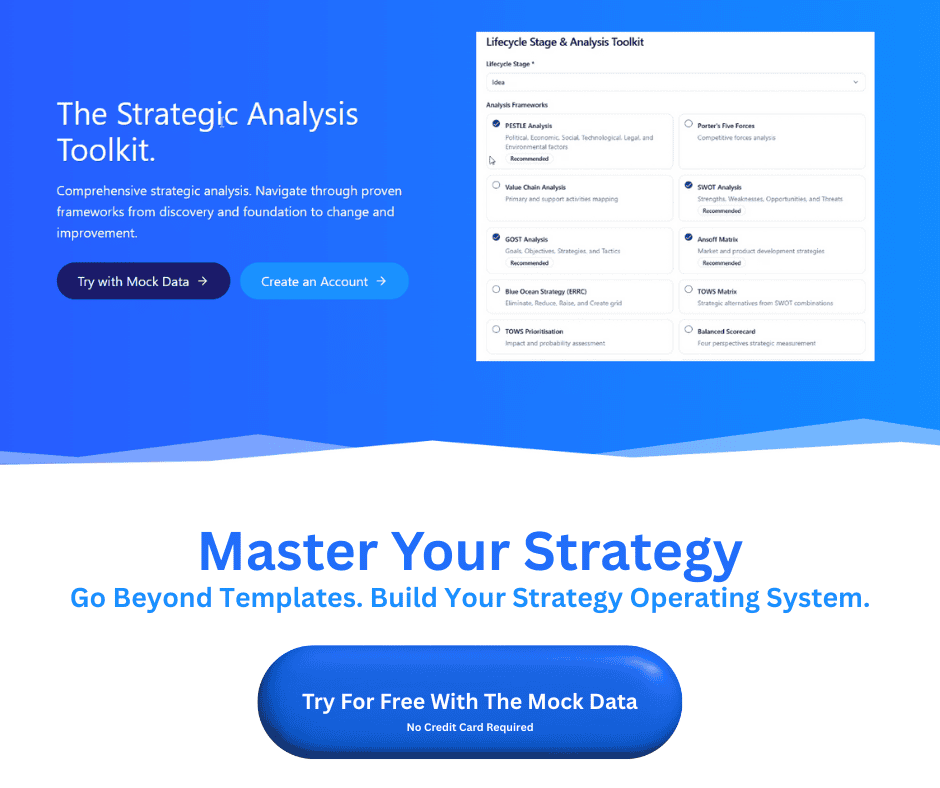
The Strategic Analysis Toolkit connects high-level theory with practical execution. It consolidates all frameworks from Discovery to Continuous Improvement into a single, portable environment.
Stop guessing, overcome cognitive bias, and transform weeks of frantic research into hours of investor-ready insights. Begin your turnaround today with the Strategic Analysis Toolkit.