
The moment you realize your market share is slipping, a dangerous instinct kicks in. You feel the pressure from aggressive competitors and new entrants, prompting a reaction. You cut prices. You boost the marketing budget. You introduce reactive features just to stay in the game.
You’re working harder, spending more, and earning less.
In business strategy, this is called competing in a Red Ocean, a market space where the water is bloody from rivals fighting over the same, shrinking pool of customers. When competition heats up, relying on gut instinct or last year’s strategic plan isn’t just ineffective; it’s business suicide.
To protect your market share, you must stop reacting and start designing. You need to bridge the gap between high-level strategy and on-the-ground execution.
Here is how to build a strong defense using a step-by-step, data-driven strategic process.
The Agitation: Why Your Current Defense Is Failing
Most leadership teams struggle with framework fragmentation. When confronting a strong competitor, the marketing team might quickly sketch a SWOT analysis on a whiteboard, while finance reviews cost-cutting spreadsheets separately.
These are isolated pockets of data. Identifying a Threat on a piece of paper doesn’t magically generate a plan to counter it. This Frankenstein Strategy approach results in execution gaps, analysis paralysis, and a significant waste of resources.
To defend your territory, you must connect your macro-environmental reality to your internal capabilities. You need a centralized system.
Step 1: Analyze the Battlefield Using Porter’s Five Forces
Before you can protect your market share, you must first identify where the attack is originating.
Using Porter’s Five Forces, you can analyze the competitive strength of your environment. Are you losing market share because a new startup has lowered the barriers to entry (Threat of New Entrants)? Or is a new technology making your main offering outdated (Threat of Substitutes)?
By systematically measuring these forces, you stop fighting shadows and begin placing your business where the barriers to entry are highest.
Step 2: Strengthen the Core Through Value Chain Analysis
You can’t win an external war if your internal operations are losing value.
While competitors focus on undercutting you on price, use a Value Chain Analysis to outpace them in efficiency and unique value creation. This framework compels you to examine every internal activity, from inbound logistics to post-sale customer service.
Where are you creating unique value that a competitor cannot easily replicate? Where are your cost drivers increasing your prices? By optimizing your value chain, you build an economic moat that rivals cannot cross without harming their own margins.
Step 3: Moving from Observation to Action Using the TOWS Matrix
You already know your Strengths, Weaknesses, Opportunities, and Threats (SWOT). But a static list isn’t a battle plan. It’s time to turn observation into tactical actions.
Enter the TOWS Matrix.
The TOWS Matrix prompts your internal capabilities to confront external realities. If a competitor initiates a massive price war (Threat), how can you leverage your superior customer service infrastructure (Strength) to retain high-value clients who prioritize quality over price? This is an S-T Strategy (Strength-Threat), an offensive approach aimed at neutralizing an external threat.
Step 4: Win by Making Competition Irrelevant with Blue Ocean Strategy
Sometimes, the best way to defend your market share is to exit the battlefield completely.
If your industry is locked in a feature-by-feature arms race, deploy the Blue Ocean Strategy. Using the ERRC Grid (Eliminate, Reduce, Raise, Create), you can systematically challenge industry norms.
- Identify which expensive features the industry still competes on that customers no longer value.
- Create: What uncontested value can you offer that has never been provided?
By focusing on creating uncontested market space rather than beating the competition, you automatically gain market share because you’re the only one in the ocean.
Step 5: Secure Your Gains with the PDCA Cycle
A defensive strategy isn’t a set-and-forget project. The market will adapt to your moves. To stay ahead, you need to shift from static planning to ongoing intelligence.
Implement the PDCA Cycle (Plan-Do-Check-Act). This scientific approach for business ensures that every strategic move you make is treated as a hypothesis. You plan the action, carry it out, check the real-time data to see if it stopped the market share decline, and then act to standardize or modify the strategy.
The Ultimate Weapon: Concentrate Your Strategy
You understand the frameworks you need to survive. The real challenge is execution. Trying to run Porter’s Five Forces, a Value Chain Analysis, a TOWS Matrix, and a Blue Ocean Strategy across multiple software tools and static slide decks will only lead to drowning in administrative overhead.
You need to accelerate more than your competitors.
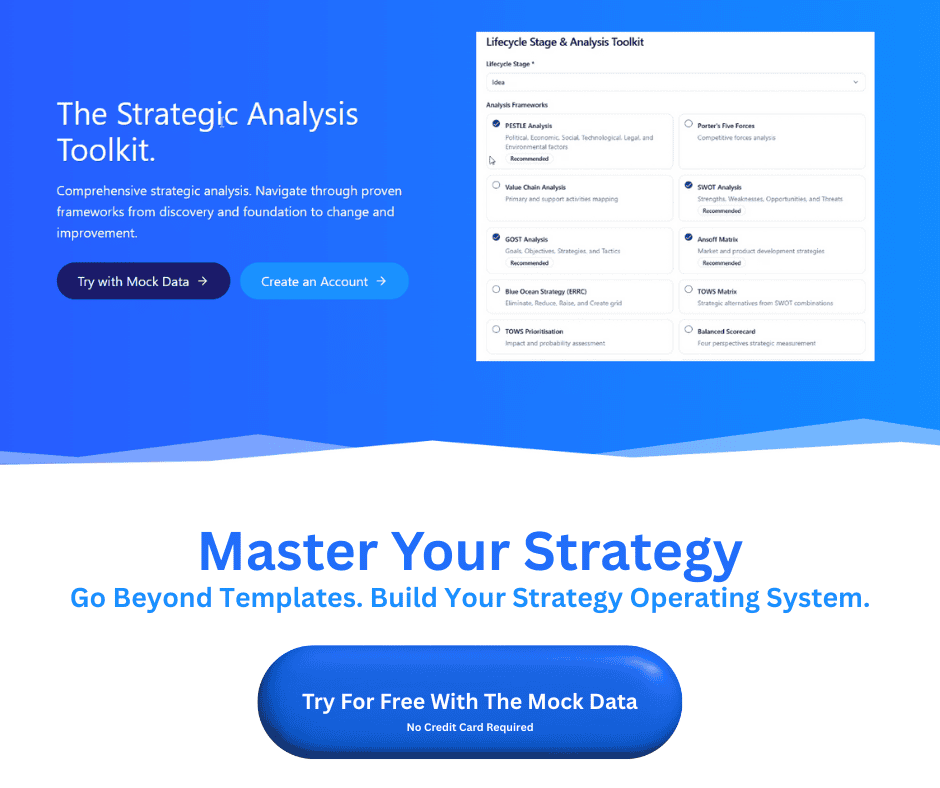
The Strategic Analysis Toolkit is the ultimate digital bridge for modern leaders. It consolidates your entire strategic process into a single, connected platform. Your Porter’s Five Forces data automatically integrates into your SWOT analysis, which then populates your TOWS Matrix. It removes analyst bias, eliminates administrative burden, and transforms weeks of frantic research into hours of investor-ready, defensive strategy.
Stop letting competitors take your market share. Upgrade your strategy from static plans to ongoing intelligence today.