
Why Most Strategies Die in the Boardroom (And How to Save Yours)
You’ve done the heavy lifting. You’ve run a PESTLE analysis to understand the market. You’ve used Porter’s Five Forces to stake your claim. Your SWOT analysis is watertight.
So, why isn’t the business growing?
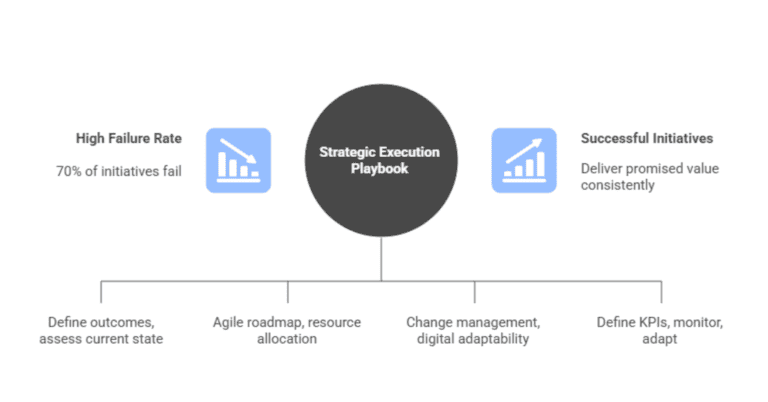
The harsh reality is that 60-90% of strategic initiatives fail. They don’t fail because the idea was bad; they fail because the execution was invisible. Leaders often fall prey to the Set and Forget syndrome, launching a strategy with fanfare and then failing to monitor the pulse of implementation.
To survive, you must transition from planning to performance. You need a system that doesn’t just track tasks but also tracks value.
The Metrics That Matter: The Balanced Scorecard
If you are only looking at your P&L to monitor strategy, you are driving while looking in the rearview mirror. Financials tell you what happened yesterday, not what will happen tomorrow.
To monitor implementation effectively, successful leaders use the Balanced Scorecard. This framework helps you track your initiative across four critical perspectives:
- Financial: Are we generating ROI?
- Customer: Is the strategy improving satisfaction?
- Internal Process: Have we improved efficiency?
- Learning & Growth: Is our team evolving to meet the new challenge?
By aligning your strategy with these four pillars, you create an early-warning system. You see process failures before they become revenue failures.
Tip: Don’t build this in a spreadsheet. It breaks, versions get lost, and nobody updates it. The Strategic Analysis Toolkit integrates the Balanced Scorecard directly into your workflow, linking your initial SWOT analysis to your performance metrics.
The Engine of Execution: The PDCA Cycle
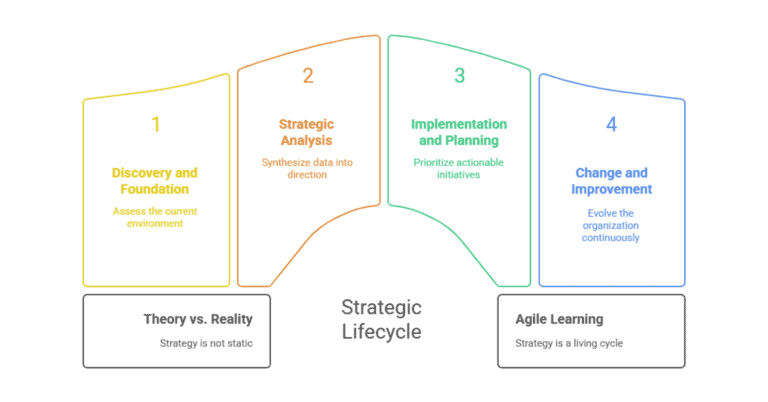
Monitoring isn’t a one-time audit; it’s a heartbeat. To keep your initiative alive, you need the PDCA Cycle (Plan-Do-Check-Act).
Most companies stop at Plan and Do, forgetting to Check and Act.
- Check: Compare your actual results with the KPIs in your Balanced Scorecard.
- Act: If you are off course, pivot immediately.
This cycle transforms your strategy from a static PDF into a living, breathing organism that adapts to market feedback in real time.
Sustaining the Win: Kotter’s 8-Step Plan
Finally, monitoring results is about momentum. Using Kotter’s 8-Step Plan, particularly the later stages, ensures you are generating short-term wins and consolidating gains.
You must visually demonstrate progress to your stakeholders. When the team sees the strategy working, backed by data, buy-in increases and execution accelerates.
Stop Guessing, Start Tracking
The difference between a failed initiative and a market-dominating success is rarely the idea; it’s the visibility.
Stop relying on disjointed documents and gut feelings. Centralize your strategy. Connect your TOWS Matrix to your Balanced Scorecard and automate your PDCA loop.
Ready to close the execution gap?
Start using the Strategic Analysis Toolkit today to turn your strategic vision into measurable reality.