
The startup world romanticizes gut instinct. We love the myth of the visionary founder who miraculously predicts the market, moves at breakneck speed, and achieves unicorn status overnight.
But here is the cold, statistical reality: roughly 35% of startups fail in their first year, not because of poor coding or branding, but because there is no market need. They build brilliant solutions to problems that don’t actually exist.
In year one, intuition is a liability. Relying on fragmented spreadsheets, one-off whiteboard sessions, and disconnected data results in a 90% startup failure rate. To survive, you must shift from a culture of guessing to one of rigorous, continuous analysis.
Here are the 10 fatal mistakes startups make in their first 12 months, along with the exact strategic frameworks to fix them.
1. Ignoring Macro-Environmental Shifts
The Mistake: You build a product for today’s market, completely blind to the tidal waves forming offshore. A sudden regulatory shift or economic downturn can derail your entire revenue model overnight.
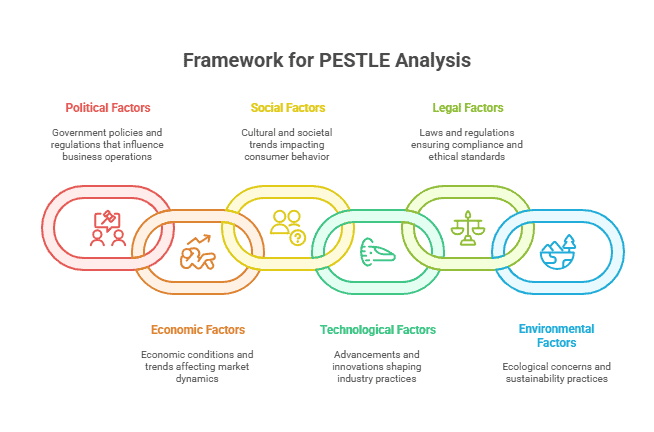
The Missing Link (PESTLE Analysis): You cannot operate in a vacuum. A PESTLE Analysis forces you to scan the Political, Economic, Social, Technological, Legal, and Environmental factors shaping your future. It serves as your early-warning radar, ensuring your startup is positioned for where the market is headed, not where it has been.
2. Misjudging the Competitive Battlefield
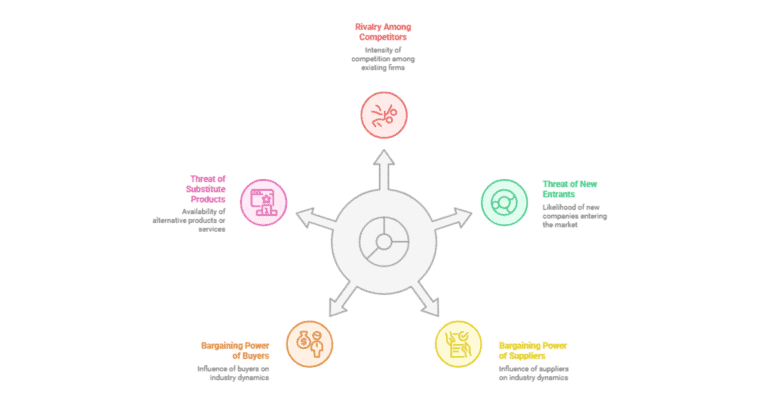
The Mistake: You assume your only threats are direct competitors with similar products. You overlook the bargaining power of your suppliers, the leverage of your buyers, and the threat of substitutes.
The Missing Link (Porter’s Five Forces): You need to know who truly holds the power in your ecosystem. Porter’s Five Forces quantifies competitive intensity. It prevents you from fighting losing battles by showing you where barriers to entry are high and where your margins are most vulnerable.
3. Bleeding Capital on Non-Core Activities
The Mistake: You try to do everything in-house. You burn precious seed capital on administrative overhead and support tasks instead of doubling down on the one thing that makes you unique.
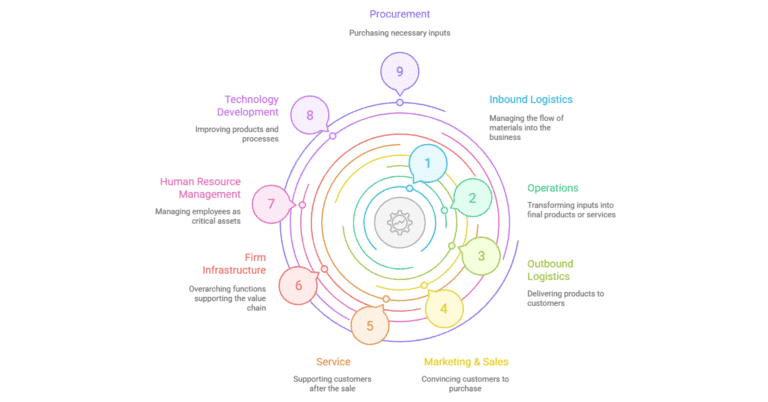
The Missing Link (Value Chain Analysis): A Value Chain Analysis is a surgical examination of your operations. It dissects every primary and support activity, revealing exactly where your startup creates value and where it leaks cash. It tells you what to outsource ruthlessly and what to protect at all costs.
4. Operating with Internal Blind Spots
The Mistake: You are too close to your product to see its flaws, leading to Confirmation Bias. You highlight your genius while ignoring critical operational vulnerabilities.
The Missing Link (SWOT Analysis): A rigorous SWOT Analysis strips away the ego. By systematically identifying your Strengths, Weaknesses, Opportunities, and Threats, you establish an objective baseline for your startup’s current reality.
5. The Execution Gap
The Mistake: You have a beautiful pitch deck with a massive vision, but on a Tuesday morning, your development and marketing teams are working on misaligned, low-priority tasks.
The Missing Link (GOST Framework): Vision without execution is just a hallucination. The GOST Framework (Goals, Objectives, Strategies, Tactics) creates a cascading hierarchy of alignment, ensuring that every daily tactic your team executes directly feeds into your highest-level corporate goals.
6. Chasing Unvalidated Growth Vectors
The Mistake: You hit a growth plateau and immediately build new features for a new demographic, spreading your team too thin and cannibalizing your core product.
The Missing Link (Ansoff Matrix): Growth shouldn’t be a guessing game. The Ansoff Matrix outlines four distinct growth vectors based on market and product novelty. It forces you to mathematically evaluate whether to deepen penetration in your current market or take the higher-risk leap into diversification.
7. Fighting in a Red Ocean
The Mistake: You enter a saturated market and try to win by slashing prices or adding marginal value-added features. You bleed margins trying to outcompete established giants.
The Missing Link (Blue Ocean Strategy): Stop competing and start creating. Blue Ocean Strategy empowers you to identify untapped market spaces. By focusing on value innovation, you make the competition irrelevant, creating a new arena where you are the only logical choice.
8. Analysis Paralysis
The Mistake: You gathered the data. You have a list of threats and weaknesses. But the data sits in a static PDF, gathering digital dust. You know what is wrong, but you don’t know how to move forward.
The Missing Link (TOWS Matrix): The TOWS Matrix bridges observation and execution. It forces your internal capabilities to collide with external realities, generating specific, actionable strategic maneuvers (like using a Strength to neutralize a Threat) that you can prioritize immediately.
9. Tracking Vanity Metrics
The Mistake: You celebrate website traffic, social media followers, and total user sign-ups, but your churn rate is high, and your cash runway is shrinking.
The Missing Link (Balanced Scorecard): Financials are lagging indicators; they tell you what happened yesterday. The Balanced Scorecard aligns your strategy across four vital perspectives: Financial, Customer, Internal Processes, and Learning & Growth. It ensures you are measuring what matters for tomorrow’s success, not just today’s ego.
10. Set and Forget Planning
The Mistake: You treat strategy as an annual event. You write the plan, lock it away, and never adjust it based on real-time feedback.
The Missing Link (PDCA Cycle): Startups must iterate scientifically. The PDCA Cycle (Plan-Do-Check-Act) ensures continuous improvement. Every launch is a test, every failure is a data point, and every success is standardized.
Stop Guessing. Start Executing.
The reason most founders fail isn’t a lack of drive; it’s a lack of a centralized strategic ecosystem. Managing these 10 frameworks across dozens of disconnected spreadsheets, whiteboard photos, and slide decks is a logistical nightmare.
You need a dynamic environment where your strategy can pivot as fast as your market.
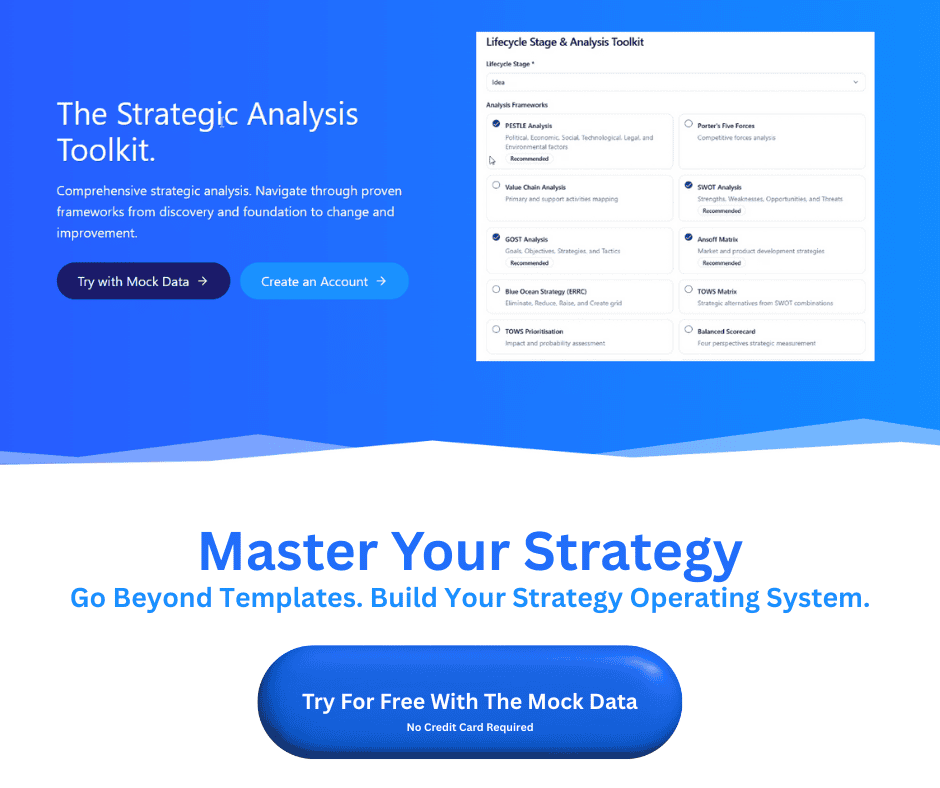
The Strategic Analysis Toolkit democratizes professional-grade consulting methodologies. It centralizes your entire strategic workflow, from PESTLE discovery to Balanced Scorecard execution, into one interconnected platform. It strips away analyst bias, automates the heavy lifting, and turns weeks of frantic research into hours of investor-ready insight.
Don’t let your startup become a statistic. Master your strategy today with the Strategic Analysis Toolkit.