
When to Hire: Building a Team That Grows With You
It’s the most common trap when scaling a business. Your team is working late into the night, customer support tickets are piling up, and your lead developer hasn’t taken a weekend off in two months. The typical, immediate response from leadership? We need to hire.
But hiring to ease pressure is a major strategic mistake. When you hire reactively based on team exhaustion or gut feelings, you’re not scaling your business, you’re just increasing your chaos. You inflate your payroll, weaken your culture, and often bring expensive talent into broken systems.
To build a resilient organization, you must change your mindset. Human capital is your most valuable and costly resource; managing it should never be based on guesswork. It needs to be a strategic, proactive approach. Here’s how to stop guessing and start using proven frameworks to identify exactly when and who to hire.
Stop Patching Leaks: Use Value Chain Analysis
Before drafting a job description, identify the precise source of your operational friction. Most leaders see their organization as a whole. When things slow down, they often just add more people to the general problem.
Enter Value Chain Analysis. This framework compels you to break down your business into primary activities (such as inbound logistics, operations, and sales) and support activities (like HR and technology development).
By mapping your value chain, you shift from we need help to we are losing 15% of our margin in outbound logistics due to a lack of specialized oversight.
Are you hiring to enhance a core competency that directly drives revenue?
Or are you hiring to patch up a support activity that should actually be automated or outsourced?
If a new hire doesn’t directly relieve a bottleneck in your value chain or significantly boost your competitive edge, you’re hiring too early.
From Weakness to Maneuver: The SWOT & TOWS Application
We all know the standard SWOT Analysis, recognizing your internal Strengths and Weaknesses, and your external Opportunities and Threats. But pinpointing that lack of specialized marketing talent is a Weakness is just noting the issue. Strategy only begins when you turn that observation into action.
This is where the TOWS Matrix becomes your key hiring filter. It compels you to compare your internal talent gaps with external market realities.
- W-O Strategy (Weakness-Opportunity): Is there a huge, untapped market space (BlueOcean) right in front of you, but you don’t have the engineering talent to develop the feature? This requires an urgent, aggressive hire. You are bringing in talent to gain immediate market share.
- W-T Strategy (Weakness-Threat): Are new regulations threatening your industry, and is your current legal or compliance team under-resourced? This is a defensive hire. You are bringing in talent to protect the baseline.
When you use TOWS, you aren’t just filling a desk; you’re deploying human capital to carry out a specific strategic move.
Measure the Impact: The Balanced Scorecard
The last obstacle to strategic hiring is the Execution Gap. You hire a talented new director, but six months later, nothing truly changes. Why? Because their role was never aligned with the larger strategic system.
The Balanced Scorecard ensures that every new hire is held accountable for more than just a vanity metric. Before signing the offer letter, use this framework to clearly outline how this role will impact the four key perspectives.
- Learning & Growth: What new capabilities will this hire bring to the team?
- Internal Process: Which specific operational workflows are they expected to streamline?
- Customer: How will their work directly enhance the end-user experience or retention?
- Financial: Ultimately, how will the efficiencies they generate or the revenue they produce impact the P&L?
If you can’t define a new role within these four pillars, it isn’t clearly enough defined to hire for.
Execute with the Strategic Analysis Toolkit
Switching from gut-feeling hiring to strategic talent acquisition doesn’t need a $64,000 consulting engagement. It requires a structured, centralized workflow.
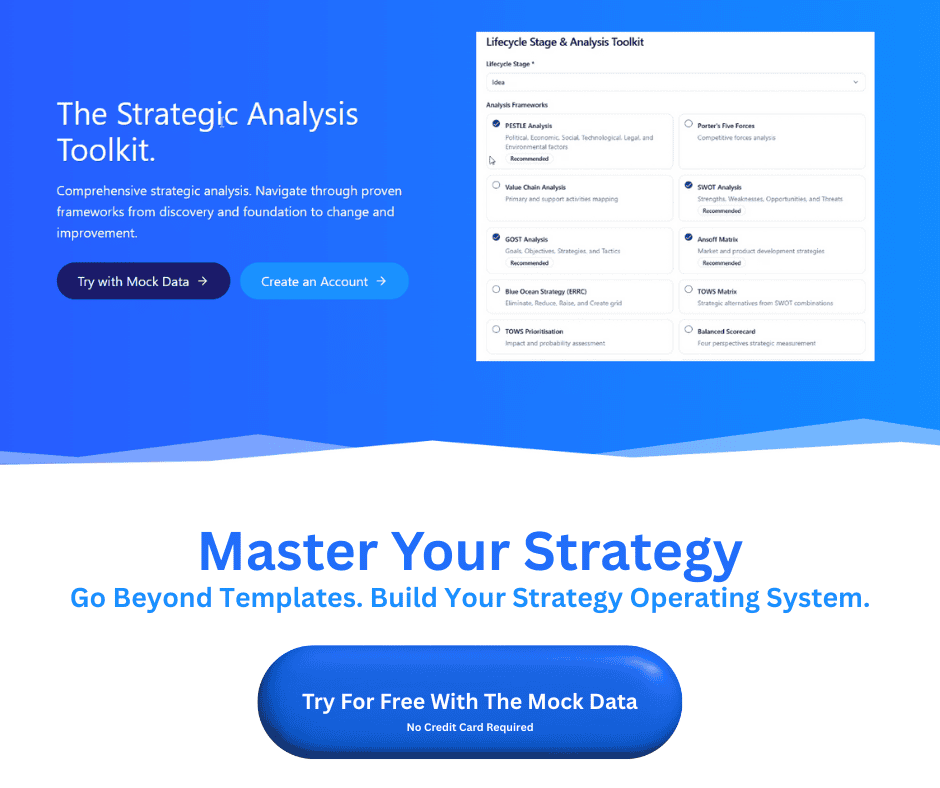
When your data is trapped in messy spreadsheets and disconnected slide decks, analysis paralysis sets in. The Strategic Analysis Toolkit is built to close this gap. It makes professional-grade consulting methods accessible, combining Value Chain Analysis, SWOT, TOWS, and the Balanced Scorecard into a single, dynamic digital platform.
Stop guessing when to scale. Automate the heavy lifting, eliminate your analytical bias, and ensure every new hire is a strategic asset. Try the Strategic Analysis Toolkit today and turn your organizational vision into an action plan.