
The Silent Threat: Has Your Business Hit a Growth Plateau?
Growth rarely follows a straight path upward. Every successful business eventually encounters a ceiling. However, a growth plateau isn’t just a temporary halt; it represents a serious vulnerability. While your numbers stay flat, your competitors are innovating, market preferences are changing, and your operational costs are gradually rising.
If you don’t identify the root cause of a plateau quickly, stagnation turns into decline. The issue is that most leaders attempt to brainstorm their way out of a plateau using gut instinct. To break through, you don’t need more brainstorming; you need the clear guidance of strategic frameworks.
Here are the five warning signs your business has reached a plateau, along with the specific analytical tools you need to overcome it.
1. Revenue Remains Steady, but Profit Margins Are Shrinking
You’re working just as hard and earning the same amount of money, but your bottom line keeps getting thinner each quarter. This usually indicates that your operational efficiency has peaked or that bloated processes are eating into your profits from within.
The Framework Fix: Value Chain Analysis
You need to analyze every stage of your operation, from inbound logistics to customer service. A Value Chain Analysis helps you pinpoint exactly where value is added and where costs are high. By finding inefficiencies in your foundation, you can improve margins without necessarily needing to boost sales volume.
2. Customer Acquisition Costs (CAC) are Skyrocketing.
When it costs twice as much to acquire the same type of customer you were getting last year, you are fighting in a saturated market. The channel you relied on for growth has dried up, and you are trapped in a bidding war for a shrinking pool of leads.
The Framework Fix: Ansoff Matrix & Blue Ocean Strategy
To break free from a saturated market, you need to look outward. The Ansoff Matrix helps you assess whether to expand into new markets with your current products or create new offerings for your existing customers. Combining this with a Blue Ocean Strategy enables you to find uncontested market space, making competitors irrelevant and significantly reducing your acquisition costs.
3. You are Constantly Reacting to Competitors
If your strategy meetings mainly revolve around copying what your competitor has just launched, you have lost your strategic edge. You’re playing defense, which means you’re no longer controlling the pace of your own growth.
The Framework Fix: Porter’s Five Forces & SWOT Analysis
It’s time to step back. Conduct a Porter’s Five Forces analysis to understand the true power dynamics in your industry. Are suppliers too dominant? Is the threat of substitution too high? Once you identify the external pressures, use a SWOT Analysis to match your internal strengths with external opportunities. Stop just reacting; start proactively positioning.
4. Legacy Products Carry the Entire Business
Your main product from five years ago still accounts for 90% of your revenue. While having a steady income is good, depending too much on one old product is a big risk. If the market shifts, your entire revenue could vanish overnight.
The Framework Fix: PESTLE Analysis
Why hasn’t your company innovated lately? Oftentimes, it’s because leadership overlooks macro-environmental changes. A PESTLE Analysis (Political, Economic, Sociological, Technological, Legal, Environmental) prompts you to examine the major external forces impacting your industry. It provides the foresight necessary to develop the next flagship product before the current one becomes outdated.
5. The Team is Busy, but Nothing Moves the Needle
Your employees are working 50-hour weeks and completing projects, but by the end of the quarter, progress remains unchanged. There is a complete disconnect between daily tasks and overarching strategic goals.
The Framework Fix: Balance Scorecard
You don’t have an effort problem; you have an alignment problem. Moving from strategic analysis to implementation requires the Balance Scorecard. This framework translates high-level strategy into tangible, measurable daily objectives across four perspectives: financial, customer, internal processes, and learning/growth. It ensures that every hour worked actually contributes to breaking the plateau.
Stop Guessing. Start Analyzing
A growth plateau is a symptom; a lack of strategic clarity is the problem. You can’t reach the next level of revenue with the same chaotic planning that initially caused your stagnation. You need structured, framework-driven analysis.
But running these frameworks manually, wrangling spreadsheets, drawing whiteboards, and compiling reports, remains tedious and time-consuming.
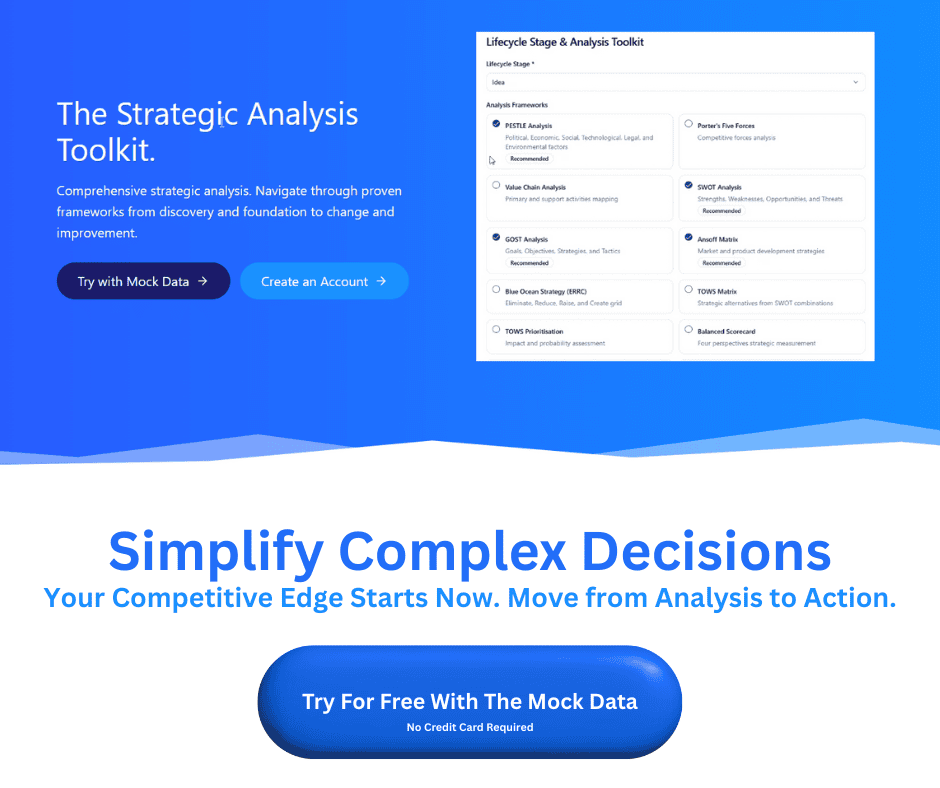
That’s precisely why we created the Strategic Analysis Toolkit.
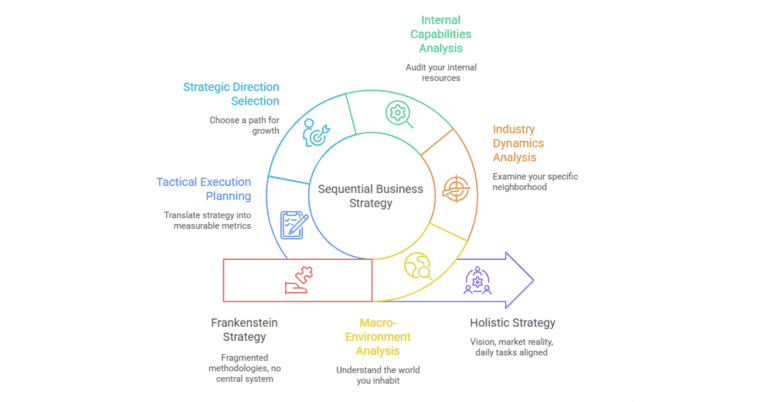
From Discovery and Foundation (PESTLE, Porter’s, Value Chain) to Strategic Analysis (SWOT, Ansoff, Blue Ocean Strategy) to Implementation Planning (Balance Scorecard), the toolkit digitizes, simplifies, and connects these exact frameworks. It guides you step-by-step, transforming abstract business theories into a clear, actionable plan for your specific company.
Don’t let a plateau become a lasting decline. Gain the clarity needed to grow again.
Begin your strategic breakthrough today with the Strategic Analysis Toolkit.