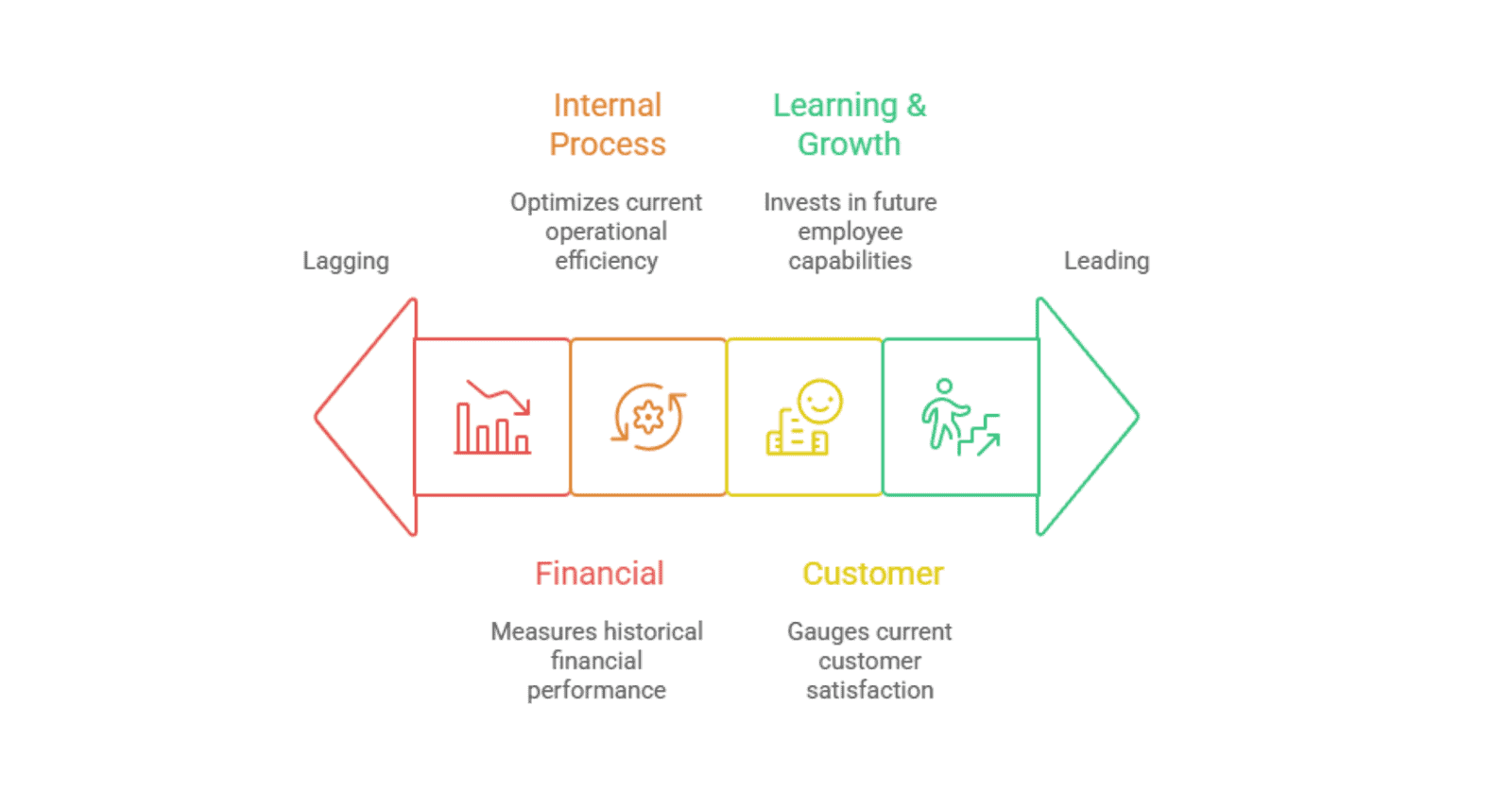
For organizations, having a brilliant strategy is only half the battle. Research suggests that roughly 67% of well-formulated strategies fail due to poor execution. The gap between what leadership envisions in the boardroom and what happens on the front lines is often a chasm filled with misaligned goals and “vanity metrics.”
If you are leading an organization today, you likely feel the pressure to move faster, innovate harder, and stay profitable. But how do you know if you’re actually making progress? If you look only at your bank balance or your quarterly P&L statement, you are effectively driving a car while looking only in the rearview mirror.
To navigate the future, you need a dashboard that looks ahead. You need the Balanced Scorecard (BSC).
What is the Balanced Scorecard? (Beyond the Buzzword)
Developed in the early 1990s by Dr. Robert Kaplan and Dr. David Norton, the Balanced Scorecard was designed to measure performance more effectively. However, it quickly evolved into a comprehensive strategic management system.
The core philosophy is simple: Financial measures are not enough. While profit and revenue are essential, they are “lagging indicators”; they tell you what happened in the past. To predict the future, you must measure the “leading indicators” that drive financial success, such as customer loyalty, internal efficiency, and employee capacity.
By viewing an organization from four distinct perspectives, the BSC provides a “balanced” view of performance, ensuring that short-term financial gains do not come at the expense of long-term sustainability.
The Four Pillars of a Balanced Scorecard
A robust strategic measurement system is built on four interconnected pillars. Each perspective answers a fundamental question about your business health.
1. The Financial Perspective: “How do we look to shareholders?”
Even in a balanced system, the bottom line still matters. This perspective focuses on the traditional financial data that investors and owners care about.
- Key Metrics: Revenue growth, profit margins, Return on Investment (ROI), and Cash Flow.
- The Strategy: Are our strategic initiatives actually contributing to the financial viability of the company?
2. The Customer Perspective: “How do customers see us?”
Customer satisfaction is a leading indicator of future financial success. If customers aren’t happy, they eventually stop paying, and the financial perspective will soon suffer.
- Key Metrics: Net Promoter Score (NPS), Customer Satisfaction Score (CSAT), market share, and customer retention rates.
- The Strategy: What is our value proposition? Are we competing on price, innovation, or intimacy?
3. The Internal Process Perspective: “What must we excel at?”
This perspective identifies the internal workflows and operational hurdles that must be mastered to satisfy customers and shareholders.
- Key Metrics: Cycle time (how long it takes to deliver), unit cost, quality error rates, and throughput.
- The Strategy: Where do we need to optimize? For a tech company, this might be software deployment speed; for a factory, it might be safety and manufacturing precision.
4. The Learning & Growth Perspective: “How can we continue to improve and create value?”
This is the foundation of the entire scorecard. It focuses on the company’s intangible assets: people, culture, and infrastructure.
- Key Metrics: Employee engagement scores, training hours per employee, turnover rates, and access to strategic data.
- The Strategy: Do our people have the skills they need? Is our corporate culture aligned with our goals?
The Secret Sauce: Strategy Mapping
The most common mistake leaders make with the Balanced Scorecard is treating the four perspectives as “silos.” They measure them separately and do not recognize the connection.
This is where Strategy Mapping comes in. A Strategy Map is a visual tool that shows the cause-and-effect relationship between your goals.
How it works in practice:
- If you invest in employee training (Learning & Growth)…
- Then your team will operate more efficiently and make fewer mistakes (Internal Processes)…
- Then your customers will receive a higher quality product faster (Customer Perspective)…
- Then those customers will buy more and refer others, leading to higher profits (Financial Perspective).
Without the map, you have a list of metrics. With the map, you have a story of how you win.
Step-by-Step: Building Your Strategic Measurement System
Building a BSC isn’t about filling out a template; it’s about a fundamental shift in how you view your business. Follow these steps to build a system that sticks:
Step 1: Define the North Star
Before you pick a single metric, you must be clear on your Mission, Vision, and Values. Your scorecard should be a direct translation of your high-level strategy into operational terms.
Step 2: Select Leading vs. Lagging Indicators
A balanced system needs both.
- Lagging Indicators: Tell you where you’ve been (e.g., Sales last month).
- Leading Indicators: Tell you where you’re going (e.g., Number of sales calls made this week).
- Expert Tip: Aim for a 50/50 split to ensure you are monitoring both current results and future potential.
Step 3: Set Targets and Initiatives
A metric without a target is just a number. For every KPI on your scorecard, you must define:
- The Target: What does “good” look like? (e.g., 90% customer retention).
- The Initiative: What project are we running to hit that target? (e.g., Launching a new loyalty program).
Step 4: Cascade the Scorecard
A strategy is useless if it stays in the CEO’s office. “Cascading” is the process of translating the corporate scorecard into departmental scorecards and, eventually, individual performance goals. When a frontline employee can see how their daily work affects the “Internal Process” bubble on the strategy map, engagement skyrockets.
Common Pitfalls to Avoid
As a consultant, I’ve seen many BSC implementations go off the rails. Avoid these three traps:
- Metric Overload: Do not try to track 50 things. A truly “balanced” scorecard usually has between 12 and 20 total metrics (roughly 3–5 per perspective). If everything is a priority, nothing is.
- The “Policing” Mentality: If employees feel the scorecard is a tool to punish them, they will “game” the numbers. Use the BSC as a coaching tool to facilitate honest conversations about why targets aren’t being met.
- Static Data: In a fast-moving market, an annual review of your scorecard is insufficient. Your leadership team should be reviewing the BSC at least monthly to make “pivots” based on the data.
From Measurement to Management
The Balanced Scorecard is more than a dashboard; it is a way of thinking. It forces your organization to move away from the “silo” mentality and toward a holistic view of value creation. By measuring what matters, from the growth of your people to the satisfaction of your shareholders, you build a business that is not just profitable today, but resilient tomorrow.
Your strategy is only as good as your ability to measure it. Start building your Balanced Scorecard today to turn your vision into a reality.
balanced-scorecard-strategic-measurement-systems