In the technology sector, “moving fast and breaking things” is a rite of passage. But speed without direction is just a fast track to failure.
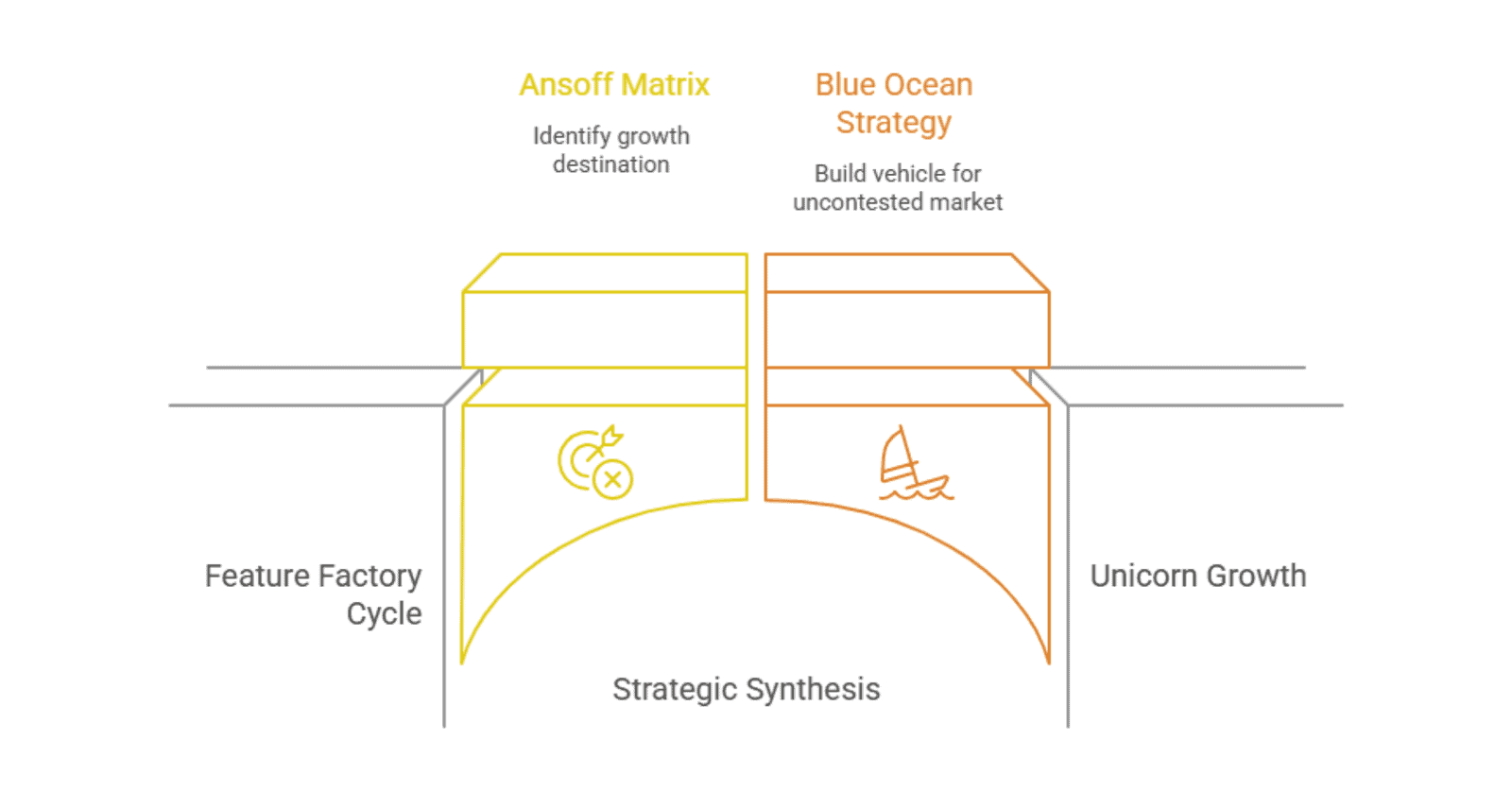
We often see product teams trapped in the “Feature Factory” cycle, churning out updates to keep parity with competitors, reacting to customer tickets, and chasing incremental gains. They are moving fast but not growing.
To break this cycle, tech leaders need to look backward to move forward. By merging a classic business school framework, The Ansoff Matrix, with the modern principles of Blue Ocean Strategy, you can build a roadmap that balances safe, predictable growth with radical, market-shifting innovation.
Here is how to apply these two powerhouses to your tech product strategy.
Part 1: The Ansoff Matrix in a SaaS World
Igor Ansoff created his matrix in 1957, long before the internet existed. Yet, it remains the gold standard for mapping growth because it forces you to answer two simple questions: Who are you selling to? And what are you selling them?
For a modern tech company, the Ansoff Matrix provides four distinct vectors for growth.
1. Market Penetration: The “Land and Expand” Play
- The Strategy: Selling more of your current product to your current market.
- The Tech Translation: This is the bread and butter of SaaS. It involves increasing Monthly Recurring Revenue (MRR) through seat expansion, improving retention to reduce churn, or aggressively marketing to capture a larger share of your existing TAM (Total Addressable Market).
- The Tactic: If you are a CRM platform, this looks like a marketing campaign aimed at getting your current users to log in daily rather than weekly, or offering annual discounts to lock in loyalty. It’s low risk, but growth is limited by the size of the pond you’re fishing in.
2. Product Development: The “Feature Set” Play
- The Strategy: creating new products (or significant features) for your existing market.
- The Tech Translation: You already have the customers’ trust; now you need to solve more of their problems. This is the most common growth lever for mature tech companies.
- The Tactic: Think of Adobe Creative Cloud. They had the users (designers), so they didn’t need to find new people. Instead, they built new tools (Lightroom, Premiere, and now Firefly AI) to sell to that same captive audience. The risk here is “feature bloat”, building things your users didn’t actually ask for.
3. Market Development: The “New Vertical” Play
- The Strategy: Taking your existing product to a new market.
- The Tech Translation: This is often where B2C companies try to move upmarket to B2B Enterprise, or where a US-centric software attempts to launch in EMEA or APAC.
- The Tactic: If you have a successful project management tool for marketing agencies, Market Development would be repackaging that same tool for construction firms. The code doesn’t change much, but the go-to-market (GTM) strategy changes entirely.
4. Diversification: The “Moonshot” Play
- The Strategy: New products for new markets.
- The Tech Translation: This is the suicide quadrant for startups but the survival quadrant for giants. It involves stepping entirely outside your comfort zone.
- The Tactic: Amazon started as a bookstore (Retail). Launching AWS (Cloud Infrastructure) was pure diversification. It was high risk, completely outside their core competency, and ultimately became their profit engine.
Key Insight
Most product roadmaps get stuck oscillating between Penetration and Product Development. To become a unicorn, you eventually have to look outward.
Part 2: Blue Ocean Strategy and Value Innovation
If the Ansoff Matrix tells you where to grow, Blue Ocean Strategy tells you how to win there.
In a “Red Ocean,” market boundaries are defined and accepted. Companies seek to outperform their rivals to capture a larger share of existing demand. In tech, this manifests as the “Feature War”, where Competitor A adds a dashboard, so Competitor B adds a dashboard, and prices drop while costs rise.
A Blue Ocean Strategy challenges you to step out of the blood-red water and create uncontested market space. This is achieved through Value Innovation: making the competition irrelevant by offering a leap in value to buyers while simultaneously reducing costs.
The Tool: The ERRC Grid
To find your Blue Ocean, you must apply the ERRC framework to your product roadmap:
- Eliminate: Which factors that the industry has long competed on should be eliminated? (e.g., lengthy onboarding processes, on-premise servers).
- Reduce: Which factors should be reduced well below the industry’s standard? (e.g., complexity of settings, number of tiered plans).
- Raise: Which factors should be raised well above the industry’s standard? (e.g., speed of support, ease of UI).
- Create: Which factors should be created that the industry has never offered? (e.g., AI automation, community-led templates).
Part 3: The Synthesis, How to Merge Them
This is where proper strategy happens. You don’t choose between Ansoff and Blue Ocean; you layer them.
Many companies fail at Ansoff’s “Market Development” (taking their product to a new market) because they enter that new market using Red Ocean thinking. They look at the incumbents in the new territory and say, “We can do what they do, but 10% cheaper.” That is a race to the bottom.
Instead, use Ansoff to identify the Destination, and Blue Ocean to build the Vehicle.
Scenario: The Project Management Pivot
Imagine you build project management software for creative agencies (Current Market). You want to grow.
Step 1: The Ansoff Decision: You decide to target the Legal Industry (New Market). This is Market Development.
Step 2: The Red Ocean Trap: Review existing legal software. It’s complex, expensive, and secure. You try to build a “Light” version of legal software. You fail because lawyers don’t want “light”; they want “secure and compliant.” You are fighting a Red Ocean battle on their turf.
Step 3: Blue Ocean Synthesis: Apply the ERRC grid to the Legal Market.
- Eliminate: The need for IT installation.
- Reduce: The complexity of billing codes.
- Raise: The visual collaboration aspect (which lawyers usually lack).
- Create: A client-facing portal that translates legal jargon into visual timelines.
Now, you aren’t just “entering the legal market.” You are redefining how lawyers communicate with clients. You have used Ansoff to select the target and Blue Ocean to ensure there are no competitors when you arrive.
Part 4: Case Studies in Strategic Synthesis
1. Netflix: The Ultimate Pivot
- Ansoff Move (Product Development): Netflix started by shipping DVDs (Market Penetration). They then introduced streaming. This was a New Product for their Existing Market.
- Blue Ocean Move: Blockbuster and cable TV were fighting over “new releases” and “primetime slots” (Red Ocean). Netflix eliminated late fees. They created the concept of “Binge-Watching” by releasing entire seasons at once. They didn’t just sell a better movie rental service; they changed the consumption model entirely.
2. Slack: Redefining Communication
- Ansoff Move (Market Development): Before Slack, IRC, and chat tools existed for developers. Slack took that technology and aimed it at general business teams (Marketing, HR, Sales).
- Blue Ocean Move: Enterprise communication (Email, Microsoft Lync) was formal, clunky, and siloed. Slack raised the “fun” factor (emojis, Giphy integration) and created channel-based transparency. They made enterprise software feel like a consumer social app, rendering the “professionalism” of email irrelevant for internal comms.
Execution is Your Strategy
The beauty of combining these frameworks is that it satisfies both the visionary and the pragmatist.
The Ansoff Matrix provides your investors and board with the assurance of a structured, logical growth plan. It demonstrates that you understand the risks associated with moving from penetration to diversification.
The Blue Ocean Strategy gives your product and marketing teams the creative fire they need. It frees them from the drudgery of copycat features and empowers them to solve problems in ways no one else has imagined.
Your Next Move
Don’t let this remain a theoretical exercise. In your next quarterly strategy session, draw the Ansoff Matrix on the whiteboard. Place your current initiatives in the boxes.
If you find that 90% of your roadmap is in the “Market Penetration” box (fixing bugs and minor updates), you are stalling. Pick a new quadrant, apply the ERRC grid, and chart a course for open waters.