
Are You Hitting Your Targets but Missing Your Goals?
In the modern boardroom, data is abundant, but alignment is rare. Most executives sit behind dashboards flashing green, indicating their teams are hitting Key Performance Indicators (KPIs) with flying colors. Yet at the end of the quarter, market share has shrunk, customer churn is up, and profit margins are razor-thin.
How can a company succeed on paper yet fail in the market?
This paradox is the direct result of measuring the wrong things. When your KPIs are disconnected from your overarching business strategy, you aren’t managing growth; you’re just tracking motion. To turn your vision into reality, you must shift from vanity metrics to strategy-aligned performance indicators.
The Vanity Metric Trap: Measuring What’s Easy, Not What Matters
It is a fundamental rule of business psychology: people manage what you measure. If your strategy is to become a premium, high-touch boutique service, but your primary customer service KPI is Average Call Handling Time, you are financially incentivizing your team to rush clients off the phone. Your metric is actively undermining your strategy.
This is the Vanity Metric Trap. Organizations default to tracking what is easy to extract from their CRM or financial software, website traffic, daily output, and raw lead volume, instead of the complex metrics that define competitive advantage.
The Execution Gap: Why Misaligned KPIs Cost Millions
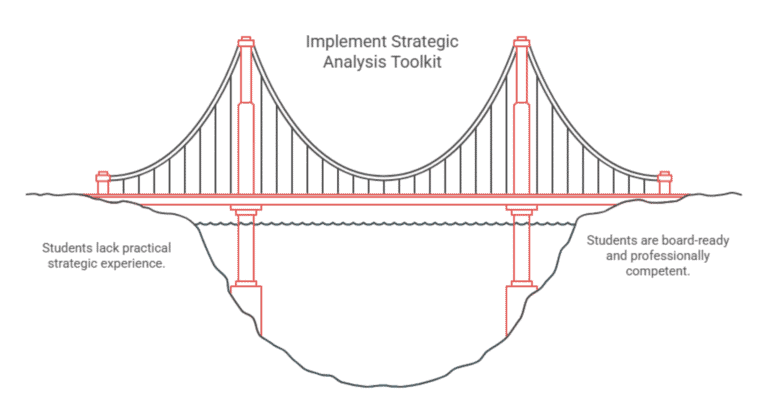
When KPIs live in a vacuum, you create an Execution Gap. This is the perilous chasm between the brilliant strategy developed in the executive suite and the daily actions on the front lines.
Without strategic alignment, departments become siloed. Marketing optimizes for raw lead volume (a marketing KPI), while Sales struggles with lead quality, causing conversion rates to plummet (a sales KPI). Both teams blame each other, budgets are drained, and the strategic objective, increasing overall market penetration, is lost amid the friction.
If you are running your business using only traditional financial metrics (like quarterly P&L or ROI), you are effectively driving a car while staring only into the rearview mirror. You know exactly where you have been, but you are blind to the obstacles directly in front of you.
The Solution: Bridging Strategy and Measurement
To fix this, you don’t need a better dashboard; you need a better strategic operating system. By using proven, interconnected frameworks, you can cascade your high-level vision into ground-level metrics.
Step 1: Cascade Your Vision with the GOST Framework
Alignment starts from the top down. The GOST Framework (Goals, Objectives, Strategies, Tactics) is the ultimate tool for ensuring that every metric has a purpose.
- Goals: Your broad, long-term destination (e.g., Become the market leader in sustainable packaging).
- Objectives: The measurable milestones required to reach it (e.g., Capture 15% market share by Q4).
- Strategies: The broad approaches to achieve the objectives (e.g., Target mid-sized e-commerce brands with eco-friendly alternatives).
- Tactics: The specific actions and metrics on the ground.
By using GOST, you ensure that no KPI is created unless it directly supports a Strategy, an Objective, and ultimately the Goal.
Step 2: Look Forward with the Balanced Scorecard
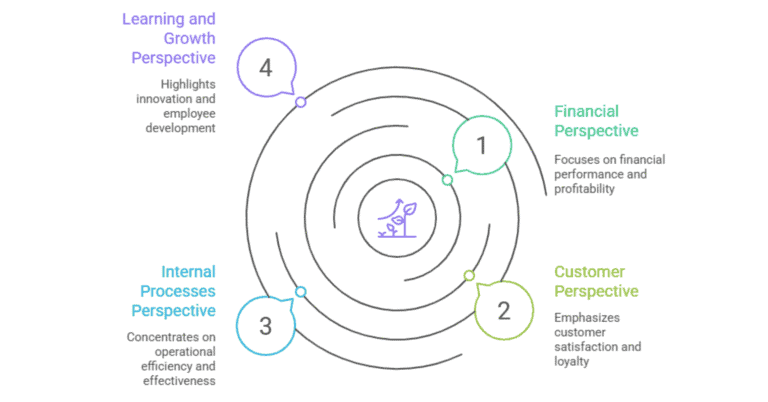
Once your tactics are defined, you must measure them effectively. The Balanced Scorecard is the antidote to the rearview mirror problem. It forces you to look beyond lagging financial indicators and establish leading indicators across four critical perspectives:
- Financial: How do we look to shareholders? (e.g., revenue growth, cost reduction).
- Customer: How do customers see us? (e.g., Net Promoter Score, customer retention rate).
- Internal Business Processes: What must we excel at? (e.g., manufacturing cycle time, quality defect rate).
- Learning and Growth: Can we continue to improve and create value? (e.g., employee training hours, technology adoption rates).
When KPIs are distributed across these four pillars, your strategy becomes a holistic, living organism rather than a static financial wish list.
Step 3: Iterate with the PDCA Cycle
The market doesn’t stand still, and neither should your metrics. The PDCA Cycle (Plan-Do-Check-Act) keeps your KPIs relevant.
- Plan: Establish the strategic KPIs.
- Do: Execute the strategy and collect data.
- Check: Analyze whether the KPIs are driving the intended business outcomes.
- Act: Refine the metrics or the strategy based on real-world feedback.
Stop Tracking, Start Aligning with the Strategic Analysis Toolkit
Building this interconnected web of strategies and metrics is incredibly difficult if you are relying on fragmented spreadsheets and disconnected slide decks. You risk building a Frankenstein Strategy, a monster made of uncoordinated parts.
Sustainable growth requires a centralized, sequential system. The Strategic Analysis Toolkit delivers exactly that.
Our comprehensive web platform democratizes professional-grade consulting methodologies. It guides you seamlessly from foundational environmental scanning through to the execution phase. You can map your overarching vision using the GOST framework, translate it into measurable actions via the Balanced Scorecard, and optimize it with the PDCA cycle, all within one dynamic, integrated environment.
Stop guessing which metrics matter. Stop managing from the rearview mirror. Elevate your strategic execution from static plans to continuous intelligence.
Start aligning your strategy today. Try the Strategic Analysis Toolkit with Mock Data or create your account.