We have all been there. It’s the annual strategic planning session. The coffee is lukewarm, the whiteboard is covered in scribbles, and the team has spent the last three hours agonizing over a SWOT analysis. You have a comprehensive list of every Strength, Weakness, Opportunity, and Threat facing your business.
The session ends. You type up the list. You put it in a slide deck. And then… nothing happens.
The SWOT analysis sits in a folder, gathering digital dust until next year.
This is the “Analysis Paralysis” trap. Most businesses treat SWOT as a checklist; a static snapshot of where they are. But a list is not a plan. Knowing you have a weakness doesn’t fix it, and identifying an opportunity doesn’t seize it.
To move from observation to execution, you need a bridge. You need a tool that forces your data to interact and generate specific, actionable steps.
That tool is the TOWS Matrix.
In this guide, we are going to move beyond the basic SWOT. We will explore how to use the TOWS Matrix to generate high-impact strategies, and more importantly, how to prioritize those strategies so you can actually execute them.
SWOT vs. TOWS: What is the Difference?
If you are familiar with SWOT, you might be thinking, “Isn’t TOWS just SWOT spelled backwards?”
Technically, yes. But functionally, they are completely different stages of the strategic process.
- SWOT is the Input. It is a brainstorming tool used to collect data. It sorts information into internal buckets (Strengths, Weaknesses) and external buckets (Opportunities, Threats). It describes the state of the business.
- TOWS is the Processor. It is a structured framework that forces you to connect the dots between those buckets. It answers the question, “So what?”
Think of your strategy as a manufacturing plant. SWOT provides the raw materials. If you stop there, you just have a pile of lumber and steel. The TOWS Matrix is the machine that takes those raw materials and processes them into a finished product: Actionable Strategy.
The Four Quadrants of Strategy
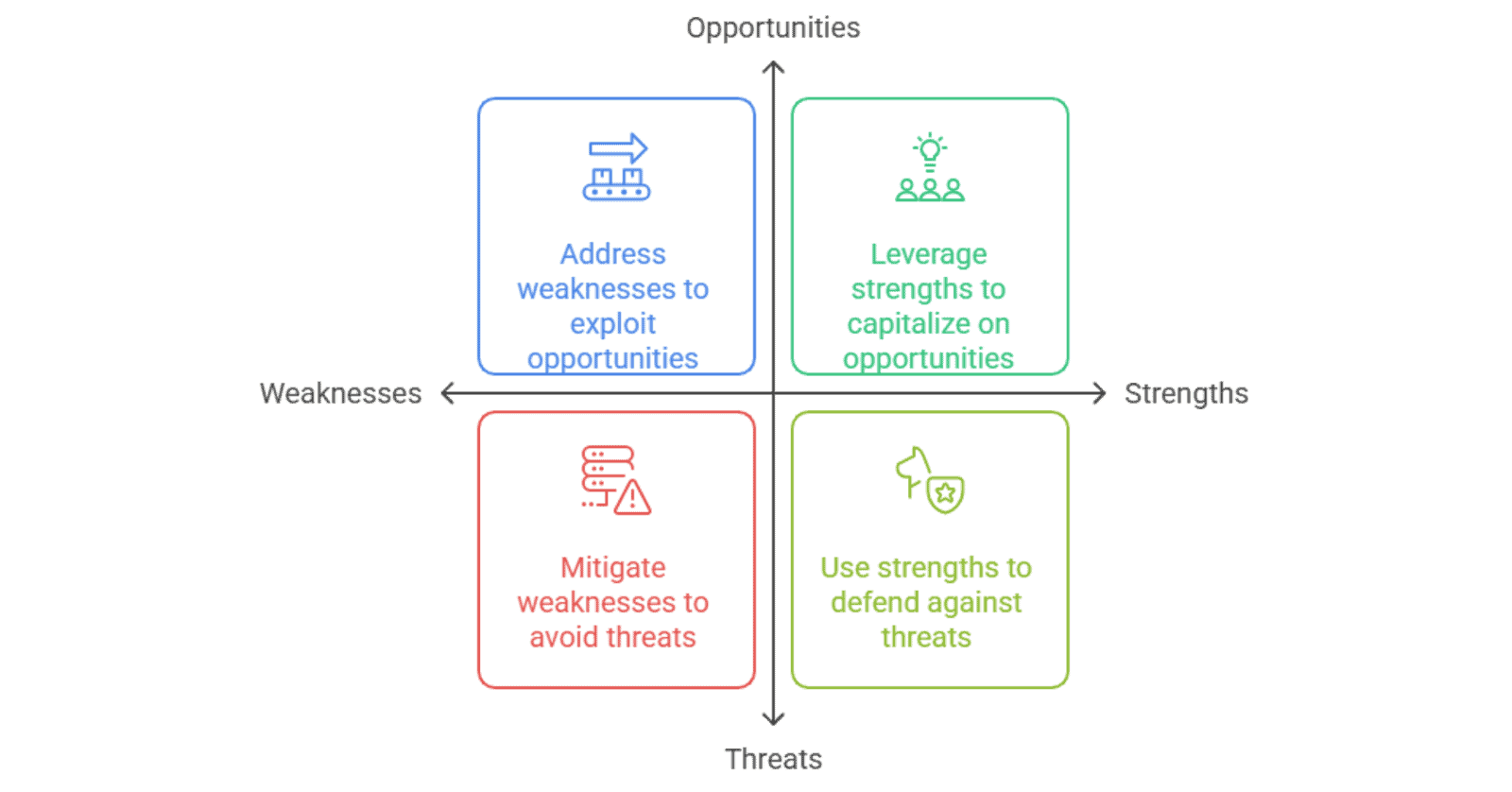
The magic of the TOWS Matrix lies in how it pairs internal factors with external factors. By crossing these elements, you generate four distinct types of strategies.
Let’s break down the four quadrants of the TOWS Matrix.
SO Strategies (Maxi-Maxi): The “Attack” Plan
Strengths + Opportunities
This is the fun quadrant. Here, you are looking at how to use your internal strengths to maximize external opportunities. These are your growth engines.
- The Question to Ask: “Which of our strengths can we deploy to take full advantage of this opportunity?”
- Example: A software company has a massive cash reserve (Strength) and the market is seeing a consolidation of smaller competitors (Opportunity).
- The Strategy: Execute an aggressive M&A strategy to acquire smaller rivals and dominate market share.
WO Strategies (Mini-Maxi): The “Improvement” Plan
Weaknesses + Opportunities
This quadrant requires honesty. You are identifying external opportunities that you are currently missing out on because of internal incompetence or lack of resources. The goal here is to fix the internal defect to unlock the external reward.
- The Question to Ask: “What weakness do we need to fix so we can seize this opportunity?”
- Example: An e-commerce brand sees a huge demand for international shipping (Opportunity) but has a poorly optimized logistics network (Weakness).
- The Strategy: Partner with a third-party logistics (3PL) provider to instantly upgrade shipping capabilities and capture the international market.
ST Strategies (Maxi-Mini): The “Defensive” Plan
Strengths + Threats
This is about using your muscle to protect your territory. You aren’t ignoring threats; you are actively countering them using what you are best at.
- The Question to Ask: “How can we use our specific strengths to minimize or neutralize this real-world threat?”
- Example: A local coffee chain faces the entry of a global giant like Starbucks (Threat). However, the local chain has incredibly high community engagement and brand loyalty (Strength).
- The Strategy: Launch a “Locals Only” loyalty program and community event series that a corporate giant cannot replicate, insulating the customer base from switching.
WT Strategies (Mini-Mini): The “Survival” Plan
Weaknesses + Threats
This is the “danger zone.” When an external threat targets an internal weakness, your business is at risk. These strategies are often about damage control, divestiture, or pivoting.
- The Question to Ask: “How can we minimize this weakness to avoid the potential damage from this threat?”
- Example: A print magazine is seeing declining ad revenue (Threat) and has a high overhead cost structure (Weakness).
- The Strategy: Pivot to a digital-first subscription model and shut down the physical print division to reduce overhead and survive the industry shift.
The Missing Link: Strategic Prioritization
If you do the TOWS exercise correctly, you will run into a new problem: Volume.
A thorough TOWS session usually yields 20, 30, or even 50 potential strategies. You cannot do them all. In fact, trying to do them all is a guarantee of failure. Strategy is as much about what you don’t do as what you do.
You need a filter.
Once you have your list of potential actions derived from the TOWS Matrix, apply the Impact vs. Effort Matrix to prioritize them.
The Impact/Effort Grid
Draw a simple 2×2 graph. The Y-axis is Business Impact (Revenue, Growth, Brand Equity). The X-axis is Effort (Cost, Time, Complexity).
- Quick Wins (High Impact, Low Effort): These are your golden tickets. Do these immediately. They provide momentum and ROI with minimal friction.
- Priority: Do Now.
- Major Projects (High Impact, High Effort): These are the game-changers—new product launches, rebrands, major tech overhauls. They define your year, but they consume resources. You should only have 1–3 of these in play at any given time.
- Priority: Plan and Schedule.
- Fill-Ins (Low Impact, Low Effort): These are “nice to haves.” They don’t move the needle much, but they are easy to do. Save these for slow periods or delegate them to junior team members as training tasks.
- Priority: Delegate or Delay.
- Money Pits (Low Impact, High Effort): These are the silent killers of productivity. These are vanity projects that consume time and money but offer little return.
- Priority: Delete Immediately.
The ICE Method (For Tie-Breaking)
If you have two “Major Projects” and can only afford one, use the ICE Score:
- Impact (1-10): How big is the result?
- Confidence (1-10): How sure are we that it will work?
- Ease (1-10): How easy is it to execute?
Multiply the three numbers (I x C x E). The highest score wins.
Real-World Application: The Independent Bookshop
Let’s look at a quick case study to see this in motion.
The Business: “PageTurners,” a local independent bookstore.
The SWOT Data:
- Strength: Highly knowledgeable staff who read everything.
- Weakness: No e-commerce website; physical sales only.
- Opportunity: Rising trend of “BookTok” (TikTok book communities) driving sales of specific genres.
- Threat: Amazon offers lower prices and same-day delivery.
The TOWS Strategy Generation:
- SO Strategy (Strength + Opportunity): Use the knowledgeable staff to create a TikTok channel offering personalized recommendations, tapping into the BookTok trend to drive foot traffic.
- WO Strategy (Weakness + Opportunity): The lack of a website prevents capturing the viral traffic. Strategy: Launch a simple Shopify store specifically for “BookTok Bundles” to capture online sales.
- ST Strategy (Strength + Threat): Amazon wins on price, but fails on connection. Strategy: Launch a paid membership program that includes monthly staff-curated book clubs and author meet-and-greets—experiences Amazon cannot digitize.
Prioritization
The owner realizes they can’t do all three at once.
- The SO Strategy (TikTok) is High Impact, Low Effort (Quick Win). They start this tomorrow.
- The WO Strategy (Website) is High Impact, High Effort (Major Project). They schedule this for Q3.
- The ST Strategy (Membership) is Medium Impact, Medium Effort. They decide to wait until the TikTok channel builds a larger audience before launching this.
Conclusion
Strategy is not a document; it is a behavior.
The SWOT analysis is excellent for situational awareness, but it is passive. The TOWS Matrix is active. It forces you to confront the reality of your market and design specific moves to win.
But remember: Ideation without prioritization is just noise.
- Gather your data (SWOT).
- Generate your options (TOWS).
- Filter for impact (Prioritization).
Don’t let your next strategic planning session end with a list. End it with a roadmap.