Every year, billions of dollars are poured into the “R&D abyss.” Companies across the globe, from fledgling tech startups to Fortune 500 stalwarts, allocate massive percentages of their revenue to research and development with a singular hope: that they will stumble upon the next “unicorn” product or a market-disrupting breakthrough.
Yet, on balance sheets, the correlation between R&D spending and market outperformance is surprisingly weak. The reason? Most companies are trapped in Innovation Theater. They have the sleek labs, the “Chief Innovation Officers,” and the internal hackathons, but they lack the commercial rigor to turn ideas into invoices.
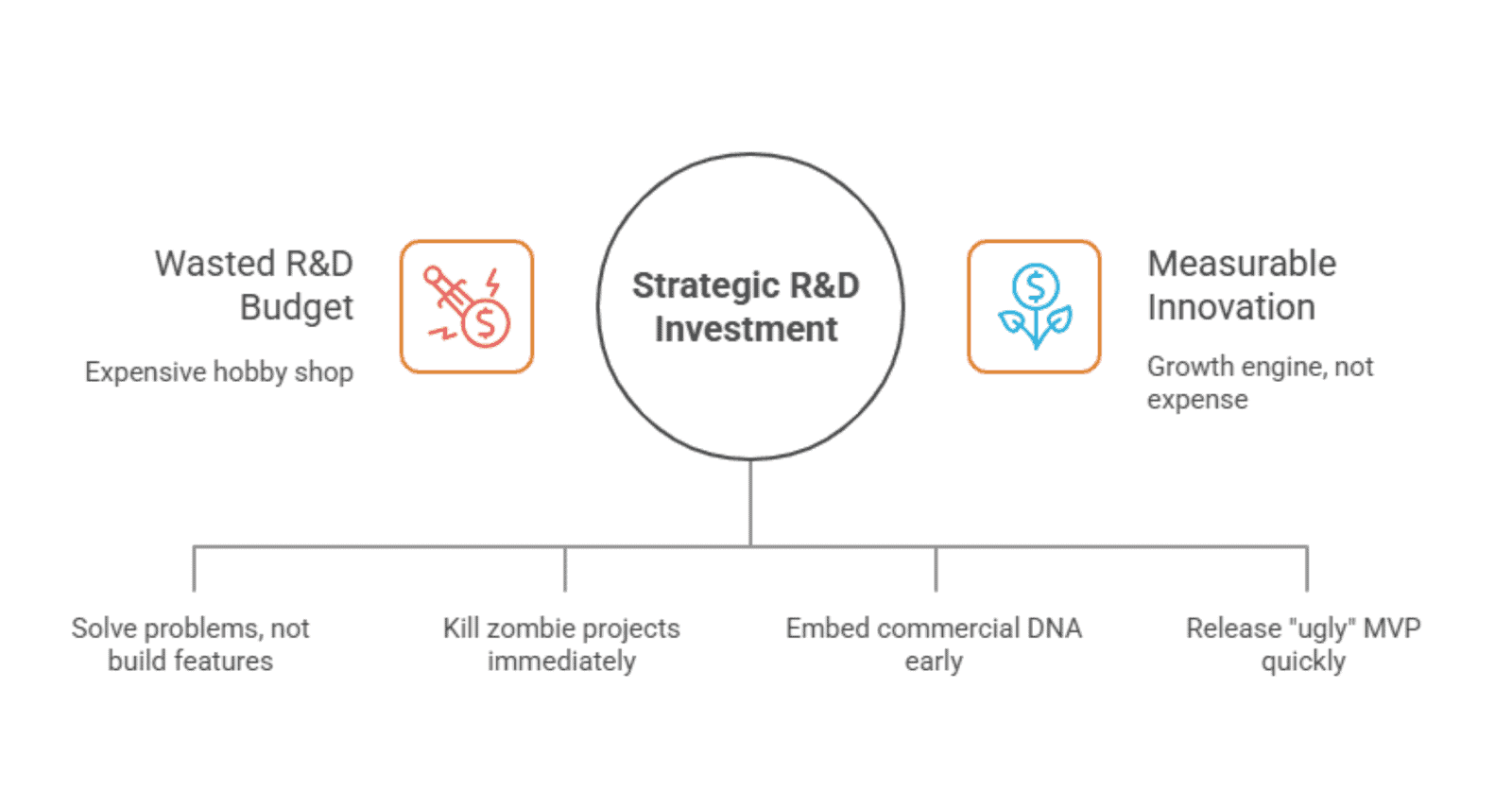
If you feel like your R&D department is an expensive hobby shop rather than a growth engine, it’s time to stop the bleeding. Here is how to stop wasting your R&D budget and start driving real, measurable innovation.
The “Innovation Theater” Trap
We’ve all seen it: the dedicated office wing with primary-colored bean bags, glass walls covered in Post-it notes, and a 3D printer that mostly makes trinkets. This is Innovation Theater. It creates the appearance of progress without the substance of profit.
The fundamental trap of R&D is mistaking activity for achievement. In many organizations, R&D is treated as a “creative” endeavor that shouldn’t be stifled by the “boring” metrics of the business. This is a fatal mistake. Innovation without a path to commercialization is just an expensive hallucination.
To escape the theater, leadership must stop asking, “What are we building?” and start asking, “What are we solving?”
Shift from “Features First” to “Problem First”
The most common cause of R&D waste is a phenomenon I call “The Inventor’s Ego.” This happens when a brilliant engineering team falls in love with a technical solution and then goes hunting for a problem to solve with it.
This is backwards. Real innovation is driven by the Jobs-to-be-Done (JTBD) framework. Customers don’t buy products; they “hire” them to do a specific job in their lives.
How to Pivot:
- Validate the Pain: Before a single line of code is written or a prototype is cast, the R&D team must provide evidence of a “struggling moment” in the market.
- The “Why” Audit: If your team proposes a new feature, ask “Why?” five times. If the final answer doesn’t relate to a customer’s willingness to pay or a significant reduction in churn, the project shouldn’t be funded.
By focusing on the problem first, you ensure your R&D budget is used to build a bridge to an existing destination.
Kill Your Darlings: The Power of Ruthless Prioritization
In the world of business strategy, the hardest thing to do isn’t starting a project; it’s killing one. Many R&D budgets are bloated with “Zombie Projects”: initiatives that are no longer viable, have been eclipsed by competitors, or have no clear market fit, yet continue to receive funding because of the Sunk Cost Fallacy.
Implement Metered Funding
Stop thinking in terms of annual budgets. Instead, adopt a “VC-style” metered funding model. In this setup, R&D projects are treated like internal startups.
- Seed Stage: Small funding for initial problem validation.
- Series A: Funding for a functional prototype.
- Series B: Funding for market testing.
If a project fails to meet its KPIs at any stage, it is “killed” or pivoted immediately. This frees up capital for the “winners” in your portfolio. Remember: A dollar spent on a failing project is a dollar stolen from your next breakthrough.
Bridge the “R&D to Commercial” Chasm
One of the most significant leaks in the R&D bucket is the organizational silo. In many companies, R&D operates in a vacuum. They hand off a “finished” design to Engineering, who then hands it to Manufacturing, who finally hands it to Sales, only for Sales to realize the market doesn’t want it at that price point.
The Solution: Cross-Functional Squads
To drive real innovation, you must embed commercial DNA into the R&D process from day one. This means:
- Product Managers are involved in research to ensure market alignment.
- Sales Leaders provide feedback on prototypes to gauge customer interest early.
- Finance models the unit economics long before the product is “finished.”
Success should not be measured by the number of patents filed or prototypes built. The only metric that truly matters is the Vulnerability Metric: What percentage of our revenue comes from products launched in the last three years? If that number is shrinking, your R&D is failing, regardless of how “cool” the tech is.
Velocity Over Perfection
The “R” in R&D stands for “Research,” which can, unfortunately, become an excuse for endless delays. In a fast-moving market, velocity is a better predictor of success than perfection. Many companies waste 80% of their budget trying to get the last 10% of a product “perfect” before it reaches a customer. This is a mistake. By the time you launch your “perfect” product, the market has likely moved on.
The 70/20/10 Rule of Capital Allocation
To maintain a healthy balance of risk and speed, allocate your R&D budget using this framework:
- 70% Core Innovation: Incremental improvements to your existing products. These are “safe” bets that keep the lights on.
- 20% Adjacent Innovation: Taking what you do well into a new market or using new technology to serve your current customers.
- 10% Transformational Innovation: High-risk, “moonshot” projects that have the potential to reinvent your company.
By categorizing your spend, you ensure you aren’t risking the whole company on a moonshot, nor are you stagnating by focusing only on incremental changes.
Embracing the “Ugly” MVP
Real innovation requires the humility to release an “ugly” Minimum Viable Product (MVP). The goal of an MVP isn’t to make sales; it’s to buy information. Every week your R&D team spends in a closed lab is a week of lost learning. Shift your culture to value rapid prototyping and real-world testing. If you aren’t slightly embarrassed by the first version of your product, you launched too late.
Innovation is a Discipline, Not a Spark
The myth of the “lone genius” in a lab is dead. Modern, high-ROI innovation is a disciplined process of capital allocation, customer empathy, and ruthless prioritization.
To stop wasting your R&D budget, you must stop treating it as a “black box” expense and start treating it as a strategic investment portfolio. Kill the zombie projects, bridge the gap between the lab and the market, and prioritize solving real problems over building shiny features.
Your R&D budget is your company’s future. Don’t let it go to waste.