
There is a delicate balance between visionary persistence and deadly stubbornness.
When revenue drops, customer churn rises, and morale drops, many leaders instinctively work harder. They stick to the original plan, hoping the market will eventually bounce back. But markets don’t bounce back to outdated models. If your business is in decline, working harder on the wrong strategy won’t save you. You don’t need more effort; you need a pivot.
The problem? Pivoting is intimidating. It requires admitting the current path has failed. But what if you could detach the emotion from the situation? What if you could depend on solid, objective frameworks to tell you exactly why you’re failing and where to go next?
This is the structured, data-driven plan to save a declining business.
Phase 1: Stop Guessing, Start Diagnosing
Before fixing the business, you must understand what is truly harming it. This involves removing your assumptions and examining your foundation.
- PESTLE Analysis: Is your decline your fault, or is the world shifting beneath your feet? A PESTLE Analysis encourages you to examine the Political, Economic, Sociological, Technological, Legal, and Environmental factors affecting your industry. If new AI technology is making your service obsolete, a marketing campaign won’t save you. You need to understand the macro-threats driving your decline..
- Value Chain Analysis: Where are you losing internally? By breaking down your operations into a Value Chain Analysis, you can identify exactly which activities are adding value and which are draining your cash runway. It highlights the inefficiencies you must cut immediately to survive.
Phase 2: Design the Pivot
Once you know the root causes of your decline, it’s time to find your exit route. You need a new direction that leverages what you still have while avoiding the traps of your current market.
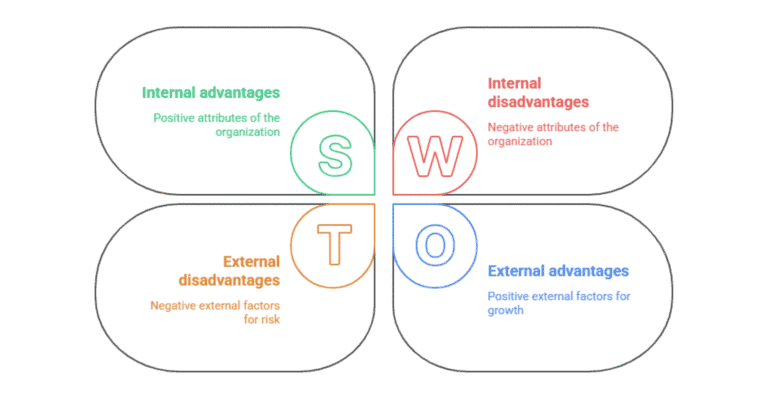
- The Brutal SWOT: Most companies treat SWOT (Strengths, Weaknesses, Opportunities, Threats) as a polite brainstorming exercise. When facing decline, it becomes a tool for survival. You need to be brutally honest about your Weaknesses and Threats to uncover the limited Opportunities remaining..
- Blue Ocean Strategy: A declining business cannot survive a price war in a saturated market. You must use the Blue Ocean Strategy to shift away from your current red ocean, where competitors are tearing each other apart over shrinking margins, and find an uncontested market space. Don’t compete for scraps; create a new category where the competition is irrelevant.
Phase 3: Execute the Survival Plan
A brilliant pivot strategy is useless if your team is too panicked to implement it. Change management is the most challenging aspect of a turnaround.
- Kotter’s 8 Step Plan: You can’t just announce a pivot in a Slack message and expect results. Using Kotter’s 8 Step Plan helps create a sense of urgency, build a guiding coalition of leaders, and communicate the new vision clearly. It transforms a scared workforce into an aligned, agile team ready to implement the new strategy.
The Missing Link: Speed and Clarity
The frameworks above are the lifeboats for a sinking business. But when you’re bleeding cash, you don’t have weeks to spend drawing matrices on whiteboards or formatting spreadsheets. You need answers today.
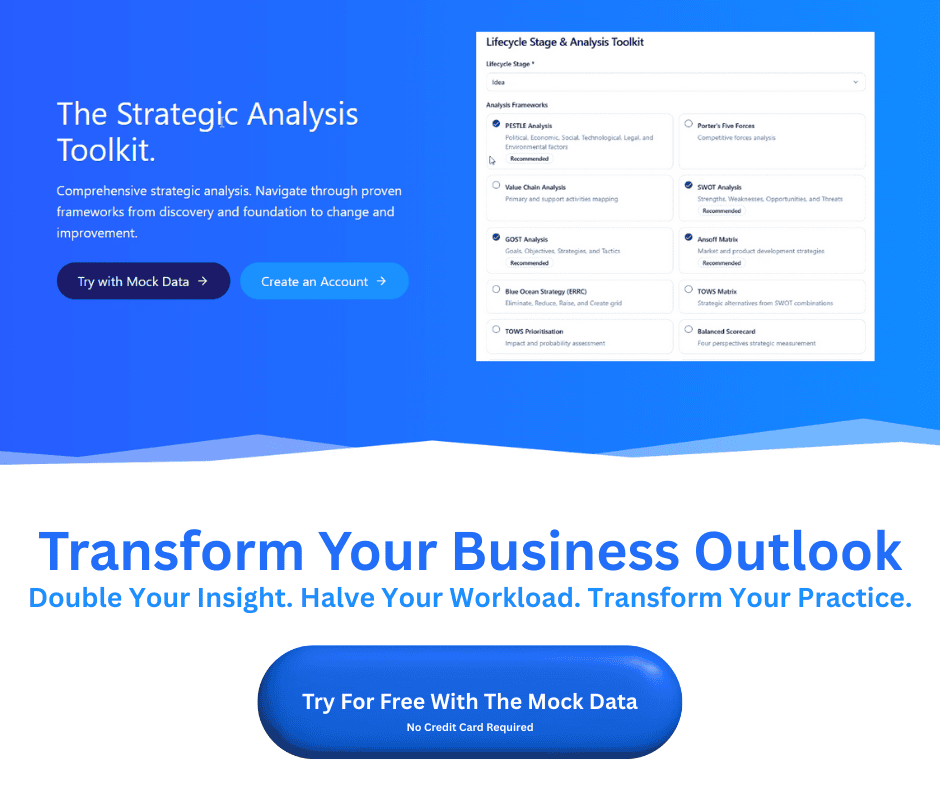
That’s why smart leaders rely on the Strategic Analysis Toolkit.
Instead of starting from scratch, the toolkit automates your Discovery and Foundation, Strategic Analysis, Implementation Planning, Change and Improvement frameworks. Whether you’re running a rapid PESTLE analysis to understand market shifts or mapping out Kotter’s 8 Step Plan to rally your team, the Strategic Analysis Toolkit gives you the immediate clarity needed to execute a successful pivot.
Stop watching your business decline while you try to figure out what went wrong. Use the right tools, confront the data, and make the pivot that will save your company.