
Moving Beyond Good Intentions to Measurable Results
Social impact is no longer a footnote in an annual report. It is a core driver of brand loyalty, employee retention, and long-term valuation.
However, many organizations fall into the Impact Gap, the space between wanting to make a difference and being able to prove they have.
To bridge this gap, you don’t need more passion; you need better systems. By applying world-class strategic frameworks, you can transform vague social initiatives into optimized, high-performance engines of change.
Here is how to measure and optimize your social impact with the Strategic Analysis Toolkit.
1. Discovery: Understanding Your Sphere of Influence
Before you can measure impact, you must understand the environment in which you operate.
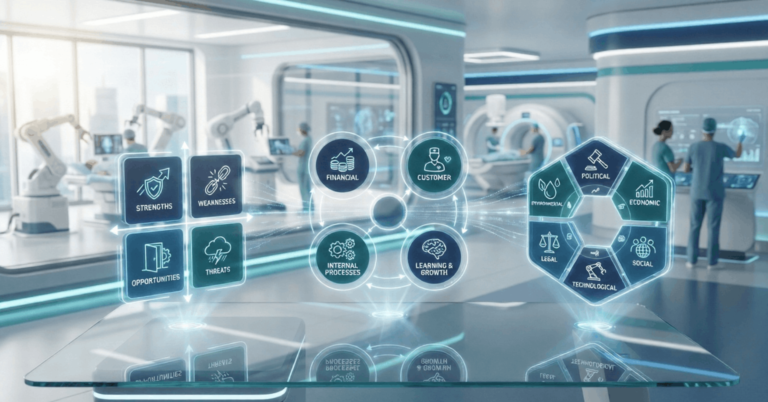
Start with a PESTLE analysis. This helps you assess the Political, Economic, Social, Technological, Legal, and Environmental factors affecting your mission. For instance, how do shifting social attitudes or new environmental regulations create opportunities for your initiative?
Once the external landscape is clear, look inward with a Value Chain Analysis. Traditional value chains focus on cost efficiency, while a social-first value chain identifies where social value is generated. Is it in your ethical sourcing (Inbound Logistics) or your inclusive hiring practices (Human Resources)? Mapping this shows exactly where your impact begins.
2. Strategic Analysis: Finding Your Unique Impact Angle
Not all social initiatives are created equal. To maximize impact, you must be strategic about where you play.
Using a SWOT analysis specifically for your social programs helps identify your unique strengths in the giving space.
However, to truly innovate, you should apply the Blue Ocean Strategy. Instead of competing for the same donor dollars or social causes as everyone else, how can you create a Blue Ocean of social value? Perhaps it’s a new way to deliver education or a technological solution to water scarcity that no one else offers.
Once your niche is identified, use the GOST framework to bring it to life. Define your broad Goals, measurable Objectives, the Strategies to achieve them, and the specific Tactics your team will execute daily.
3. Implementation: Turning Data into Action
The most common failure in social impact is initiative fatigue, trying to do everything and accomplishing nothing.
The TOWS Matrix and TOWS Prioritization are your best filters. By pairing your internal strengths with external social opportunities, you can identify SO (Strengths-Opportunities) strategies with the highest impact. Use the prioritization tool to rank these initiatives by feasibility and social ROI.
To keep track of progress, the Balanced Scorecard is essential. It moves the needle beyond Profit alone and allows you to track:
- Financial: Is the social initiative sustainable?
- Customer/Beneficiary: Are the people we aim to help actually satisfied?
- Internal Processes: Are our social operations efficient?
- Learning and Growth: Is our team evolving to meet emerging social challenges?
4. Optimization: The Cycle of Continuous Improvement
Measuring impact once isn’t enough; you must optimize it. This is where the PDCA Cycle (Plan-Do-Check-Act) is your most valuable asset.
- Plan: Set your social targets.
- Do: Implement the initiative.
- Check: Measure results against your Balanced Scorecard.
- Act: Adjust your strategy based on the data.
Go further by using Executive Summary and What-if Scenarios to future-proof your impact. What if funding drops by 20%? What if a new technological breakthrough makes your current social solution obsolete? Stress-testing your strategy ensures your impact remains resilient in a changing world.
Your Impact, Systematized
Measuring and optimizing social impact is complex, but it doesn’t have to be confusing. The difference between a charity project and a strategic social powerhouse lies in the tools you use to manage it.
The Strategic Analysis Toolkit brings you every framework mentioned above, from PESTLE to the Balanced Scorecard, on one intuitive, professional platform. Don’t just hope you’re making a difference. Prove it.
Ready to transform your social impact? Use the Strategic Analysis Toolkit today.