In leadership, we are often sold the magic bullet of a single framework. One year, the executive suite is obsessed with OKRs (Objectives and Key Results). The next, it pivots toward Blue Ocean Strategy. While these tools are individually brilliant, most organizations use them in a fragmented, Frankenstein-like fashion, bolting together pieces of different methodologies without a central nervous system to connect them.
The result? A Frankenstein Strategy that looks impressive in a slide deck but fails to move the needle in the real world.
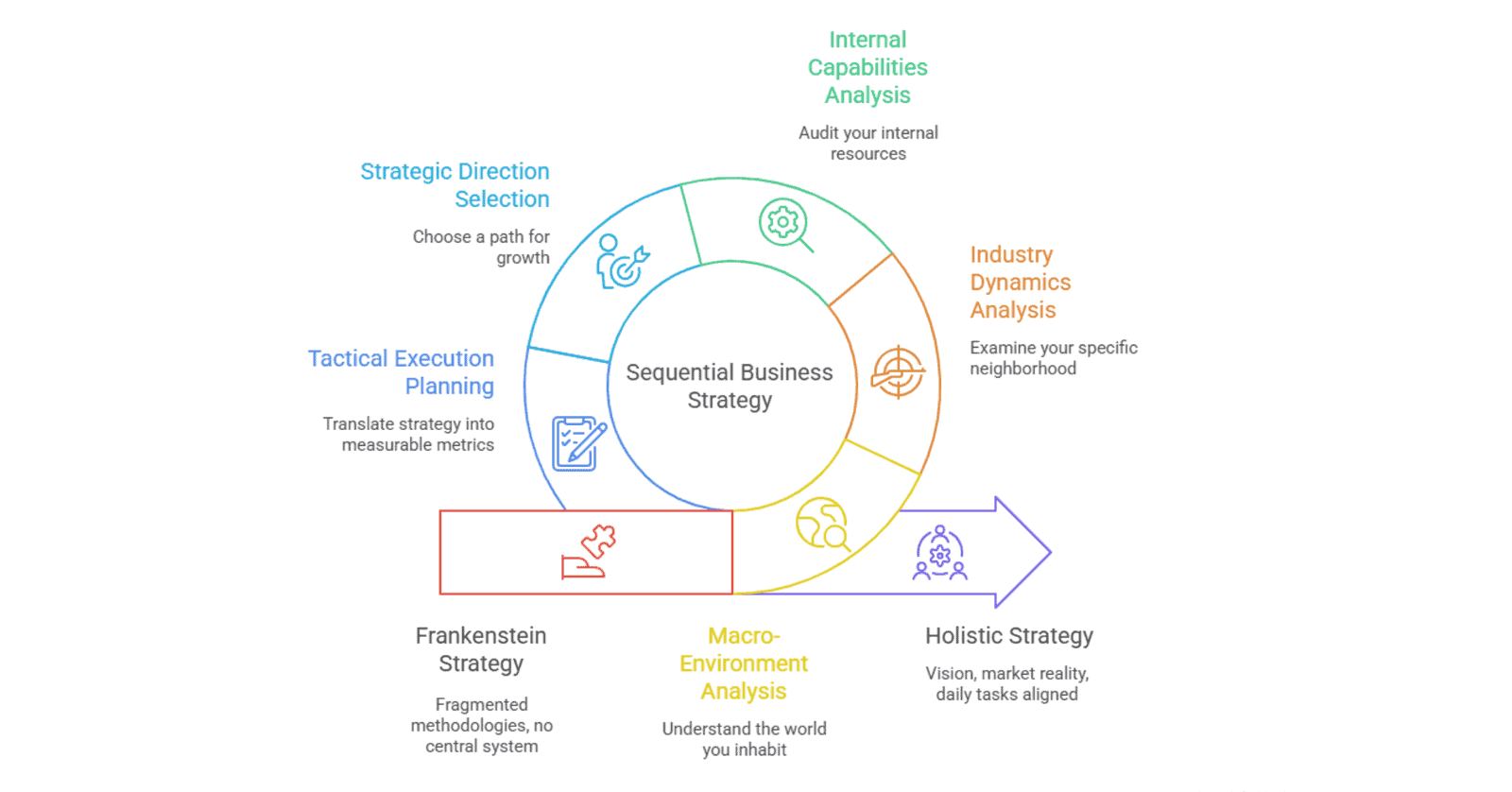
To achieve sustainable growth, you don’t need more frameworks; you need Sequential Business Strategy Framework Integration. This is the art of linking macro-environmental analysis to internal capabilities and, ultimately, to daily execution.
The Problem: The Frankenstein Strategy Trap
A lack of intelligence doesn’t cause most business failures; rather, they stem from a lack of alignment. When a marketing team uses a SWOT analysis that doesn’t inform the product team’s Value Chain Analysis, or when the finance department’s KPIs have nothing to do with the CEO’s PESTLE findings, the organization experiences strategic drift.
Strategic drift occurs when the external environment changes, but the company’s internal mechanisms keep grinding away at outdated goals. Fragmented frameworks create silos where information goes to die. To avoid this, we must view strategy as a sequence rather than a collection of independent events.
The Sequential Stack: How to Build a Holistic Strategy
To build a holistic strategy, you must move from the Outside-In (the world) to the Inside-Out (your capabilities). Here is how the most successful consultants sequence these frameworks to ensure nothing is lost in translation.
The Macro-Environment (PESTLE)
Before you can decide what to do, you must understand the world you inhabit. PESTLE (Political, Economic, Social, Technological, Legal, and Environmental) is the Outside-In lens.
Why it’s first: It identifies the reasons behind market shifts.
The Integration Point: The findings from your PESTEL analysis shouldn’t just be a list; they should provide context for your industry analysis.
Industry Dynamics (Porter’s Five Forces)
Once you understand the global climate, you examine your specific neighborhood. Porter’s Five Forces assesses the competitive intensity and attractiveness of an industry.
The Integration Point: If PESTLE reveals a new regulation (Legal), Porter’s Five Forces shows how it affects the Bargaining Power of Suppliers or the Threat of New Entrants.
Internal Capabilities (Value Chain Analysis)
Now we move Inside-Out. Knowing the industry is great, but do you have the tools to compete? Value Chain Analysis helps you audit your internal resources.
The Integration Point: You are looking for a Strategic Fit. Do your internal strengths actually address the opportunities identified in your PESTLE and Porter’s analysis?
Strategic Direction (Ansoff Matrix & Blue Ocean)
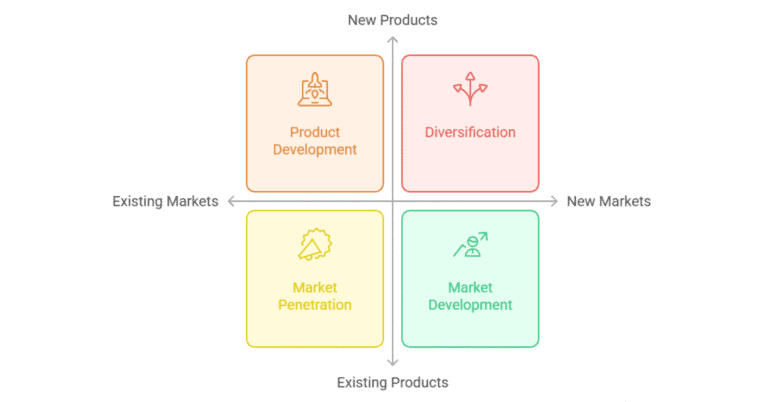
With a clear view of the world and your own capabilities, you can now choose a path. The Ansoff Matrix helps you decide between market penetration, product development, or diversification. Blue Ocean Strategy enables you to find uncontested market space.
The Integration Point: Your choice here is dictated by the previous steps. You cannot pursue a Blue Ocean if your Value Chain Analysis shows you lack the innovative talent to create it.
Tactical Execution (Balanced Scorecard)
Finally, we reach the boots-on-the-ground stage. The Balanced Scorecard translates high-level strategy into 90-day sprints and measurable metrics.
The Integration Point: This is the most common point of failure. If your Balanced Scorecard isn’t directly tied to the growth path chosen, for example, in your Ansoff Matrix, your team will be busy but not strategic.
The Domino Effect: A Case Study in Integration
Imagine a mid-sized automotive parts manufacturer facing the rise of electric vehicles (EVs).
If they relied on isolated frameworks, the Board might conduct a SWOT analysis, recognize EVs as a threat, and then tell the sales team to sell more. This is a recipe for failure.
If they used the Integrated Sequential Strategy, the flow would be as follows:
- PESTLE: Identifies government subsidies for EVs (Political) and shifting consumer preferences (Social).
- Porter’s Five Forces: Identifies that the Threat of Substitutes (EV batteries) is high, threatening their internal combustion engine (ICE) parts business.
- Value Chain Analysis: Reveals that while they are great at ICE parts, they hold a rare patent in heat-dissipation technology that could be used in EV batteries.
- Ansoff Matrix: They choose Product Development, leveraging their heat-dissipation patent to enter the EV battery market.
- Balanced Scorecard: The R&D team is given a key result – prototype an EV-ready cooling plate by Q3.
The result? The entire company, from the CEO to the R&D intern, is aligned on the same survival and growth goal.
The 3 Pillars of Holistic Success
To implement this in your own organization, you must focus on three core principles of integration:
I. Data Continuity
The output of one framework must be the input for the next. If your SWOT analysis identifies Digital Transformation as a priority, that phrase should appear in both your Value Chain Analysis and your Balanced Scorecard. If the language changes, the focus is lost.
II. Cross-Functional Strategic Audits
Strategy shouldn’t happen behind closed doors. When conducting a Value Chain Analysis, involve the product, marketing, and operations leads. This ensures that the internal capabilities you believe you have are grounded in reality.
III. Agility Through Feedback Loops
A holistic strategy is not a one-and-done annual event. It is a living system. Use your Balanced Scorecard to monitor performance monthly. If metrics are lagging, trace the problem back through the sequence. Is the issue execution (Balanced Scorecard), or did we misread the industry (Porter’s Five Forces)?
Strategy is a System, Not a Spreadsheet
In an era of rapid disruption, the Frankenstein Strategy is a liability you cannot afford. Using business frameworks in isolation is like trying to build a car by buying a steering wheel, an engine, and four tires from different manufacturers without checking whether they fit together.
Integrating a sequential business strategy framework ensures that your vision, your market reality, and your daily tasks are in perfect harmony. When these elements align, execution stops being a struggle and becomes a natural consequence of your strategic design.
Stop checking boxes and start building a system. In the end, a holistic strategy isn’t just a plan; it’s a competitive advantage that’s nearly impossible for your competitors to replicate.