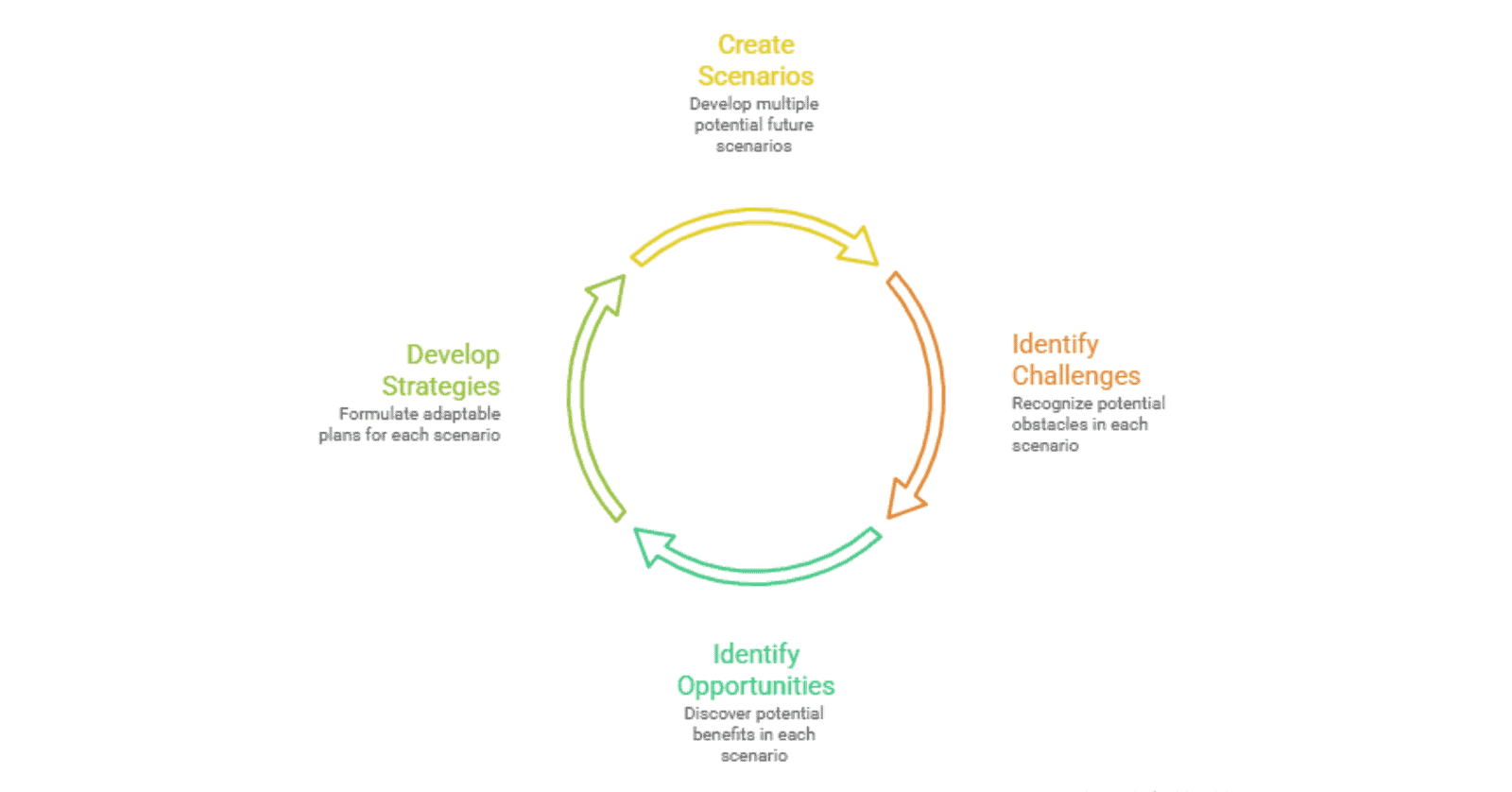
Business is often described by the acronym VUCA: Volatile, Uncertain, Complex, and Ambiguous. In such an environment, the traditional linear forecasting method, predicting next year based solely on an incremental change from last year, is effectively dead. Relying on a single projected future is no longer a viable risk management strategy; it’s a recipe for catastrophic surprise.
Unexpected market shifts, crippling supply chain disruptions, rapid regulatory changes, and disruptive technological advancements, like generative AI, catch unprepared businesses off guard. This leads to reactive panic, costly mistakes, and, often, strategic failure.
The solution is not to become a psychic but to become a masterful planner. What-If Scenarios, also known as Scenario Planning, are not about predicting the future; they are about rehearsing for multiple plausible futures. By systematically exploring these potential realities, businesses can move from a posture of reactive vulnerability to one of proactive agility and business resilience. This practice ensures that no matter how the world turns, your organization has already gamed out the response, reducing the critical “decision latency” that can make or break a company during a crisis.
What Exactly is What-If Scenario Planning?
At its heart, What-If Scenario Planning is a strategic method for developing flexible, robust long-term plans. It involves identifying the most critical forces shaping your industry’s future, economic, technological, and political, and then creating a set of coherent, imaginative narratives about how these forces might play out.
The crucial distinction lies between Forecasting and Scenario Planning:
- Forecasting attempts to predict a single, specific outcome, e.g., “We will achieve 15% growth next quarter”. It assumes predictability.
- Scenario Planning accepts uncertainty and prepares for multiple plausible outcomes, e.g., “What if the economy contracts by 5%?” or “What if a major competitor acquires our key supplier?”.
The core goal of this process is not certainty, but clarity. It forces the leadership team to challenge fundamental assumptions about their market, their customers, and their competitive advantage. By doing so, you deliberately identify potential blind spots in your current strategic decision-making, ensuring your strategy is robust across a wide range of future conditions.
Why Your Business Needs This Now (The Benefits)
Adopting strategic foresight practices provides competitive advantages far beyond simple risk avoidance:
Superior Risk Mitigation
This is the most direct benefit. By running Worst Case scenarios, you identify vulnerabilities in your operations, finances, and supply chain. For example, if a scenario reveals that a significant trade war would wipe out 40% of your raw material supply, you can proactively diversify sourcing today rather than scramble tomorrow. This shifts risk management from damage control to systemic prevention.
An Engine for Innovation
When running scenarios, you often identify constraints or needs that don’t yet exist but will in a specific future world. Preparing for a future in which labor costs double might force you to rapidly accelerate automation, a move that becomes an innovative competitive advantage even if labor costs rise only marginally. Identifying these constraints often serves as a powerful innovation trigger, leading to new product ideas, operational pivots, or entirely new business models.
Executive Alignment and Shared Language
Scenario planning is a powerful tool for achieving Executive Alignment. When a team collectively designs a set of possible futures, they develop a shared understanding of the external landscape. This creates a common language for discussing and assessing risk. When an actual event occurs, the leadership team doesn’t waste time debating if it’s happening or what it means; they enact the pre-designed strategy for that specific scenario.
Strategic Agility and Resilience
The ultimate benefit is reducing decision latency, the time it takes for an organization to recognize a threat or opportunity and execute a response. Because a scenario plan already contains pre-approved triggers and playbooks, the organization can respond almost instantaneously. This high level of business resilience is what separates market leaders from those who merely survive.
The 4 Archetypes of What-If Scenarios
To ensure you cover a meaningful range of possibilities, scenarios are typically grouped into four archetypes. Running each of these provides a comprehensive view of your strategic options:
The Business as Usual Scenario (The Baseline)
What if current trends, e.g., steady 3% GDP growth, moderate inflation, and stable technology adoption, continue with only minor variations? This is the necessary starting point. It grounds the entire exercise in reality and allows you to clearly measure the impact of the other, more extreme scenarios against expected outcomes.
The Worst Case Disaster
This scenario explores maximum pain. It might involve a simultaneous global recession, a complete supply chain collapse due to geopolitical conflict, or a key competitor launching a product that undercuts your market price by 50%. The goal is to determine the point of corporate failure and build contingency plans to ensure survival.
The Best Case Growth Explosion
What if your product hits viral status, demand triples overnight, and your manufacturing capacity is immediately maxed out? The Best Case scenario is crucial because most companies are only prepared for failure, not massive, overwhelming success. This analysis addresses potential scale issues, resource bottlenecks, and the cash flow required to support rapid expansion.
The Wild Card (Black Swan)
This covers completely unforeseen, low-probability but high-impact events. Examples include a revolutionary new regulation that makes your core product illegal, a sudden shift in consumer values, e.g., a permanent aversion to physical retail, or a disruptive AI technology that renders your entire service model obsolete. These scenarios help develop organizational flexibility rather than specific playbooks.
How to Build Your Own What-If Framework (Step-by-Step)
Implementing scenario planning doesn’t require complex software; it requires focused, disciplined thinking. Here is a five-step framework:
Step 1: Identify Drivers of Change
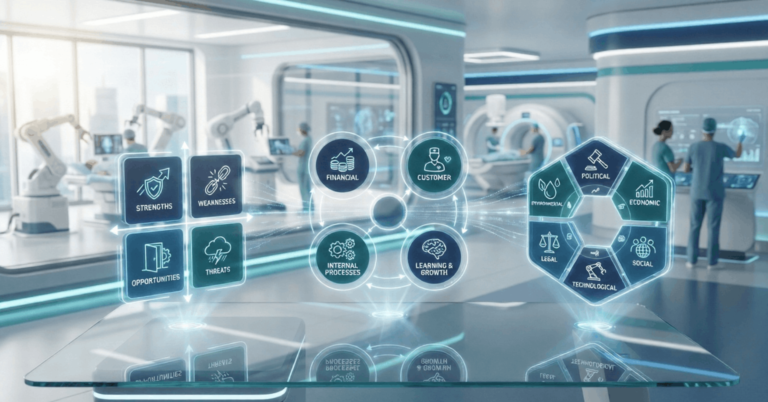
Begin by brainstorming all the external forces that could affect your business over the next 5 to 10 years. A classic method here is PESTLE Analysis:
- Political (Trade tariffs, elections)
- Economic (Inflation, interest rates, recession)
- Social (Demographic shifts, consumer values)
- Technological (AI, quantum computing, new connectivity standards)
- Legal (Data privacy, labor laws)
- Environmental (Climate change, resource scarcity)
Step 2: Select Critical Uncertainties
From your list of PESTLE drivers, identify the two factors that meet both of the following criteria:
- Highest Impact: If this factor changes, it fundamentally alters your business model and profitability.
- Highest Uncertainty: You have the least certainty about which direction this factor will move.
Example: For a high-end fashion retailer, two critical uncertainties might be: Level of Global Inflation (High vs. Low) and Consumer Adoption of Digital Fitting Tech (High vs. Low).
Step 3: Build the Matrix
Use the two critical uncertainties identified in Step 2 to build a 2×2 matrix. The result is four distinct worlds.
| Axis | X-Axis: Low Global Inflation | X-Axis: High Global Inflation |
| Y-Axis: High Digital Fitting Adoption | Scenario 1: Digital Disruption & Prosperity | Scenario 2: Cost-Conscious Digital Shift |
| Y-Axis: Low Digital Fitting Adoption | Scenario 3: Return to Physical Retail Boom | Scenario 4: Stagflation & Traditional Retreat |
Each quadrant now represents a coherent, distinct future world.
Step 4: Flesh Out the Narratives
This is the creative phase. Write a compelling, detailed story for each of the four quadrants. What does the consumer look like in Scenario 2? Which competitors thrive? Where is funding coming from? What materials are scarce? Give each scenario a provocative name, e.g., The Age of the Minimalist or The Hyper-Local Economy. This narrative detail makes the scenarios feel real and facilitates deeper strategic conversation.
Step 5: Stress-Test Your Strategy
With the four narratives complete, the final step is to ask the defining question: Does our current strategy survive, succeed, or fail in all four worlds?
- Survive: Which minimal changes must we make to remain viable?
- Succeed: Which proactive, no-regrets moves should we make now that benefit us in at least three of the four worlds?
- Fail: Where is the point of no return? What early warning indicators would signal that we need to execute the playbook for a specific, complex scenario?
Tools and Techniques to Facilitate the Process
While the process is primarily analytical, several tools and techniques can enhance your scenario planning sessions:
- Revisiting SWOT Analysis: Apply the classic Strengths, Weaknesses, Opportunities, and Threats framework within the context of each scenario. For example, your current Strength (deep investment in physical stores) might become a massive “Weakness” in Scenario 1 (Digital Disruption)
- War Gaming: This involves role-playing. Assign teams to act as your key competitors and make decisions based on what they would do in a specific scenario. This helps uncover competitive strategies you might otherwise overlook.
- Quantitative Sensitivity Analysis: Use financial modeling tools to change core variables, e.g., COGS, customer acquisition cost, and price elasticity, based on the narratives. This provides quantitative data (a profit impact) for each possible future, moving the discussion from abstract ideas to concrete financial outcomes.
Common Pitfalls to Avoid
As an expert business strategist, I’ve observed several traps that often derail new scenario planning efforts:
The Probability Trap
Teams often waste hours arguing over which scenario is most likely (probability) rather than focusing on which is plausible (possibility). The value of the exercise lies in its ability to cover a wide range of outcomes, not in its predictive accuracy. Focus on plausibility and impact, not probability.
Optimism Bias
This occurs when the team is unconsciously biased toward positive outcomes, leading them to create “bad” scenarios that aren’t actually that bad. Ensure your Worst Case truly tests the limits of your organization’s viability. Challenge assumptions constantly.
Analysis Paralysis
A common mistake is creating 10 or 12 different scenarios. This dilutes focus and makes a strategic response impossible. Stick rigorously to 3–4 distinct, well-developed scenarios (usually the four quadrants of the 2×2 matrix) to maintain clarity and actionable insights.
Conclusion
Uncertainty is an inevitable feature of the business landscape, but being unprepared is a strategic choice. What-If Scenario Planning is the ultimate tool for strategic decision-making in a turbulent world. It allows your leadership team to move beyond a single forecast and proactively build the organizational muscle needed to thrive, regardless of the challenges ahead.
Ready to gain the strategic foresight that distinguishes market leaders? Don’t wait for the next disruption to force your hand. Schedule a half-day session with your key stakeholders to run your first What-If analysis and begin building your futures roadmap today.