Why do some companies consistently outperform their rivals, even when selling similar products or services? It’s not just luck, a bigger marketing budget, or a “secret sauce.” They understand exactly where their value is created and, crucially, where it’s wasted.
Too many businesses focus only on the final product or service, missing the forest for the trees. They try to compete on price without understanding their cost drivers, or attempt to differentiate without truly knowing where they add unique value.
Enter Value Chain Analysis (VCA). This powerful framework, developed by Harvard Business School professor Michael Porter, isn’t just academic jargon. It’s a strategic lens that allows you to “see inside” your business, dissecting every activity that contributes to your final offering. By the end of this article, you won’t just know what a value chain is; you’ll know how to use it to cut costs, increase differentiation, and widen your profit margin.
What is Value Chain Analysis? (Beyond the Textbook)
At its core, VCA is a systematic way to break down your company into its individual, discrete activities. The goal? To understand the cost and value of each step in the process of creating and delivering your product or service to the customer.
Imagine your business as a complex machine. VCA helps you inspect every gear, lever, and connection. You’re looking for:
- Cost Drivers: Which activities are expensive, and why?
- Value Creators: Which activities truly add something special for the customer?
- Inefficiencies: Where are resources being used poorly?
- Opportunities for Differentiation: Where can you stand out?
The ultimate objective is simple: to increase your “Margin.” This isn’t just about accounting profit; it’s the gap between the total value you deliver to customers (what they are willing to pay) and the total cost of creating that value. The bigger that gap, the more sustainable and profitable your business.
The Anatomy of a Business: Primary vs. Support Activities
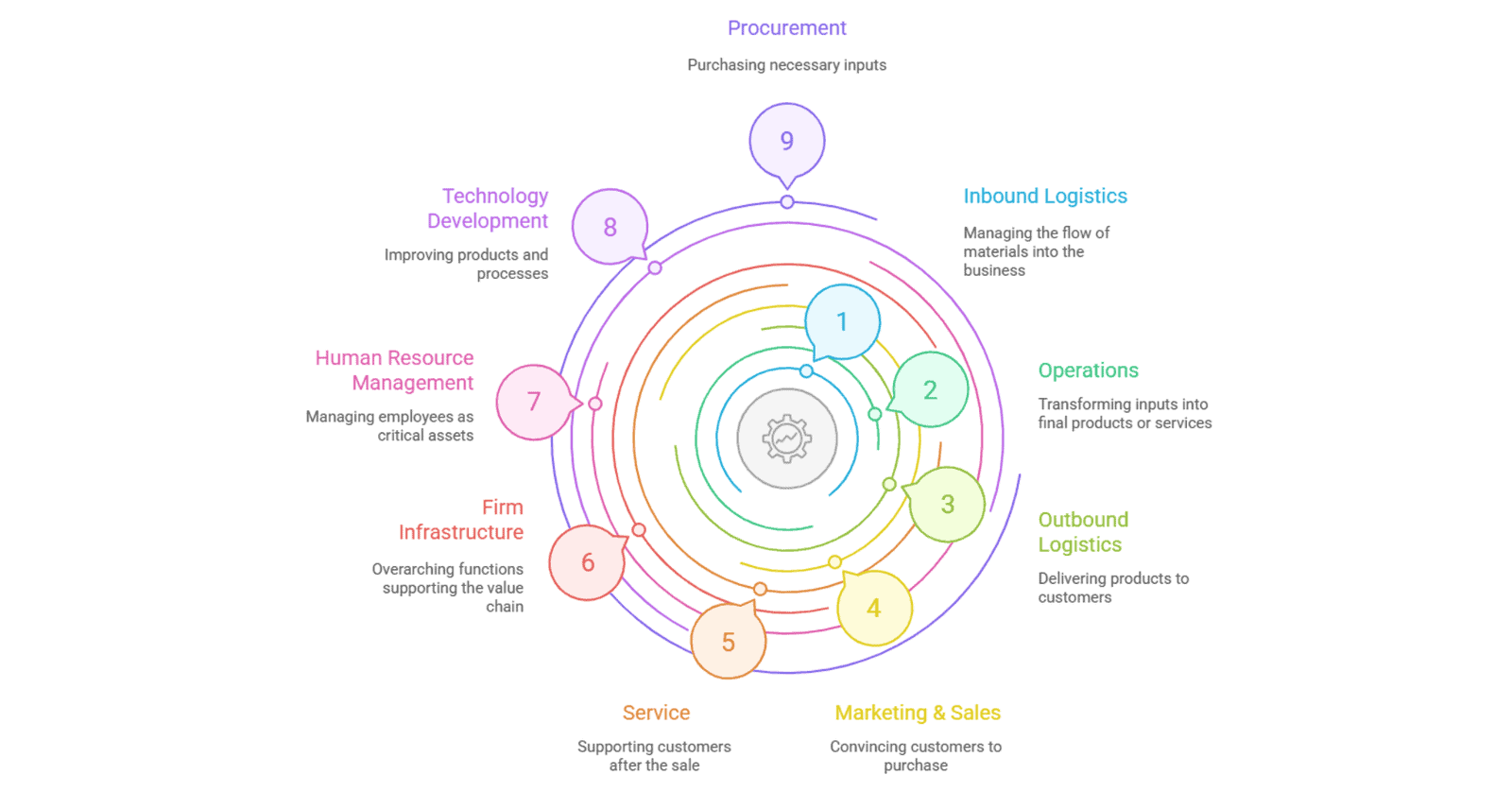
Porter’s genius was in categorizing all business activities into two main types: Primary Activities (those directly involved in creating and delivering the product/service) and Support Activities (those that enable the primary activities to function efficiently).
Primary Activities (The “Direct” Value Creators)
These are the activities directly involved in the creation, sale, and delivery of your product or service to the customer, and the after-sale support.
- Inbound Logistics: How you get raw materials, components, or information into your business. Think receiving, warehousing, inventory management, and scheduling.
- Operations: How you transform inputs into final products or services. This includes manufacturing, assembly, packaging, testing, software development, or service delivery.
- Outbound Logistics: How you get the final product or service out to the customer. This covers order processing, warehousing of finished goods, scheduling, transportation, and delivery.
- Marketing & Sales: How you convince customers to buy your offering. This encompasses advertising, promotions, pricing strategies, sales force management, and channel selection.
- Service: How you support the customer after the sale. Installation, repair, training, customer support, and handling complaints all fall here.
Support Activities (The “Enablers”)
These activities support the primary activities and each other, ensuring the entire value chain functions smoothly and efficiently.
- Firm Infrastructure: The “catch-all” for overarching functions like general management, planning, finance, accounting, legal, public affairs, and quality management. These support the entire value chain.
- Human Resource Management: Recruiting, hiring, training, development, compensation, and retention of all employees. Your people are a critical asset in every activity.
- Technology Development: All activities related to improving products, processes, and systems. This includes R&D, product design, process automation, information systems (IT), and database management.
- Procurement: The function of purchasing the inputs needed for the primary activities (raw materials, supplies, machinery, office equipment, software licenses). It’s about finding vendors, negotiating contracts, and ensuring quality.
How to Conduct a Value Chain Analysis: A 3-Step Strategic Guide
Ready to get started? Here’s a practical, three-step guide to conducting your own VCA.
Step 1: Map Your Activities
Don’t just use the generic list above. Be specific to your unique business. Gather a cross-functional team and brainstorm the distinct activities performed under each primary and support category.
Example for a SaaS Company:
- Inbound Logistics: Managing incoming customer feature requests, bug reports, and market research data.
- Operations: Coding, testing, debugging, deploying new features, maintaining servers.
- Marketing & Sales: Content marketing, SEO, paid ads, demo calls, sales presentations, onboarding.
- Service: Live chat support, knowledge base management, technical troubleshooting, customer success calls.
- Technology Development: R&D for new product lines, AI/ML integration, core platform architecture.
- HRM: Hiring specialized developers, training support staff on new features.
Step 2: Pinpoint Costs & Value
For each activity you’ve mapped, ask two critical questions:
- What is the cost associated with this activity? (e.g., labor, materials, software licenses, advertising spend). Try to quantify as much as possible.
- How does this activity create value for the customer or support other value-creating activities? This is where you identify your strengths and weaknesses.
Cost Example: You might find your “Service” activity is highly expensive due to high staffing levels and specialized training.
Value Example: But that same expensive “Service” might also be a key differentiator, leading to incredibly high customer satisfaction and retention. Conversely, a low-cost “Marketing” activity might be failing to generate valuable leads.
Step 3: Find the “Linkages”
This is where the real strategic insights emerge. No activity exists in isolation. They are all interconnected. A decision in one area impacts others. Identifying these “linkages” is key to finding competitive advantage.
- Forward Linkage Example: Investing more in Technology Development (e.g., automating part of your production line) can dramatically reduce costs in Operations and improve consistency.
- Backward Linkage Example: Better Procurement (e.g., securing higher-quality raw materials or components) might reduce defects in Operations, leading to fewer customer complaints and lower costs in Service.
- Internal Linkage Example: A strong Human Resource Management function (e.g., thorough training for your sales team) directly improves the effectiveness of Marketing & Sales.
Thinking about linkages helps you understand that a cost in one area might be an investment that saves money or creates significant value elsewhere.
Turning Your Analysis into Competitive Advantage
Once you’ve mapped your value chain and understood its costs, value points, and linkages, you have a clear roadmap to building a sustainable competitive advantage. You generally have two strategic paths:
Strategy 1: Become the Cost Leader
If your industry rewards low prices, use your VCA to ruthlessly identify and eliminate inefficiencies.
Ask: “Where can we automate? Streamline processes? Outsource non-core activities? How can we optimize our linkages to reduce costs without sacrificing essential value?”
Example: Companies like Walmart excel by optimizing their Inbound and Outbound Logistics. Their highly efficient supply chain minimizes transportation and warehousing costs, allowing them to offer everyday low prices. Ryanair, in airlines, strips out non-essential Service activities to offer ultra-low fares.
Strategy 2: Become the Differentiator
If your customers are willing to pay a premium for unique features, superior quality, or an exceptional experience, VCA helps you identify where to invest to stand out.
Ask: “Where can we invest more to create truly unique value for our customers? Which activities are critical for our brand reputation or customer loyalty?”
Example: Apple invests heavily in Technology Development (R&D) for innovative products and a seamless user experience. They also pour resources into Marketing & Sales (branding and premium retail experiences) and Service (customer support) to command a premium price for their perceived superior value and ecosystem. Similarly, luxury car brands differentiate through high-quality Procurement, sophisticated Operations, and personalized Service.
Stop Guessing, Start Analyzing
A Value Chain Analysis is not a one-time academic exercise; it’s a dynamic, living blueprint for strategic decision-making. It forces you to look beyond superficial market trends and delve into the fundamental workings of your own business.
By understanding your value chain, you gain clarity on:
- Where your true costs lie.
- Where you create genuine value for your customers.
- How different parts of your organization interact and influence each other.
- The most impactful levers you can pull to gain a competitive advantage.
Don’t just compete in your industry; understand how you compete. Take 30 minutes this week, sketch out your primary and support activities, and ask one simple question: “Where can we be better?” The answer will define your future profitability and market position.