In business, the only thing we can predict with 100% certainty is that our predictions will be wrong.
Imagine it is January 2020. You are a CEO looking at your polished, data-backed 5-year strategic plan. You have forecasted 5% growth, mapped out international expansion, and finalized your marketing budget. Then, the world changes overnight. Within weeks, your static plan isn’t just outdated; it’s a liability.
The organizations that survived and thrived during the disruptions of the last few years weren’t those with the most accurate forecasts. They were the ones who had already practiced for the unthinkable. This is the power of Scenario Planning.
As a business leader, you don’t need a crystal ball. You need a What-If engine. In this guide, we will break down how to move from reactive firefighting to proactive mastery of uncertainty.
The Death of the Static Plan
For decades, strategic planning followed a linear path: review last year’s data, apply a growth percentage, and execute. This works in a stable environment. But we no longer live in a stable environment. We live in a VUCA world:
- Volatility: The speed of change is accelerating.
- Uncertainty: The past is no longer a reliable predictor of the future.
- Complexity: Multiple moving parts (tech, geopolitics, climate) are intertwined.
- Ambiguity: The rules of the game are constantly being rewritten.
A static plan is a single point of failure. Scenario planning is the antidote. It is the process of creating a set of diverse, plausible future scenarios to test your current strategy. It’s not about being right; it’s about reducing the cost of being wrong.
What Scenario Planning Is (and Isn’t)
Before we dive into the how, we must clarify what we are building. Many leaders confuse scenario planning with other tools.
- It is NOT a Forecast: A forecast uses historical data to predict one likely outcome. Scenario planning assumes the future is a range of possibilities.
- It is NOT a Contingency Plan: A contingency plan is a Plan B for a specific event (e.g., What if our supplier goes bust?). Scenario planning explores entire ecosystems and how they shift.
- It IS a Strategic Stress-Test: It’s a mental rehearsal. By the time a crisis or opportunity arrives, your leadership team has already seen it in a workshop and knows exactly which levers to pull.
The 4-Step Framework to Master What-If
To implement scenario planning effectively, you need a structured approach. Follow these four steps to build your What-If engine.
Step 1: Identify Key Drivers (The PESTLE Filter)
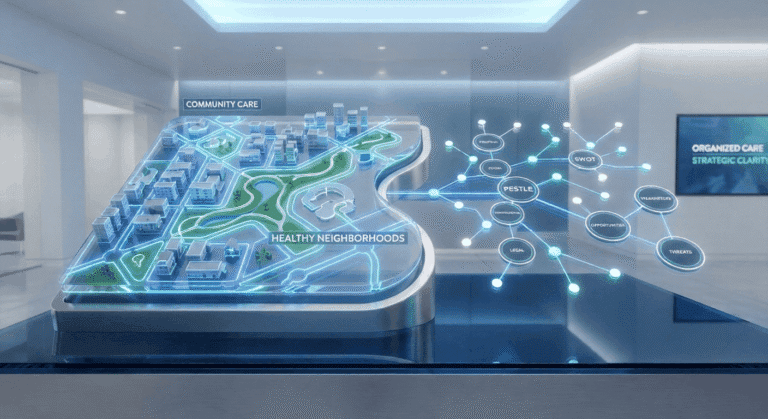
Start by looking outside your office walls. What forces are shaping the world five to ten years from now? Use the PESTLE framework to ensure you aren’t missing anything:
- Political: Trade wars, tax changes, or shifting regulations.
- Economic: Inflation cycles, interest rates, or currency shifts.
- Social: Changing consumer habits, aging populations, or remote work trends.
- Technological: AI breakthroughs, cybersecurity threats, or energy transitions.
- Environmental: Climate change impacts or resource scarcity.
- Legal: Antitrust laws or data privacy mandates.
Step 2: Isolate the Critical Uncertainties
You cannot plan for every single driver. You must filter them based on two variables: Impact and Uncertainty.
- High Impact / Low Uncertainty: These are Trends. (e.g., the population is getting older). You should already be planning for these.
- High Impact / High Uncertainty: These are your Critical Uncertainties. (e.g., will AI lead to a productivity boom or a regulatory crackdown?). These are the foundations of your scenarios.
Step 3: Create the Scenario Matrix
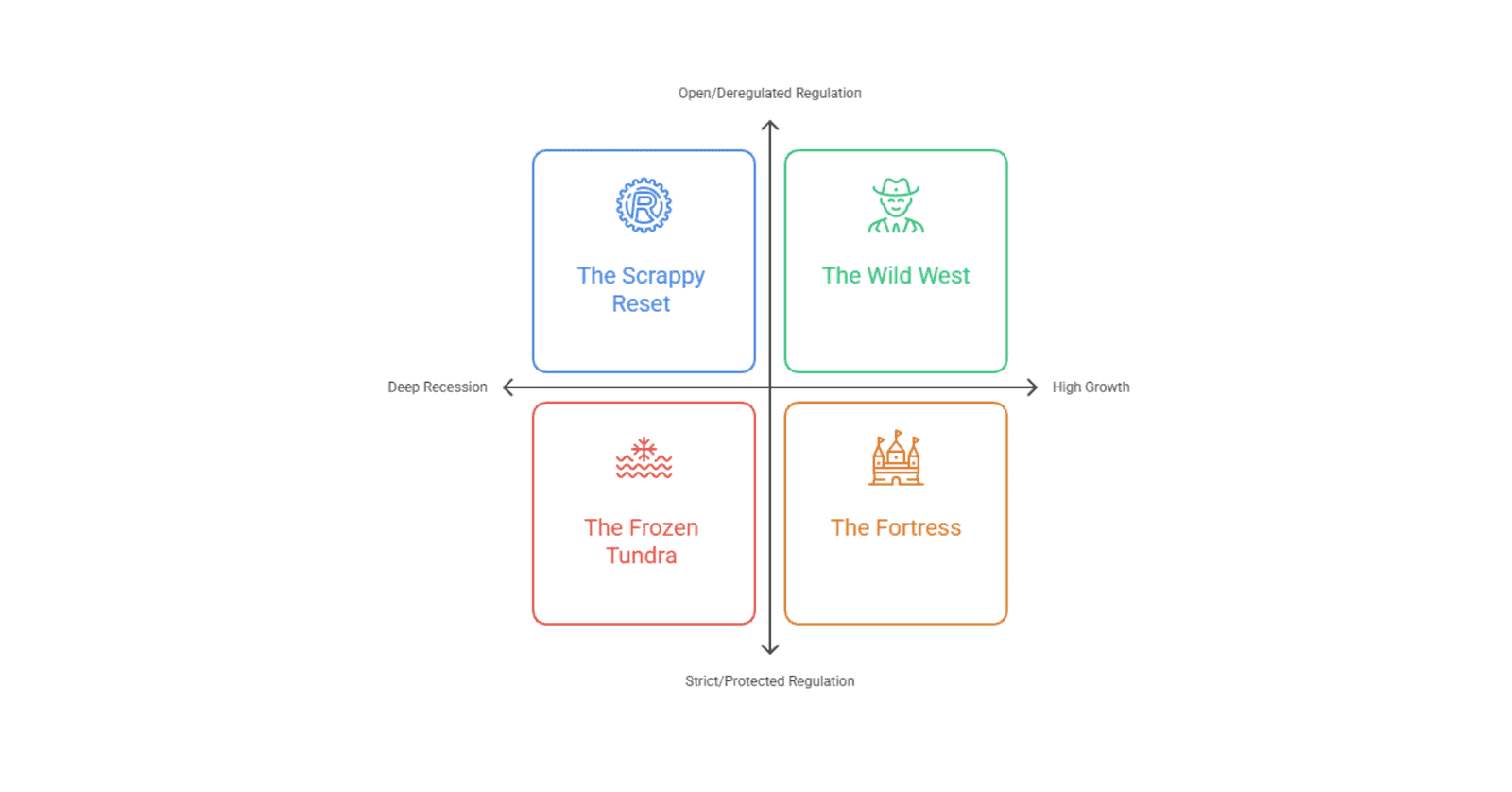
Pick your two most critical uncertainties and cross them. This creates a 2×2 matrix with four distinct Future Worlds.
Example for a Fintech Company:
- Axis 1: Global Economy (Boom vs. Deep Recession)
- Axis 2: Regulation (Open/Deregulated vs. Strict/Protected)
This gives you four quadrants to explore:
- The Wild West: High Growth + Low Regulation.
- The Fortress: High Growth + High Regulation.
- The Frozen Tundra: Deep Recession + High Regulation.
- The Scrappy Reset: Deep Recession + Low Regulation.
Step 4: Develop the Narratives
Now, breathe life into these quadrants. Give them evocative names. Write a memo from the future for each.
- What does your customer care about in The Fortress?
- Who are your competitors in The Wild West?
- What talent do you need to survive The Frozen Tundra?
Stress-Testing Your Current Strategy (Wind-Tunneling)
Once you have your scenarios, it’s time for the most important part
- Identify No-Regret Moves: These are actions that are successful in all four scenarios. For example, investing in data security or improving operational efficiency is almost always a winning move, regardless of the economic climate.
- Identify Big Bets: These are strategies that pay off massively in one scenario but could be catastrophic in another. If your strategy is a Big Bet, scenario planning helps you assess whether the risk is worth the reward and determine your exit strategy.
- Establish Signposts: You cannot monitor everything. Signposts are specific, measurable data points that indicate which scenario is beginning to unfold.
Practical Benefits: Why This Matters for the C-Suite
In the boardroom, the biggest threat isn’t usually a competitor; it’s blind spots. Scenario planning offers several high-ROI benefits for leadership:
Accelerated Decision-Making
When a crisis hits, most teams spend the first 48–72 hours in shock, scrambling to gather data. With scenario planning, you’ve already rehearsed the response. You shift from What do we do? to Initiate Plan B.
Spotting Hidden Opportunities
Uncertainty is often viewed as a risk, but it is also the most significant source of opportunity. By looking at Extreme scenarios, you might discover a niche market that only emerges during a high-regulation environment, a market your competitors haven’t even considered.
Psychological Resilience and Alignment
Scenario planning reduces the fear factor. When the leadership team has collectively considered the worst-case scenario and mapped a way through it, the organization remains calmer and more focused when volatility strikes. It creates a culture of agile strategy.
Common Pitfalls to Avoid
Even the most seasoned consultants see companies fall into the same traps when trying to master uncertainty.
The Middle Ground Trap
Many teams create three scenarios: Best Case, Worst Case, and Most Likely. Human nature dictates that we gravitate toward the middle. This is a mistake. Your scenarios should be equally plausible but fundamentally different. Avoid the business-as-usual middle ground; it kills the creative thinking required to see real threats.
Ignoring the Black Swan
Nassim Taleb coined the term black swan to describe high-impact, rare events. While you can’t plan for every outlier, your scenarios should include at least one low-probability, high-impact world. If your scenarios feel too safe, they aren’t doing their job.
Analysis Paralysis
The goal of scenario planning is not to produce a 200-page report. It is to change the way your leaders think. If you find yourself bogged down in hyper-specific data for a future that might not happen, step back. Focus on the narrative and the strategic response, not the decimal points.
The Competitive Advantage of Agility
In the 21st century, the most valuable currency isn’t just capital, it’s agility. Scenario planning is the gym where your organization builds its agility muscles.
By asking What-if? Today, ensure you aren’t asking about what happened tomorrow. You transition from a company that is buffeted by the winds of change to one that knows how to set its sails, no matter which way the wind blows.
Mastering uncertainty doesn’t mean having all the answers. It means having the right questions and the courage to explore them before the clock starts ticking.
Tip: Your Scenario Signpost Checklist
To make this actionable, use the following table to monitor your environment. Assign a Signpost to each scenario to help you know when to pivot.
| Scenario Name | Key Signpost (Trigger) | Immediate Strategic Action |
| The Digital Renaissance | AI integration reaches 40% in your industry. | Increase R&D budget for automation by 15%. |
| The Great Fragmentation | New regional trade tariffs exceed 10%. | Diversify the supply chain to local providers. |
| The Green Mandate | Carbon tax legislation passes the Senate. | Pivot marketing to emphasize sustainability. |
| The Economic Winter | The consumer confidence index has declined for three consecutive months. | Shift focus from acquisition to customer retention. |