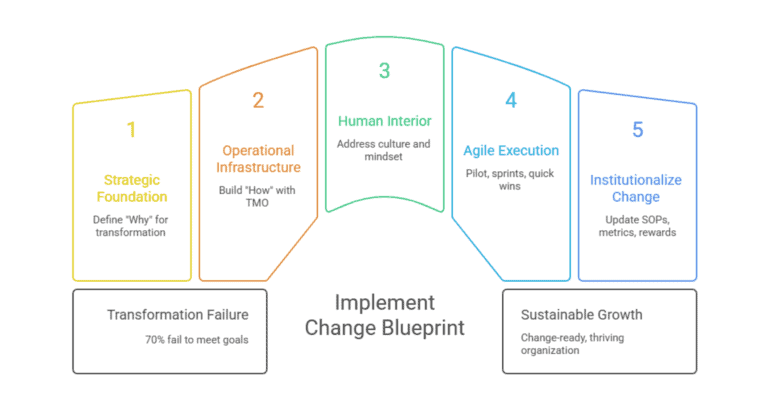
It is the statistic that keeps CEOs awake at night. According to research consistently cited by McKinsey, Harvard Business Review, and John Kotter himself, approximately 70% of large-scale change programs fail to achieve their goals.
Think about the capital burned in that percentage. The wasted implementation costs, the eroded employee trust, the “change fatigue” that sets in when yet another strategic pivot fizzles out after six months.
Why is the failure rate so high? It is rarely due to a lack of strategy. Most organizations have brilliant strategies. They fail because they treat change as an engineering problem, a matter of moving boxes on an org chart or installing new software, rather than a human behavior problem.
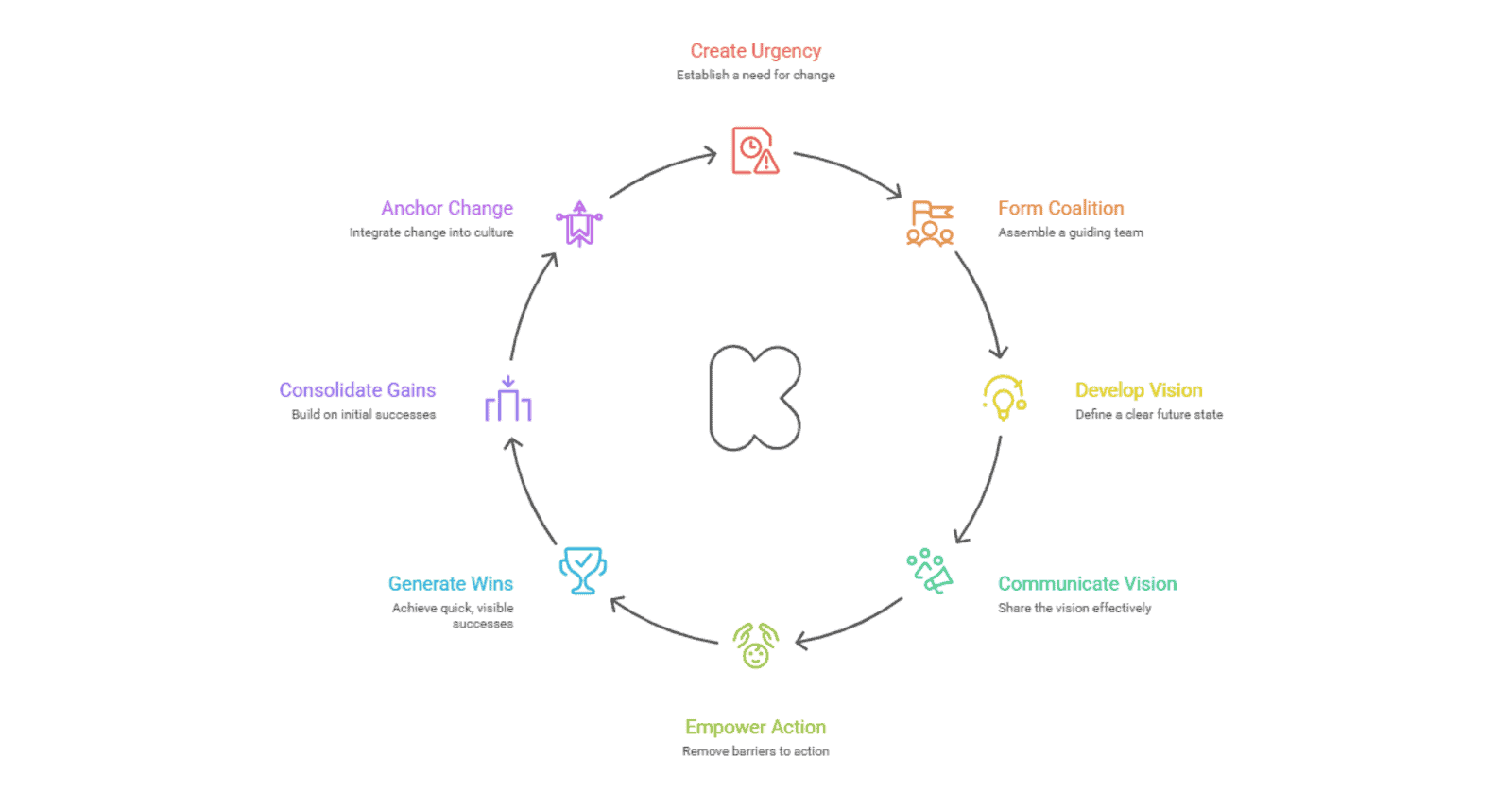
In 1996, Harvard professor John Kotter introduced his 8-Step Change Model in the seminal book Leading Change. Unlike other frameworks that focus on project management milestones, Kotter’s model focuses on people. It creates a roadmap for altering human behavior at scale.
If you are leading a transformation, whether it’s a digital pivot, a merger, or a cultural overhaul, this guide will walk you through how to apply Kotter’s 8 steps to ensure your initiative falls into the 30% that succeed.
Phase 1: Creating the Climate for Change
The first three steps are all about preparation. Most leaders skip straight to execution (Step 4), which is akin to planting seeds in frozen soil. You must thaw the ground first.
Step 1: Create a Sense of Urgency
The Core Concept: Change requires a catalyst. Without a compelling reason to move, human nature defaults to the status quo. Complacency is the silent killer of transformation.
The Strategist’s Perspective: Many executives mistake urgency for panic. They try to motivate through fear of layoffs or burning platforms. This is unsustainable. True urgency is a hyper-awareness of a closing window of opportunity. It is not about screaming Fire!; it is about saying, The market is moving, and if we don’t move with it, we will be irrelevant.
You need to examine the market and competitive realities for potential crises and untapped opportunities.
Actionable Strategy: Stop protecting your team from the brutal facts. If customer satisfaction is dipping, or if a competitor has launched a superior product, share that data transparently.
- Do: Use data to show why now
- Don’t: Manufacture a crisis. If your urgency feels fake, you lose credibility instantly
Step 2: Build a Guiding Coalition
The Core Concept: No single leader, no matter how charismatic, can mandate change alone. You need a team.
The Strategist’s Perspective: A common trap is forming a Change Committee composed entirely of C-Suite executives. While you need authority, you also need influence. A Vice President might have the power to fire people, but a tenured engineer might have the social capital to sway the entire R&D department.
Your coalition must be a mix of:
- Positional Power: To clear roadblocks.
- Expertise: To make informed decisions.
- Credibility: To be taken seriously by employees.
- Leadership: To drive the vision.
Actionable Strategy: Identify the hidden influencers in your organization. Who is the person everyone goes to for advice? Who is the skeptic that, if converted, would bring everyone else along? Recruit them. This group must operate outside the normal hierarchy, acting as a nimble SWAT team for the transformation.
Step 3: Form a Strategic Vision and Initiatives
The Core Concept: Urgency motivates, but vision directs. You must clarify how the future will differ from the past and how you will make that future a reality.
The Strategist’s Perspective: There is a crucial difference between a Vision, a Strategy, and a Plan.
- Vision: We will become the fastest, most customer-centric provider in the region
- Strategy: We will achieve this by digitizing our supply chain and decentralizing decision-making
- Plan: We will roll out Salesforce by Q3
Too many leaders communicate the Plan but forget the Vision. Without the vision, the plan is just a list of tedious tasks.
Actionable Strategy: Test your vision with the 5-Minute Rule. If you cannot describe the vision in five minutes or less and elicit a response that shows both understanding and interest, you are not done yet. Simplify it until it fits on a napkin.
Phase 2: Engaging and Enabling the Organization
Once the climate is set, you must bring the organization on board. This is where telling shifts to selling.
Step 4: Enlist a Volunteer Army (Communicate the Vision)
The Core Concept: Change cannot be executed by the few; it requires the many. You need a “volunteer army” of employees who are willing to go above and beyond to make the change happen.
The Strategist’s Perspective: Under-communication is the norm. Executives often believe that sending one company-wide email constitutes communication” Kotter estimates that an employee receives 2.3 million words of communication over three months. A typical vision statement is communicated in 13,400 words over that same period. That is 0.58% of the communication market share. You are being drowned out.
Actionable Strategy:
- Use every vehicle: Town halls, newsletters, 1:1s, posters in the hallway
- Walk the talk: Nothing undermines change faster than a leader who behaves inconsistently with the vision. If the vision is innovation, but you punish a manager for a failed experiment, the movement dies instantly
Step 5: Enable Action by Removing Barriers
The Core Concept: If you ask people to fly, you must first unlock their cages.
The Strategist’s Perspective: You have built urgency, you have a vision, and you have communicated it. Employees are ready to act. But then they hit a wall: an outdated compensation system that rewards the old behavior, a micromanager who refuses to delegate, or legacy IT systems that make the new workflow impossible.
This step is about structural alignment. You cannot drive a new strategy through an old structure.
Actionable Strategy: Empower your middle management. Often, they are the frozen middle, stuck between strategic directives from above and operational reality below. Give them the authority to break rules that no longer make sense. Identify the most significant obstacles (people or processes) and remove them visibly.
Step 6: Generate Short-Term Wins
The Core Concept: Transformation is a marathon, and people get tired. You need to engineer quick victories to prove that the effort is worth it.
The Strategist’s Perspective: Do not wait 18 months for the big reveal. By then, the critics will have taken over. You need a win in 6 to 12 months. These wins must be unambiguous and clearly related to the change effort.
Actionable Strategy: Select pilot projects based on the Low Effort, High Impact matrix.
- Is it visible?
- Is success probable?
- Can we measure it?
When you get the win, celebrate it loudly. This silences the cynics and provides the political capital you need to tackle the harder, more expensive parts of the transformation.
Phase 3: Implementing and Sustaining Change
This is the danger zone. This is where the 70% failure rate usually hits, right when things look like they are working.
Step 7: Sustain Acceleration (Don’t Let Up)
The Core Concept: Do not declare victory too soon.
The Strategist’s Perspective: After a few short-term wins, there is a temptation to relax. We did it! The new software is installed! But installation is not adoption. If you let up now, the organizational gravity will pull you back to the old way of doing things.
This step is about using the credibility earned from early wins to tackle the larger systems, structures, and policies that don’t align with the vision. It is about hiring, promoting, and developing employees who can implement the vision.
Actionable Strategy: Practice rotational leadership. The original guiding coalition may be exhausted by this point. Bring in fresh energy, people from the volunteer army who have proven themselves, to drive the next wave of change.
Step 8: Anchor New Approaches in the Culture
The Core Concept: Change only sticks when it becomes the way we do things around here.
The Strategist’s Perspective: Culture is what happens when the CEO isn’t in the room. Until the new behaviors are rooted in social norms and shared values, they are subject to degradation as soon as the pressure is removed.
Kotter argues that culture comes last, not first. You cannot change culture by talking about it; you change it by successfully altering actions, seeing the results, and then acknowledging that the new way is superior.
Actionable Strategy:
- Succession Planning: Ensure the next generation of leaders embodies the new approach. If you promote someone who represents the old guard simply because they hit their numbers, you signal that the change isn’t real
- Onboarding: Teach recruits the new ways immediately
Critical Limitations of the Model
While Kotter’s model is the gold standard, it is not without criticism in the modern era.
- It is Top-Down: The model assumes change starts at the top and cascades down. In the age of Agile and decentralized teams, innovation often bubbles up from the bottom
- It is Linear: The 8 steps imply a neat sequence. In reality, change is messy. You may need to be working on Step 2 and Step 5 simultaneously
The Fix: Use Kotter for the macro strategy (the human element), but pair it with Agile methodologies for the micro execution (the project management element).
Conclusion: Kotter’s 8-Step Change Model
Transforming an organization is not a sprint; it is an endurance sport. It requires the discipline not to skip steps. Leaders often skip establishing a sense of urgency or declaring victory too soon because it feels faster. But this creates the illusion of speed, not the reality of progress.
By following these 8 steps, you move beyond simply managing a project to leading a movement.